Full text
Breaking into ASEAN
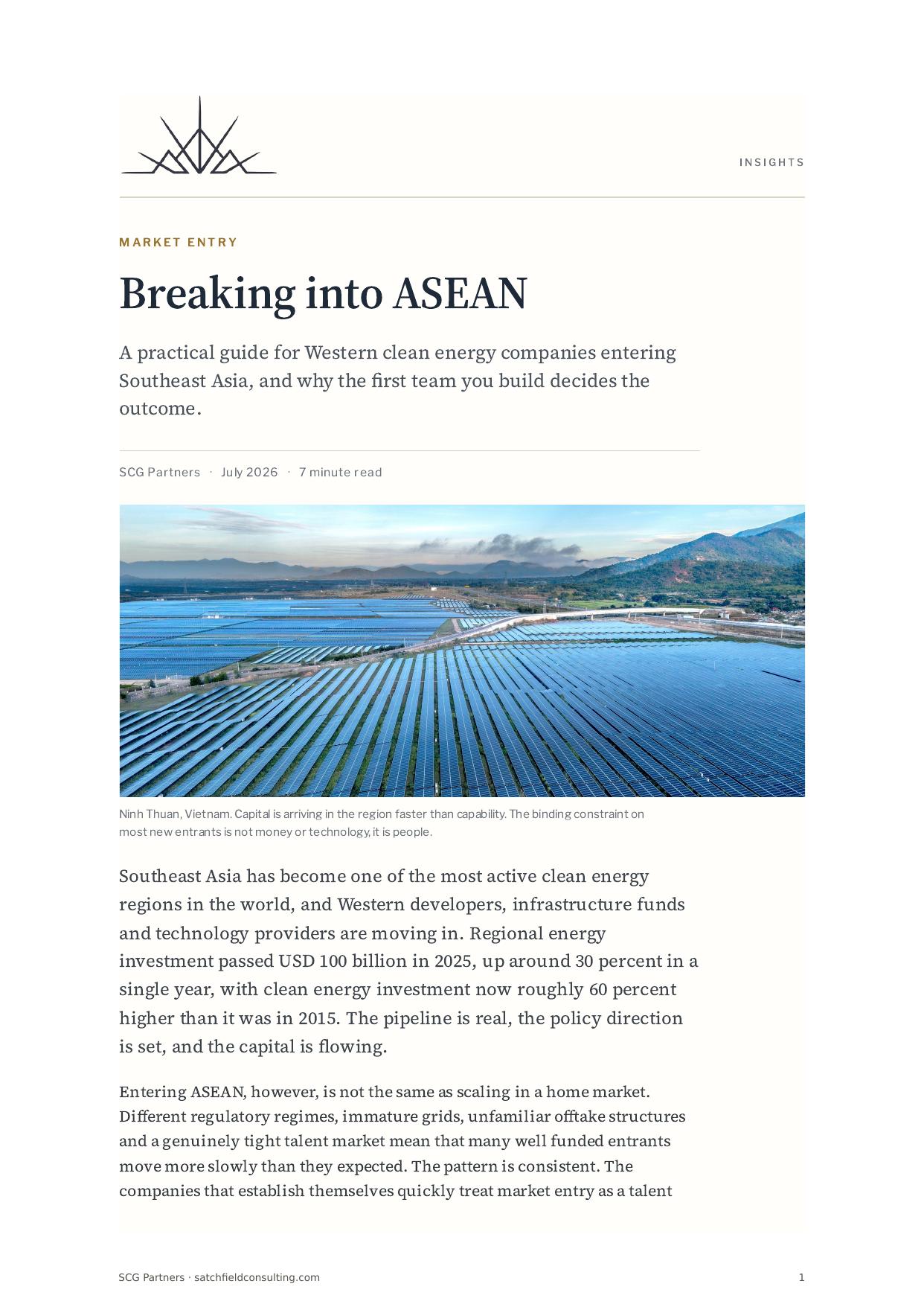
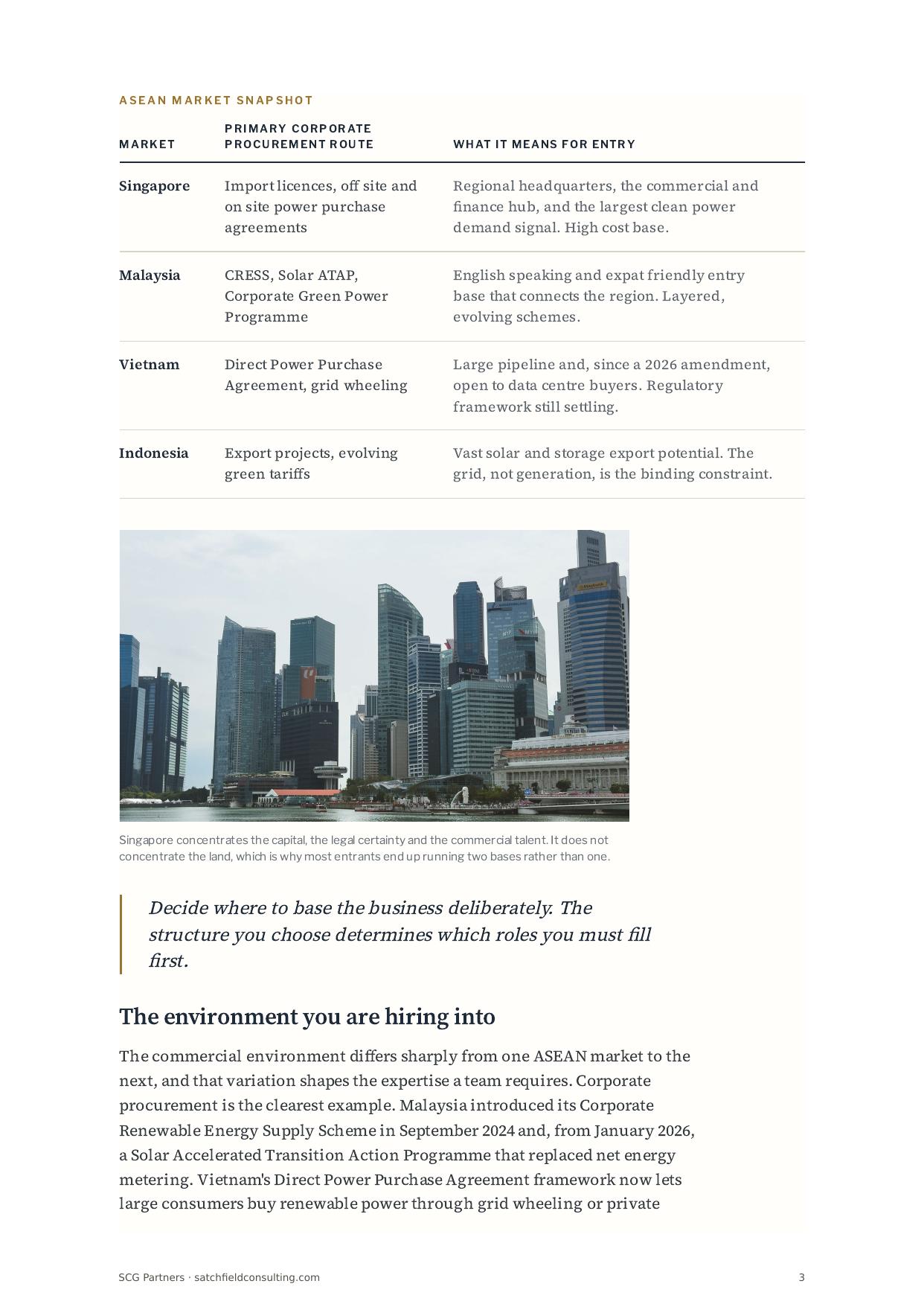
Ninh Thuan, Vietnam. Capital is arriving in the region faster than capability. The binding constraint on most new entrants is not money or technology, it is people.
Southeast Asia has become one of the most active clean energy regions in the world, and Western developers, infrastructure funds and technology providers are moving in. Regional energy investment passed USD 100 billion in 2025, up around 30 percent in a single year, with clean energy investment now roughly 60 percent higher than it was in 2015. The pipeline is real, the policy direction is set, and the capital is flowing.
Entering ASEAN, however, is not the same as scaling in a home market. Different regulatory regimes, immature grids, unfamiliar offtake structures and a genuinely tight talent market mean that many well funded entrants move more slowly than they expected. The pattern is consistent. The companies that establish themselves quickly treat market entry as a talent decision first and a project decision second. What follows is how to think about that decision.
The profile of a successful entrant
The firms arriving now share a recognisable shape. They hold a strong track record at home, keep a lean initial presence in the region, and run a small number of live projects rather than a mature portfolio. Singapore's low carbon electricity import programme has become a powerful pull for exactly this profile. As of October 2025 the city state had awarded conditional approval to eleven projects to import 8.35 GW of low carbon electricity from Australia, Cambodia, Indonesia, Sarawak and Vietnam, with six Indonesian projects already advanced to conditional licences. International names anchor that buildout, with consortia including TotalEnergies with RGE, and Shell with Vena, developing large solar and storage export projects in Indonesia.
For a Western company the opportunity is clear. The difficulty is that a strong balance sheet and a good asset do not, on their own, deliver a project in an unfamiliar market. People do.
Where to plant the business
The earliest decision an entrant makes is where to base the regional operation, and it shapes everything that follows.
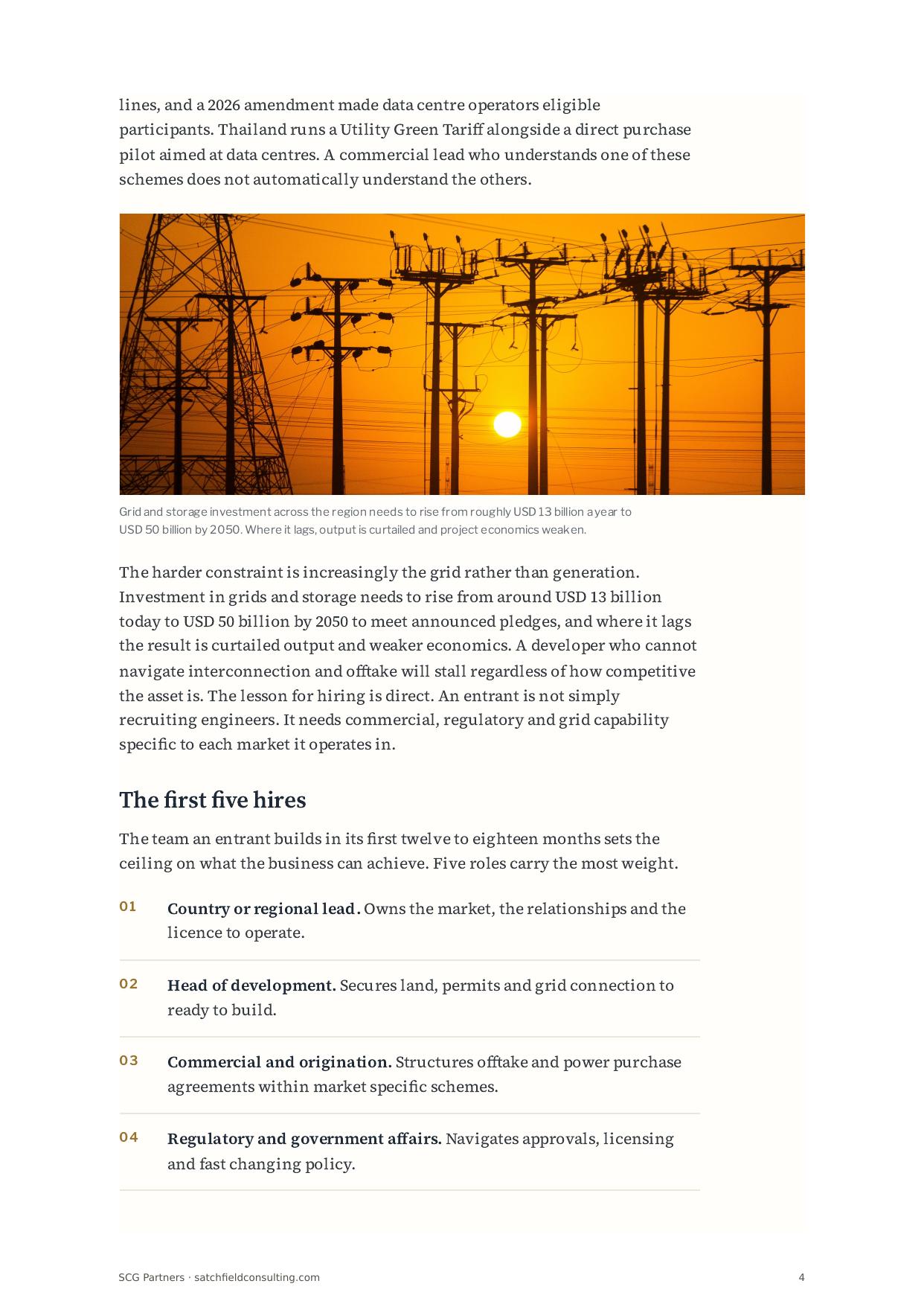
Singapore offers capital, legal certainty, deep commercial and financial talent, and proximity to the region's largest demand signal for imported clean power. What it does not offer is land or wind, which is to say it is not where megawatts are actually built. In market presence in Indonesia, Vietnam, the Philippines or Malaysia is where projects are delivered, and it demands local knowledge of permitting, grid connection, land and community engagement that cannot be run remotely.
Malaysia is frequently cited as an entry base in its own right, valued for an English speaking workforce, an openness to international hires, and a location that connects Singapore, Thailand and Indonesia. In practice most successful entrants run a hybrid model: a Singapore hub for leadership, commercial and finance functions, paired with in country teams that carry delivery. The right structure depends on where the projects sit, but the principle holds. Decide deliberately, because the structure determines which roles you fill first.
ASEAN MARKET SNAPSHOT
MARKET: Singapore. PRIMARY CORPORATE PROCUREMENT ROUTE: Import licences, off site and on site power purchase agreements. WHAT IT MEANS FOR ENTRY: Regional headquarters, the commercial and finance hub, and the largest clean power demand signal. High cost base.
MARKET: Malaysia. PRIMARY CORPORATE PROCUREMENT ROUTE: CRESS, Solar ATAP, Corporate Green Power Programme. WHAT IT MEANS FOR ENTRY: English speaking and expat friendly entry base that connects the region. Layered, evolving schemes.
MARKET: Vietnam. PRIMARY CORPORATE PROCUREMENT ROUTE: Direct Power Purchase Agreement, grid wheeling. WHAT IT MEANS FOR ENTRY: Large pipeline and, since a 2026 amendment, open to data centre buyers. Regulatory framework still settling.
MARKET: Indonesia. PRIMARY CORPORATE PROCUREMENT ROUTE: Export projects, evolving green tariffs. WHAT IT MEANS FOR ENTRY: Vast solar and storage export potential. The grid, not generation, is the binding constraint.
Singapore concentrates the capital, the legal certainty and the commercial talent. It does not concentrate the land, which is why most entrants end up running two bases rather than one.
Decide where to base the business deliberately. The structure you choose determines which roles you must fill first.
The environment you are hiring into
The commercial environment differs sharply from one ASEAN market to the next, and that variation shapes the expertise a team requires. Corporate procurement is the clearest example. Malaysia introduced its Corporate Renewable Energy Supply Scheme in September 2024 and, from January 2026, a Solar Accelerated Transition Action Programme that replaced net energy metering. Vietnam's Direct Power Purchase Agreement framework now lets large consumers buy renewable power through grid wheeling or private lines, and a 2026 amendment made data centre operators eligible participants. Thailand runs a Utility Green Tariff alongside a direct purchase pilot aimed at data centres. A commercial lead who understands one of these schemes does not automatically understand the others.
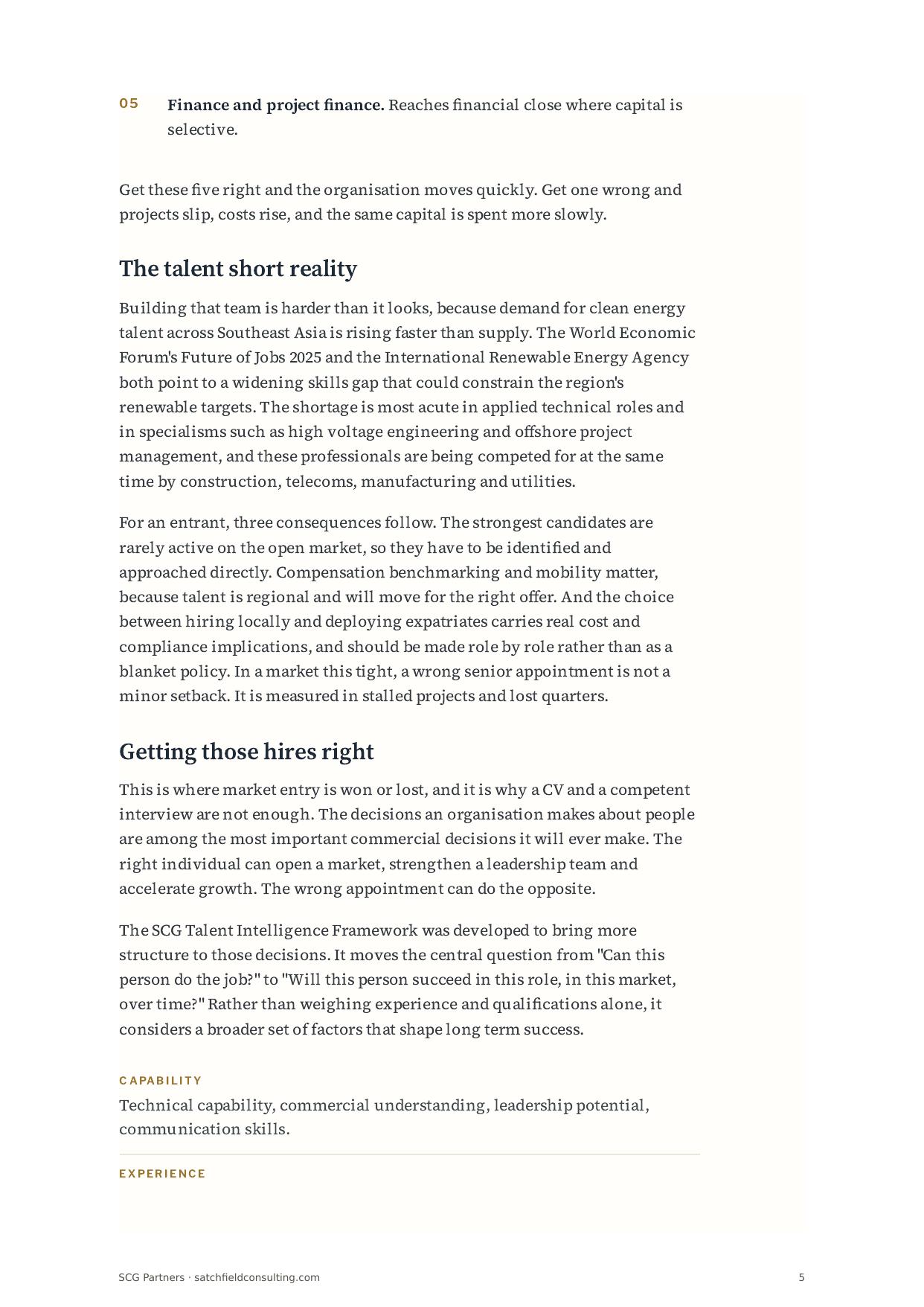
Grid and storage investment across the region needs to rise from roughly USD 13 billion a year to USD 50 billion by 2050. Where it lags, output is curtailed and project economics weaken.
The harder constraint is increasingly the grid rather than generation. Investment in grids and storage needs to rise from around USD 13 billion today to USD 50 billion by 2050 to meet announced pledges, and where it lags the result is curtailed output and weaker economics. A developer who cannot navigate interconnection and offtake will stall regardless of how competitive the asset is. The lesson for hiring is direct. An entrant is not simply recruiting engineers. It needs commercial, regulatory and grid capability specific to each market it operates in.
The first five hires
The team an entrant builds in its first twelve to eighteen months sets the ceiling on what the business can achieve. Five roles carry the most weight.
- Country or regional lead. Owns the market, the relationships and the licence to operate.
- Head of development. Secures land, permits and grid connection to ready to build.
- Commercial and origination. Structures offtake and power purchase agreements within market specific schemes.
- Regulatory and government affairs. Navigates approvals, licensing and fast changing policy.
- Finance and project finance. Reaches financial close where capital is selective.
Get these five right and the organisation moves quickly. Get one wrong and projects slip, costs rise, and the same capital is spent more slowly.
The talent short reality
Building that team is harder than it looks, because demand for clean energy talent across Southeast Asia is rising faster than supply. The World Economic Forum's Future of Jobs 2025 and the International Renewable Energy Agency both point to a widening skills gap that could constrain the region's renewable targets. The shortage is most acute in applied technical roles and in specialisms such as high voltage engineering and offshore project management, and these professionals are being competed for at the same time by construction, telecoms, manufacturing and utilities.
For an entrant, three consequences follow. The strongest candidates are rarely active on the open market, so they have to be identified and approached directly. Compensation benchmarking and mobility matter, because talent is regional and will move for the right offer. And the choice between hiring locally and deploying expatriates carries real cost and compliance implications, and should be made role by role rather than as a blanket policy. In a market this tight, a wrong senior appointment is not a minor setback. It is measured in stalled projects and lost quarters.
Getting those hires right
This is where market entry is won or lost, and it is why a CV and a competent interview are not enough. The decisions an organisation makes about people are among the most important commercial decisions it will ever make. The right individual can open a market, strengthen a leadership team and accelerate growth. The wrong appointment can do the opposite.
The SCG Talent Intelligence Framework was developed to bring more structure to those decisions. It moves the central question from "Can this person do the job?" to "Will this person succeed in this role, in this market, over time?" Rather than weighing experience and qualifications alone, it considers a broader set of factors that shape long term success.
CAPABILITY: Technical capability, commercial understanding, leadership potential, communication skills.
EXPERIENCE: Industry experience, international exposure, project complexity, career progression.
FIT AND GROWTH: Cultural fit and contribution to long term growth.
For a company entering ASEAN, several of these carry additional weight. International exposure and cultural fit are decisive for a country lead who has to build trust in an unfamiliar market. Commercial understanding separates a candidate who can structure offtake under a scheme like CRESS or a Direct Power Purchase Agreement from one who cannot. Project complexity indicates whether a head of development can move a first of a kind project, not just maintain an established pipeline.
The right individual can open a market. The wrong appointment can quietly close one. In a region this competitive, the difference is rarely visible on a CV.
The framework is designed to enhance professional judgement, not replace it. It combines industry expertise, structured assessment and market knowledge, and over time it will develop into a broader Talent Intelligence Platform supporting recruitment, workforce planning, succession and leadership assessment. The underlying philosophy does not change. Technology should support better decisions, not make them. Successful organisations are built by understanding not only what people have done, but what they are capable of achieving next.
A genuine opportunity, and a genuine test
The companies that build the right first team move faster, reach financial close and establish a durable regional position. Those that under invest in that team spend the same money more slowly, and sometimes lose the window entirely.