Full text
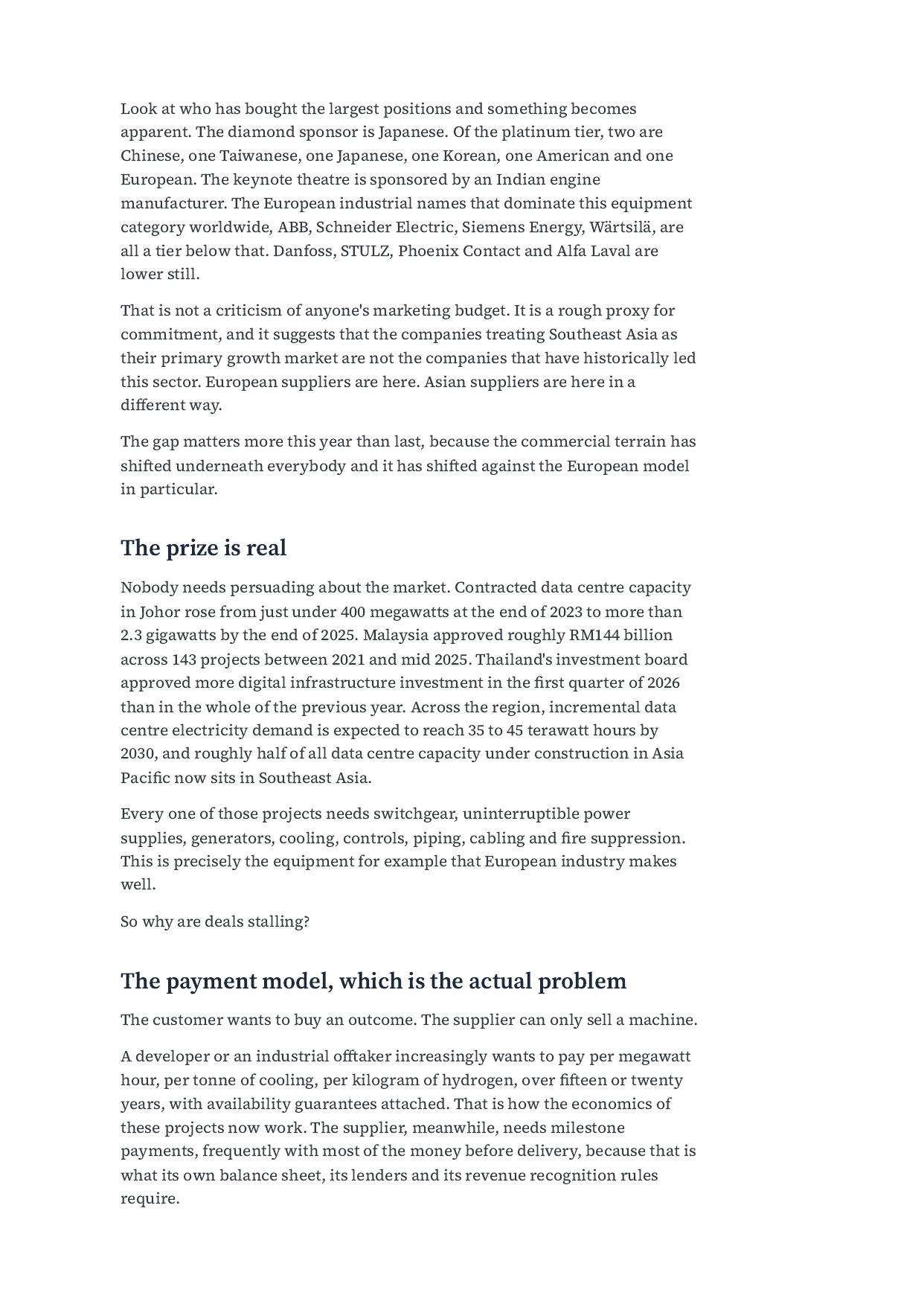
Marina Bay Sands, where Tech Week Singapore opens on 29 September. The equipment on the floor is rarely the reason a deal stalls.
Tech Week Singapore opens at Sands Expo tomorrow. Data Centre World Asia reaches its twelfth edition, and last year the combined shows drew more than 29,000 attendees, including over 17,000 data centre professionals, across 346 technology and solution providers. It is the most concentrated gathering of buyers and sellers this industry has in Asia.
Look at who has bought the largest positions and something becomes apparent. The diamond sponsor is Japanese. Of the platinum tier, two are Chinese, one Taiwanese, one Japanese, one Korean, one American and one European. The keynote theatre is sponsored by an Indian engine manufacturer. The European industrial names that dominate this equipment category worldwide, ABB, Schneider Electric, Siemens Energy, Wärtsilä, are all a tier below that. Danfoss, STULZ, Phoenix Contact and Alfa Laval are lower still.
That is not a criticism of anyone's marketing budget. It is a rough proxy for commitment, and it suggests that the companies treating Southeast Asia as their primary growth market are not the companies that have historically led this sector. European suppliers are here. Asian suppliers are here in a different way.
The gap matters more this year than last, because the commercial terrain has shifted underneath everybody and it has shifted against the European model in particular.
The prize is real
Nobody needs persuading about the market. Contracted data centre capacity in Johor rose from just under 400 megawatts at the end of 2023 to more than 2.3 gigawatts by the end of 2025. Malaysia approved roughly RM144 billion across 143 projects between 2021 and mid 2025. Thailand's investment board approved more digital infrastructure investment in the first quarter of 2026 than in the whole of the previous year. Across the region, incremental data centre electricity demand is expected to reach 35 to 45 terawatt hours by 2030, and roughly half of all data centre capacity under construction in Asia Pacific now sits in Southeast Asia.
Every one of those projects needs switchgear, uninterruptible power supplies, generators, cooling, controls, piping, cabling and fire suppression. This is precisely the equipment for example that European industry makes well.
So why are deals stalling?
The payment model, which is the actual problem
The customer wants to buy an outcome. The supplier can only sell a machine. A developer or an industrial offtaker increasingly wants to pay per megawatt hour, per tonne of cooling, per kilogram of hydrogen, over fifteen or twenty years, with availability guarantees attached. That is how the economics of these projects now work. The supplier, meanwhile, needs milestone payments, frequently with most of the money before delivery, because that is what its own balance sheet, its lenders and its revenue recognition rules require.
Neither party is being unreasonable. Both are behaving rationally inside their own capital structure. The deal simply has no room in the middle, because nobody present at the table owns the balance sheet that would sit between them.
Add the balance of plant problem and the gap widens. The tanks, compressors, pipework, civil works, shelters and integration often cost more than the core equipment, and most suppliers cannot quote for any of it. The customer is asking for a system. The supplier is selling a component and calling it a solution.
This is not new. What is new is that the conditions which used to let suppliers muddle through have disappeared.
Three things that changed in 2026
Money got expensive, and it got expensive at the long end. The global bond market has repriced. As of early September the United States ten year Treasury yield stood at 4.80 percent with the thirty year at 5.25 percent. The United Kingdom sold a thirty year gilt at 5.82 percent, the highest borrowing cost at an auction or syndication since comparable records began in 1998. The German ten year bund reached its highest level since 2011. Japan's ten year yield crossed 3 percent for the first time in around three decades.
This is not a cyclical wobble. It reflects heavy government issuance meeting weaker demand from traditional buyers, and it is compounded by technology companies issuing enormous volumes of long dated debt to fund artificial intelligence infrastructure, competing directly with governments for the same capital and doing so with very little price sensitivity. For anyone selling capital equipment, the consequence is immediate. Long dated infrastructure is discounted at a higher rate, which means projects that pencilled at 2023 financing costs no longer do. Customers respond by pushing capital cost off their own balance sheets and onto somebody else's, which is exactly the service structure most suppliers cannot provide. The companies most exposed are the leveraged ones and those financed on the assumption that capital would remain cheap and plentiful.
The customer wants to buy an outcome. The supplier can only sell a machine.
Energy supply stopped being predictable.
The diesel market is in a condition without recent precedent. United States distillate inventories stood at 107.9 million barrels on 11 September, the lowest for that point in the calendar since the Energy Information Administration began keeping records in 1982, and are forecast to sit below the five year low through the end of 2026 and most of 2027. The diesel crack spread hit a record on 14 September. The International Energy Agency reports that diesel and gasoil prices in the United States passed 200 dollars a barrel in early September, 94 percent above pre war levels, with Europe and Asia close behind.
The causes are structural rather than momentary. Global refinery runs fell by roughly 5.1 million barrels per day year on year in the second quarter. Russia banned diesel exports in July and extended the ban to the end of the year after strikes on its refineries. Middle Eastern refining has been damaged and shipping through Hormuz disrupted.
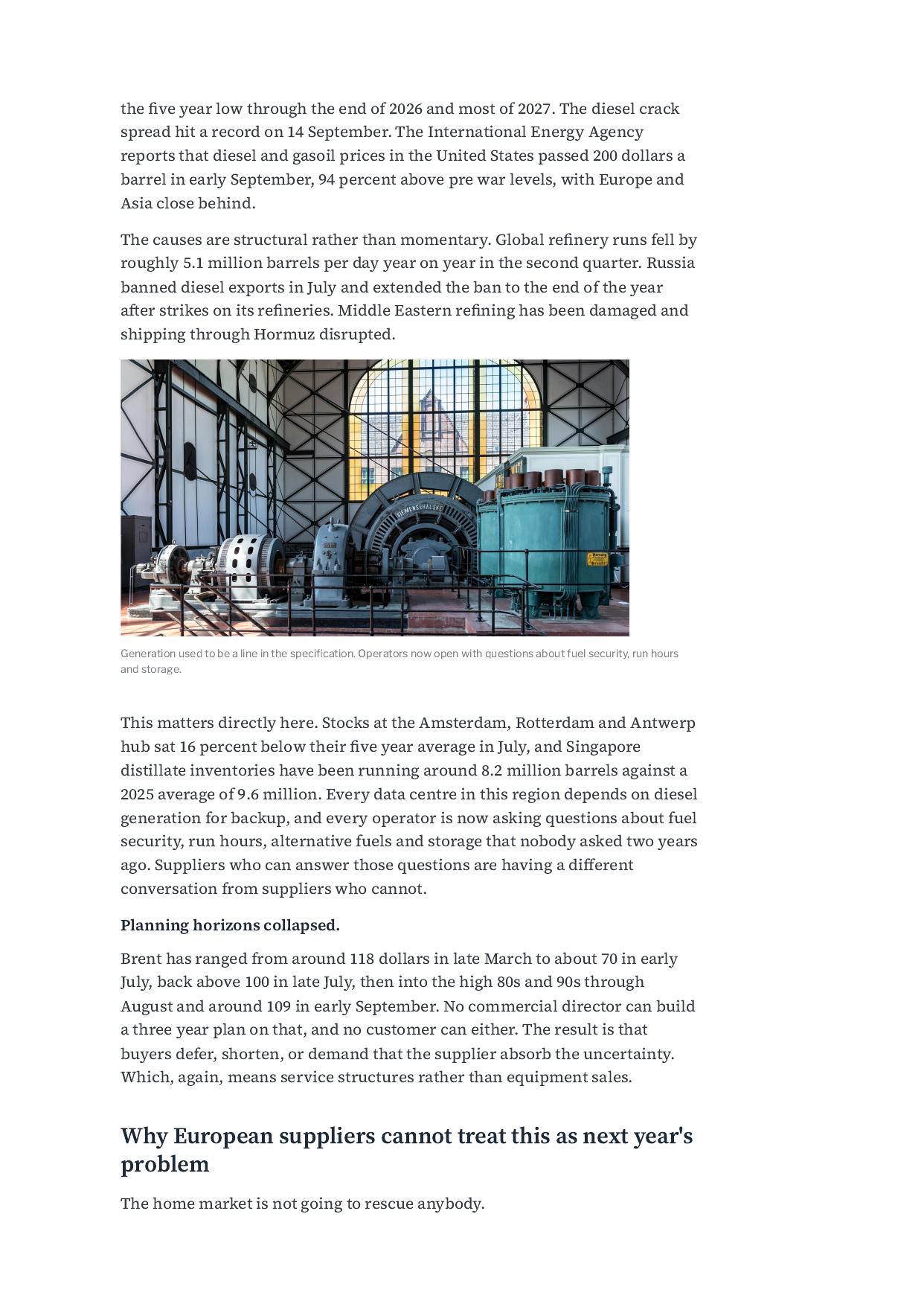
Generation used to be a line in the specification. Operators now open with questions about fuel security, run hours and storage.
This matters directly here. Stocks at the Amsterdam, Rotterdam and Antwerp hub sat 16 percent below their five year average in July, and Singapore distillate inventories have been running around 8.2 million barrels against a 2025 average of 9.6 million. Every data centre in this region depends on diesel generation for backup, and every operator is now asking questions about fuel security, run hours, alternative fuels and storage that nobody asked two years ago. Suppliers who can answer those questions are having a different conversation from suppliers who cannot.
Planning horizons collapsed.
Brent has ranged from around 118 dollars in late March to about 70 in early July, back above 100 in late July, then into the high 80s and 90s through August and around 109 in early September. No commercial director can build a three year plan on that, and no customer can either. The result is that buyers defer, shorten, or demand that the supplier absorb the uncertainty. Which, again, means service structures rather than equipment sales.
Why European suppliers cannot treat this as next year's problem The home market is not going to rescue anybody.
The German government has cut its 2026 growth forecast to around 0.5 percent. The probability of a second quarter recession climbed to 33.5 percent, nearly tripling in the space of two months. The Federation of German Industries has warned of a possible fifth consecutive year of declining manufacturing output, with capacity utilisation at just over 78 percent. German non household electricity ran at around 22.6 euro cents per kilowatt hour in the second half of 2025, among the highest in the European Union, and the European Commission approved a 3.8 billion euro state aid scheme in April specifically to bring industrial power costs down, conditional on recipients reinvesting part of the relief into low carbon technology.
Read that condition carefully. European industry is being asked to fund its own transition while defending its competitiveness in a harder global market. That is not a base from which to wait and see.
Meanwhile the evidence that the old model is failing has become difficult to ignore. In the electrolyser segment alone, Nel reported 2025 revenues down 31 percent with losses more than trebling, Cummins cut jobs at its Belgian plant, Thyssenkrupp Nucera signalled further cost reduction on falling sales, and Green Hydrogen Systems moved towards insolvency. In solar and storage, Soluxtec and Commeo have both gone. Earlier this month Enerparc filed for insolvency in Hamburg with 5.5 gigawatts installed across more than five hundred parks, only months after announcing a one billion euro financing package.
That last case carries the sharpest lesson. Enerparc was not a hardware vendor. It had already become an asset owner, which is the transition most of this analysis recommends. It failed anyway, because owning assets replaces manufacturing risk with financing risk, and in this rate environment financing risk is the more dangerous of the two.
The answer is therefore not simply to become an infrastructure business. The answer is to work out which part of the value chain you can defend and who carries the balance sheet for the rest.
Four realistic responses Partner with an energy as a service platform. These exist and are well capitalised in this region. A smaller share of a deal that closes beats full margin on a deal that does not.
Sell through a systems integrator that carries the balance of plant. This costs margin and control, and it converts a stalled pipeline into revenue.
Use vendor finance or leasing structures. This requires a different treasury function rather than a different sales pitch, and it is the option most often discussed and least often resourced.
Restructure into an asset owning business. Possible, but it is a change of company rather than a change of contract, it needs new capital and usually new shareholders, and Enerparc is the reason to be careful about it.
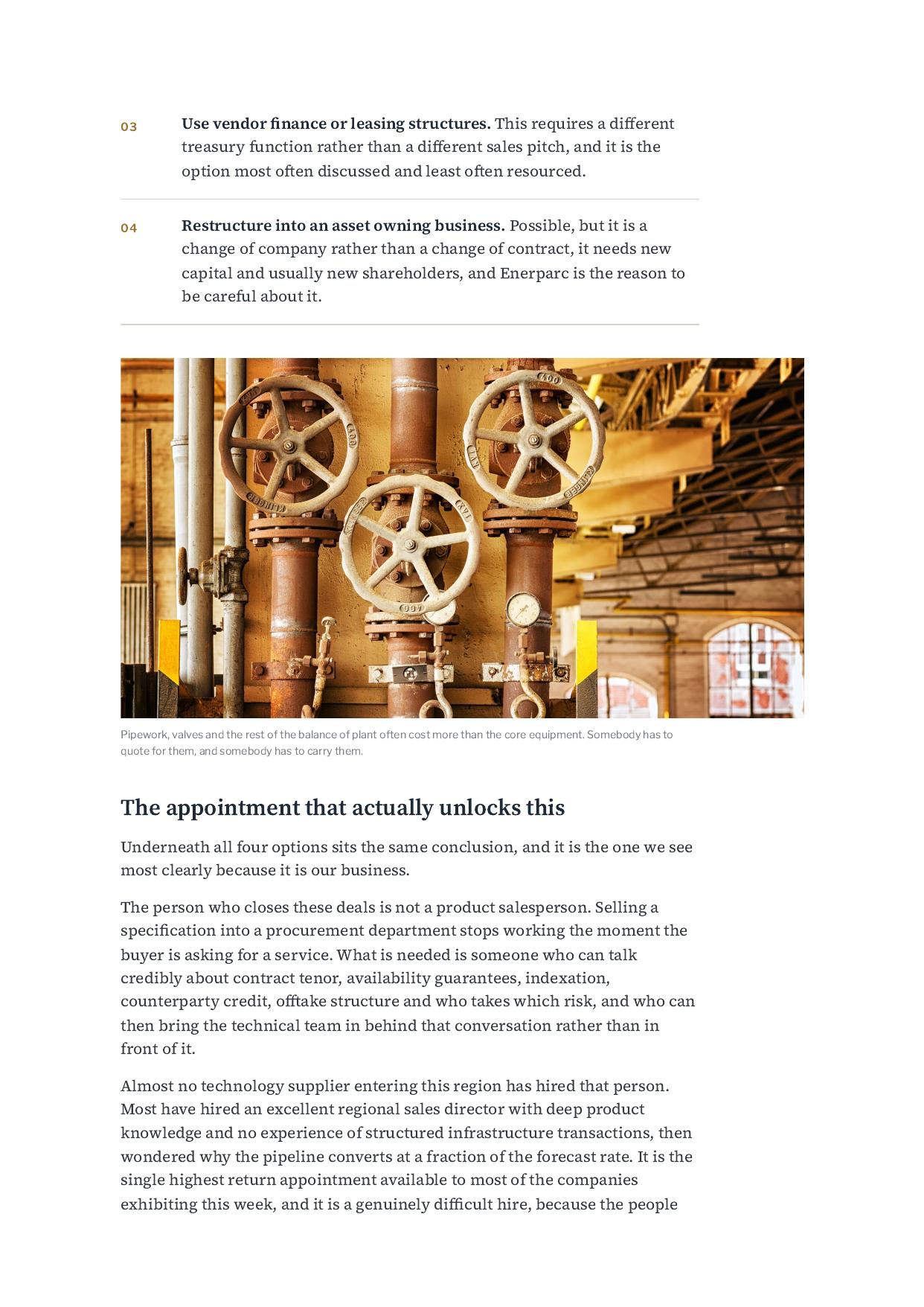
Pipework, valves and the rest of the balance of plant often cost more than the core equipment. Somebody has to quote for them, and somebody has to carry them.
The appointment that actually unlocks this
Underneath all four options sits the same conclusion, and it is the one we see most clearly because it is our business.
The person who closes these deals is not a product salesperson. Selling a specification into a procurement department stops working the moment the buyer is asking for a service. What is needed is someone who can talk credibly about contract tenor, availability guarantees, indexation, counterparty credit, offtake structure and who takes which risk, and who can then bring the technical team in behind that conversation rather than in front of it.
Almost no technology supplier entering this region has hired that person. Most have hired an excellent regional sales director with deep product knowledge and no experience of structured infrastructure transactions, then wondered why the pipeline converts at a fraction of the forecast rate. It is the single highest return appointment available to most of the companies exhibiting this week, and it is a genuinely difficult hire, because the people who can do it are currently working for developers, independent power producers and infrastructure funds.
Assessing a hire the business has never made
A strong CV and a competent interview will not find this person. The decisions a business makes about people are among the most important commercial decisions it will ever make, and few carry more weight than this one. The right appointment turns a stalled pipeline into contracted revenue. The wrong one spends two years presenting specifications to buyers who have stopped buying them.
The SCG Talent Intelligence Framework was developed to bring more structure to decisions like this. It moves the central question from "Can this person do the job?" to "Will this person succeed in this role, in this market, over time?" Rather than weighing experience and qualifications alone, it considers ten dimensions in three groups.
Technical capability, commercial understanding, leadership potential, communication skills.
Industry experience, international exposure, project complexity, career progression.
Cultural fit and contribution to long term growth.
The weighting for this appointment is not the one most suppliers would expect. Commercial understanding carries the most, by some distance. It separates a candidate who can price a fifteen year availability guarantee, and explain what indexation does to it, from one who can present a datasheet. Project complexity comes next, because the evidence that counts is a closed transaction with a lender, an integrator and a counterparty credit question all in play at once. Communication skills matter more than usual, because the role is translation: from the buyer's language of tenor and risk into the supplier's language of specification and delivery, and back again.
The person who closes these deals is not a product salesperson.
Industry experience carries less weight than a supplier would instinctively give it. Insisting on a career inside the supplier's own equipment category screens out the people most likely to succeed, because they sit on the buying side of the table. Cultural fit then works in an unexpected direction. The question is less whether the candidate suits the market than whether an engineering led head office will let a buyer side hire change how the company prices, contracts and carries risk. If it will not, the strongest candidate in the region will fail.
The framework is designed to enhance professional judgement, not replace it. It combines industry expertise, structured assessment and market knowledge, and over time it will develop into a broader Talent Intelligence Platform supporting recruitment, workforce planning, succession and leadership assessment. The underlying philosophy does not change. Technology should support better decisions, not make them. Successful organisations are built by understanding not only what people have done, but what they are capable of achieving next.
What SCG Partners do
We are a Singapore based executive recruitment and talent advisory firm working across infrastructure, energy and the energy transition in Asia Pacific. We know these markets, we know the operators and developers buying this equipment, and we know where the commercially structured people sit, because placing them is what we do.
For suppliers entering the region, the useful work usually starts before a search does. Understanding how the buyers in a given market actually contract, what a realistic route to first revenue looks like, who the local partners and integrators are, and what commercial capability needs to exist inside the business before a product is pitched, is advisory work rather than recruitment. We are happy to do it on that basis, and to move to hiring when and if the company decides that is the right next step. One thing we do not do is advise on capital raising or financing structures. That is regulated activity in Singapore and it belongs with licensed advisers. Where a conversation turns in that direction, we say so and point elsewhere.
Matt Hyslop will be at Tech Week Singapore on both days. If you are exhibiting and any of the above sounds familiar, he would welcome the conversation.