
Full text
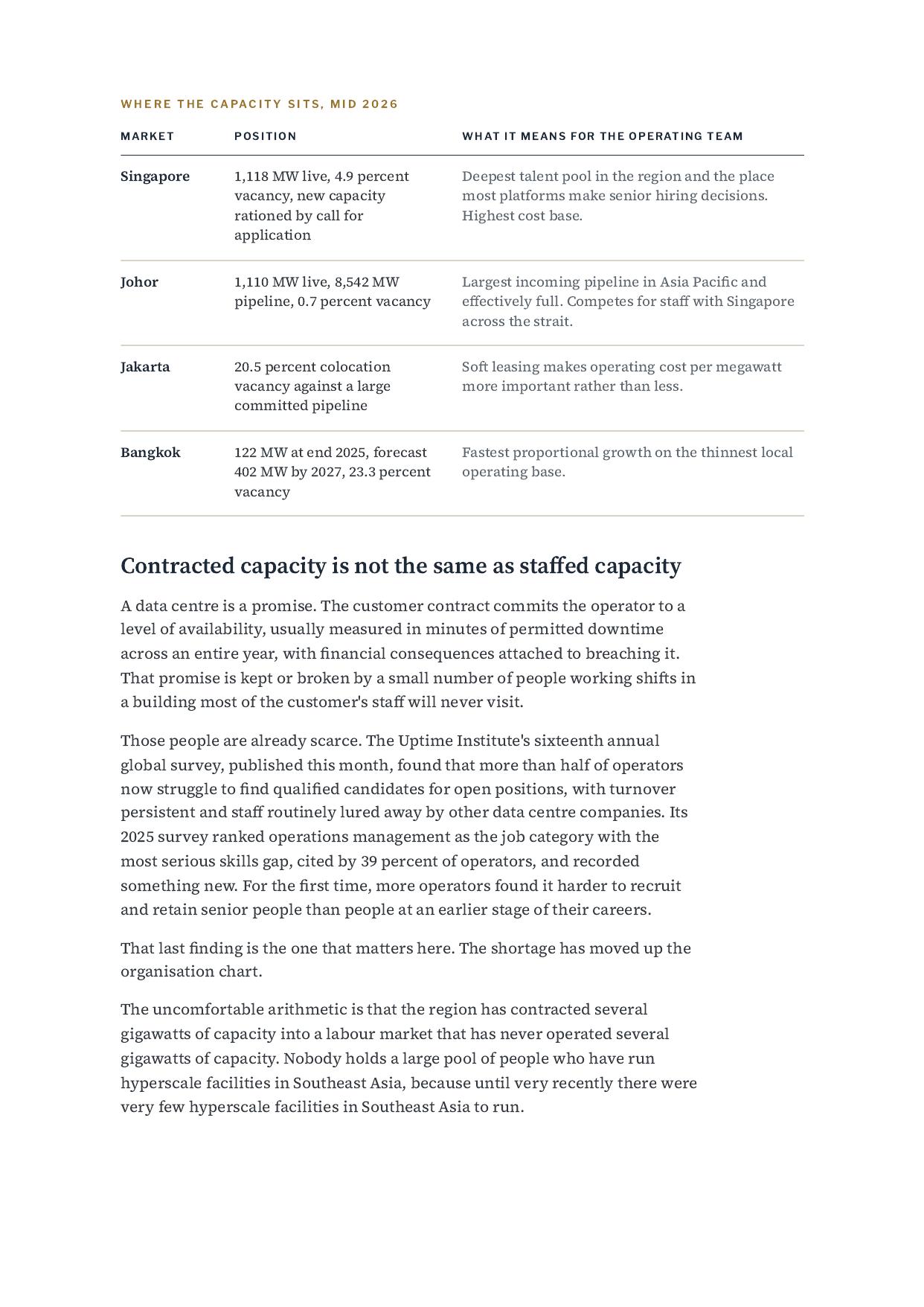
Capacity has been contracted across the region faster than the workforce to operate it has been built. The constraint on the next eighteen months is not steel or silicon, it is people.
In Iskandar Puteri, Johor, the first building of the TM Nxera campus topped out in April 2026. The structural frame was finished and the work moved on to mechanical and electrical installation, systems integration and commissioning, with first phase commercial operations due in the second half of this year. Nearby in Nusajaya, Empyrion Digital holds 145 MW of allocated power from Tenaga Nasional and expects earliest energisation in September, with the first of five 40 MW buildings ready for service in the final quarter.
Across Johor, Batam, Greater Jakarta and Bangkok, a very large volume of capacity that has so far existed only as contracts, land titles, electricity supply agreements and structural steel is about to become an operating business.
That moment of handover, when a construction project becomes a live facility carrying customer workloads, is the most commercially significant event in this sector and the least discussed. Almost everything written about Southeast Asian data centres over the past three years has been about getting capacity built. Land, power allocation, water, planning approvals, capital. Very little has been written about who runs the thing afterwards. That is where the return actually comes from.
The size of what is arriving
Knight Frank's Data Centre Atlas 2026, published at the end of July, puts Johor's live IT capacity at 1,110 MW, third in Asia Pacific behind Tokyo at 1,473 MW and Singapore at 1,118 MW. Johor also holds the region's largest incoming pipeline at 8,542 MW, its tightest colocation vacancy at 0.7 percent, and a market value of USD 39.11 billion, second only to Japan. Malaysia's Ministry of Investment, Trade and Industry approved roughly RM 144 billion, around USD 31 billion, across 143 data centre projects between 2021 and the middle of 2025.
Singapore has rationed new capacity since 2019. A second call for applications, announced on 1 December 2025, released at least 200 MW and closed on 31 March 2026, with applicants required to draw half their power from green sources. A proposed Digital Infrastructure Bill goes further, requiring a licence for any facility with a critical load of 3 MW or more and weighing energy efficiency, water efficiency and the character of the energy source in granting it.
Bangkok is the fastest mover in proportional terms, on the back of a Thai Board of Investment pipeline that approved 141 digital infrastructure projects worth 623 billion baht during 2025, then 48 more worth 874 billion baht in the first quarter of 2026 alone.
Set those numbers next to one another and a pattern emerges. Live capacity across the region is a fraction of what has been contracted, financed and committed. The buildings are coming, and the delivery dates cluster in the eighteen months ahead of us.
WHERE THE CAPACITY SITS, MID 2026
Singapore: 1,118 MW live, 4.9 percent vacancy, new capacity rationed by call for application. Deepest talent pool in the region and the place most platforms make senior hiring decisions. Highest cost base.
Johor: 1,110 MW live, 8,542 MW pipeline, 0.7 percent vacancy. Largest incoming pipeline in Asia Pacific and effectively full. Competes for staff with Singapore across the strait.
Jakarta: 20.5 percent colocation vacancy against a large committed pipeline. Soft leasing makes operating cost per megawatt more important rather than less.
Bangkok: 122 MW at end 2025, forecast 402 MW by 2027, 23.3 percent vacancy. Fastest proportional growth on the thinnest local operating base.
Contracted capacity is not the same as staffed capacity
A data centre is a promise. The customer contract commits the operator to a level of availability, usually measured in minutes of permitted downtime across an entire year, with financial consequences attached to breaching it. That promise is kept or broken by a small number of people working shifts in a building most of the customer's staff will never visit.
Those people are already scarce. The Uptime Institute's sixteenth annual global survey, published this month, found that more than half of operators now struggle to find qualified candidates for open positions, with turnover persistent and staff routinely lured away by other data centre companies. Its 2025 survey ranked operations management as the job category with the most serious skills gap, cited by 39 percent of operators, and recorded something new. For the first time, more operators found it harder to recruit and retain senior people than people at an earlier stage of their careers.
That last finding is the one that matters here. The shortage has moved up the organisation chart.
The uncomfortable arithmetic is that the region has contracted several gigawatts of capacity into a labour market that has never operated several gigawatts of capacity. Nobody holds a large pool of people who have run hyperscale facilities in Southeast Asia, because until very recently there were very few hyperscale facilities in Southeast Asia to run.
The hiring happens before the building opens
The mistake operators make is treating operations recruitment as something that happens once the facility is finished. It cannot be, and the sequence explains why.
An operations director needs to be in post well before the first customer load arrives, ideally six to twelve months ahead. They are the client side presence during commissioning, the person who witnesses integrated systems testing rather than reading a report about it afterwards. They write or approve the standard operating procedures, the methods of procedure and the emergency operating procedures that will govern every subsequent intervention on live plant. They design the shift structure and hire into it. They negotiate the maintenance contracts and set the service levels those contracts carry. They build the spares strategy. They own the handover documentation, which in practice means chasing the contractor for the record drawings and test certificates that will matter enormously in three years and matter to nobody today.
Appoint that person late and the facility still opens. It simply opens with procedures written by somebody who was not there when the systems were tested, a team hired in a hurry from a small pool, and a maintenance regime inherited rather than designed. The cost shows up slowly, in unplanned outages, in insurance conversations, in customer audits, and eventually in the price a buyer is willing to pay for the asset.
Four capabilities that are genuinely hard to find
- Critical facilities engineering. Electrical and mechanical engineers who understand uninterruptible power supplies, generator plant, switchgear, chilled water systems and, increasingly, liquid cooling, and who can work on live infrastructure without taking it down. This is not building services experience with a different job title.
- Commissioning and handover. This sits awkwardly between the construction and operating worlds. The people who are good at it tend to be in permanent demand, because every project needs them and no project needs them forever.
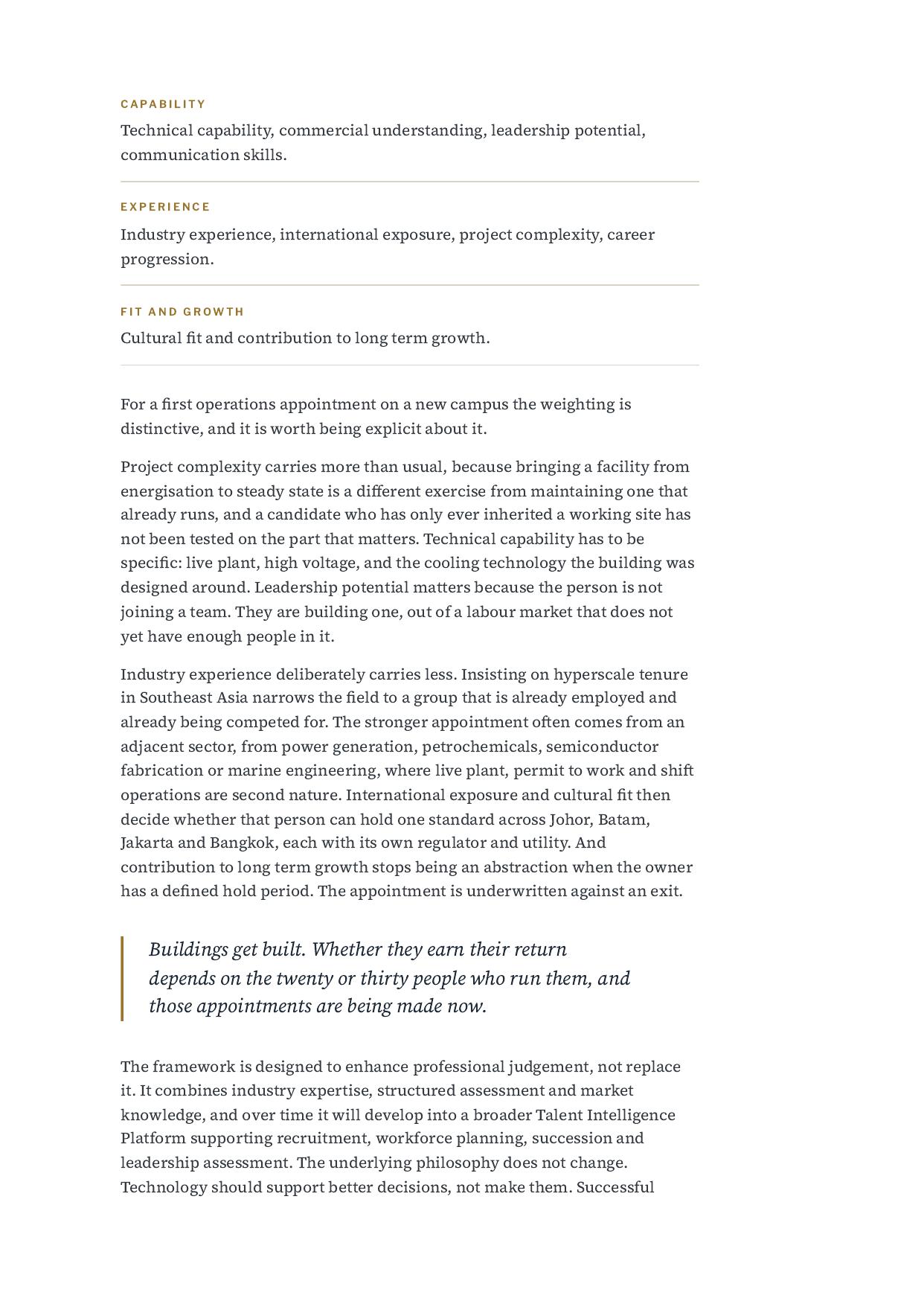
- The high voltage and grid interface. Facilities in this region increasingly connect at transmission voltages with substations on site. The engineers who can own that relationship with the utility, manage the connection process and understand what a tariff structure does to operating cost are drawn from the power sector rather than from information technology.
- Operations leadership at portfolio level. Someone who can run several sites across more than one country, hold a consistent standard across them, and sit credibly in front of an owner who wants to discuss availability, efficiency and cost per megawatt. There are not many of these people in the region, and most are already employed.
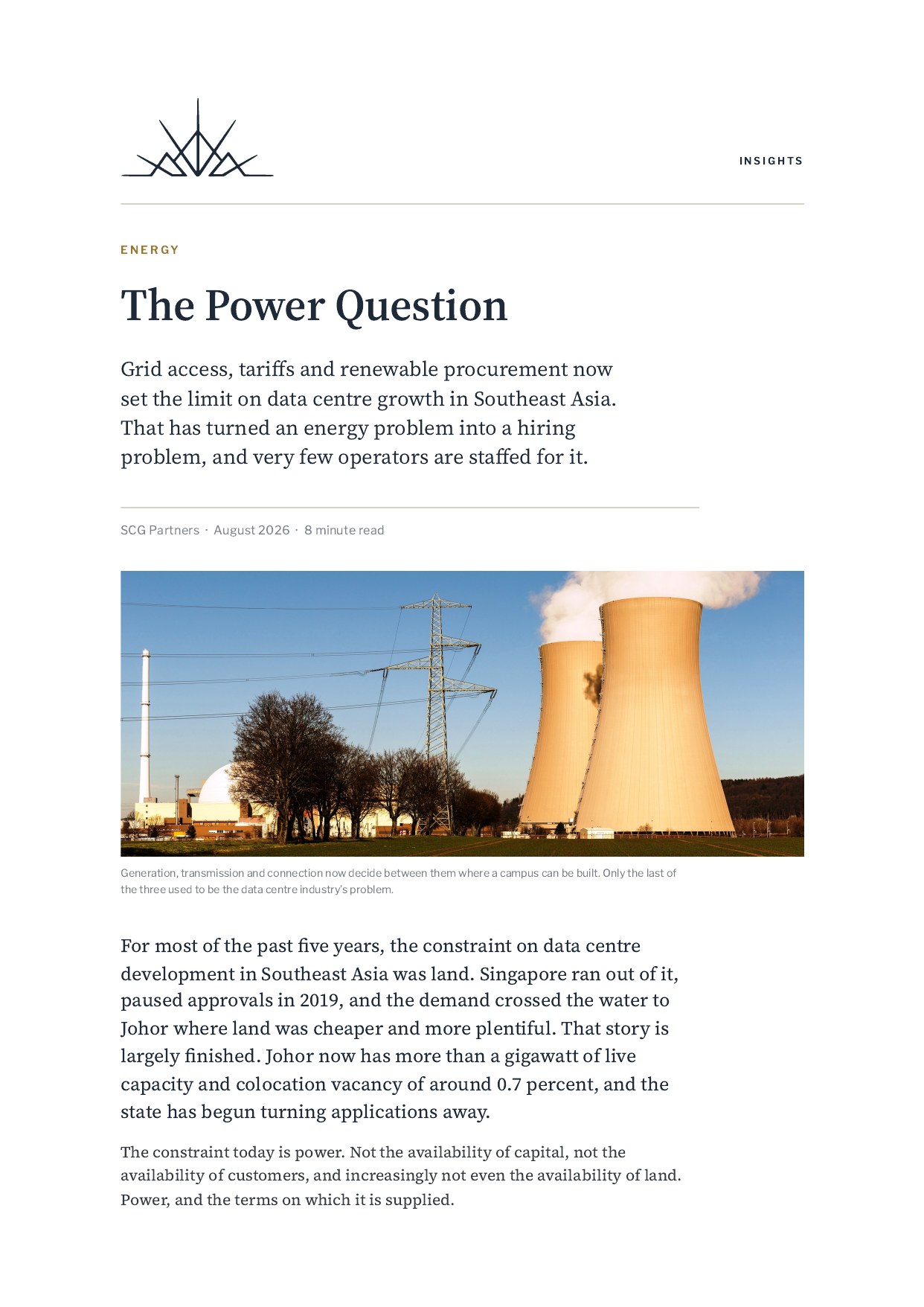
Campuses in the region increasingly connect at transmission voltages with substations on site. The engineer who owns that relationship with the utility comes from the power sector, not from information technology.
Why the owners should care more than they do
Most of this capacity is not owned by technology companies. It is owned by infrastructure funds, pension money and sovereign capital, and that ownership has been consolidating quickly. In February 2026 a KKR led consortium with Singtel agreed to acquire the remaining 82 percent of ST Telemedia Global Data Centres for SGD 6.6 billion, valuing the platform at an enterprise value of SGD 13.8 billion, or about USD 10.9 billion, with completion expected in the second half of this year. That follows the Blackstone and CPP Investments acquisition of AirTrunk in 2024 at around USD 16 billion, still the largest transaction of its kind in Asia Pacific.
Capital of that type has hold periods and exit plans, and that changes what operations means. Availability record, power usage effectiveness, operating cost per megawatt and the depth of the operating team are not engineering statistics in a fund owned asset. They are inputs to the valuation, they appear in technical due diligence, and a thin or unstable operating team is a discount at exit.
The operations director is a capital allocation decision wearing an engineering job title.
The parts of this that could go wrong
None of the above assumes the boom continues untroubled, and it would be dishonest to present it that way.
Malaysia has tightened approvals. A Johor vetting committee established in June 2024 rejected close to 30 percent of applications on sustainability and infrastructure grounds in its first months. In November 2025 the state asked investors to defer water cooled expansions for about eighteen months, to roughly the middle of 2027, and halted new approvals for the largest and highest water use facilities. A dedicated data centre water tariff of RM 5.33 per cubic metre now applies. The cost advantage is narrowing on power too. The Tenaga Nasional overhaul of 1 July 2025 raised the Peninsular Malaysia base rate from 39.96 to 45.62 sen per kWh under a voltage based structure, and its time of use scheme offers limited relief to a facility running around the clock.
Jakarta and Bangkok face the opposite problem. Colocation vacancy sits at 20.5 percent and 23.3 percent respectively, against 0.7 percent in Johor and 4.9 percent in Singapore.
What none of that changes is the operating requirement. Capacity that has been built has to be staffed whether or not it is fully let, and a soft leasing market makes the operating cost line more important rather than less.
Getting those appointments right
This is where the return is protected or lost, and it is why a strong CV and a competent interview are not enough. The decisions an organisation makes about people are among the most important commercial decisions it will ever make. The right individual can bring a facility into service cleanly, hold a standard across a portfolio and give an owner something defensible to show a buyer. The wrong appointment can do the opposite, quietly, over several years.
The SCG Talent Intelligence Framework was developed to bring more structure to those decisions. It moves the central question from "Can this person do the job?" to "Will this person succeed in this role, in this market, over time?" Rather than weighing experience and qualifications alone, it considers a broader set of factors that shape long term success.
- CAPABILITY: Technical capability, commercial understanding, leadership potential, communication skills.
- EXPERIENCE: Industry experience, international exposure, project complexity, career progression.
- FIT AND GROWTH: Cultural fit and contribution to long term growth.
For a first operations appointment on a new campus the weighting is distinctive, and it is worth being explicit about it.
Project complexity carries more than usual, because bringing a facility from energisation to steady state is a different exercise from maintaining one that already runs, and a candidate who has only ever inherited a working site has not been tested on the part that matters. Technical capability has to be specific: live plant, high voltage, and the cooling technology the building was designed around. Leadership potential matters because the person is not joining a team. They are building one, out of a labour market that does not yet have enough people in it.
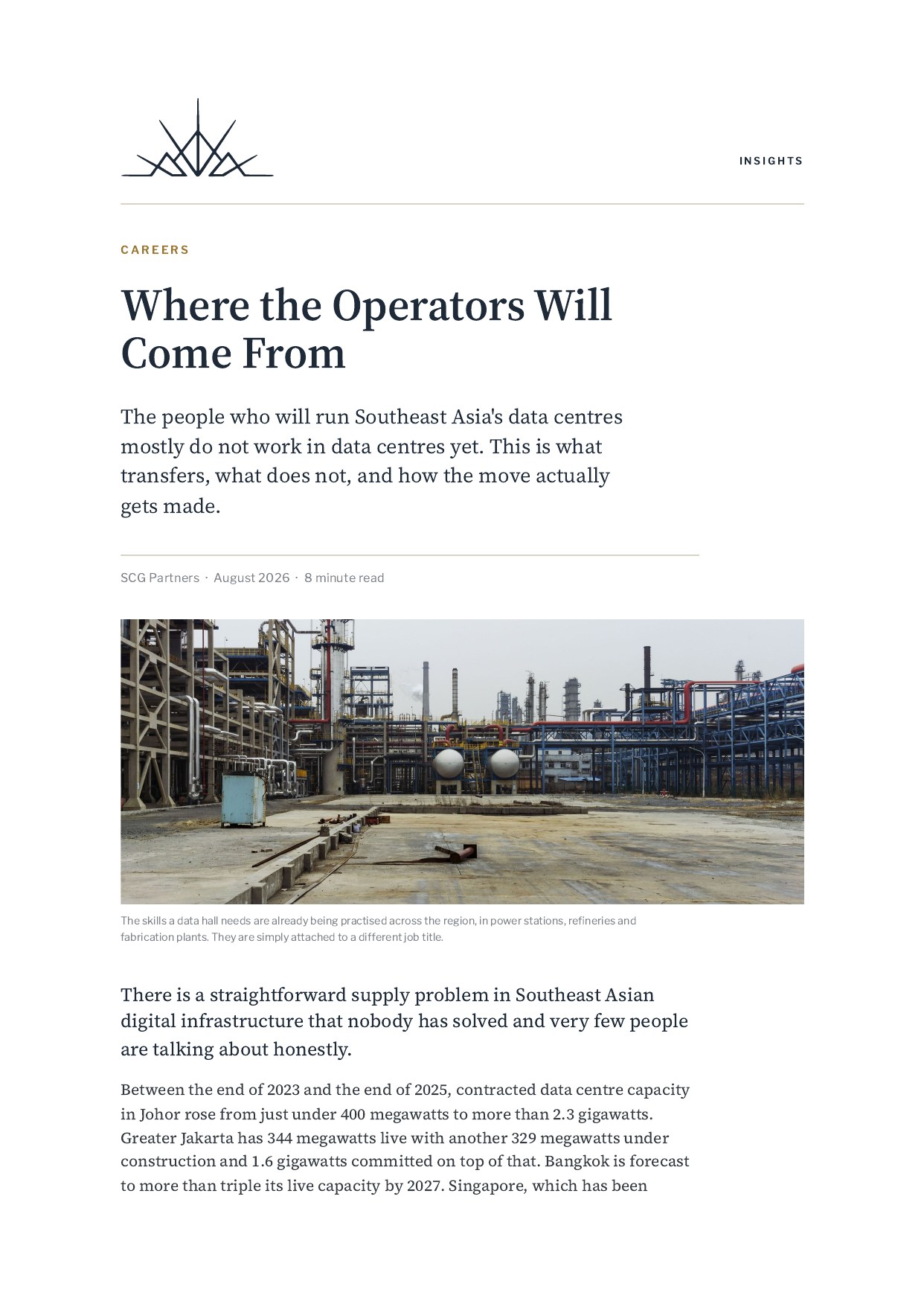
Industry experience deliberately carries less. Insisting on hyperscale tenure in Southeast Asia narrows the field to a group that is already employed and already being competed for. The stronger appointment often comes from an adjacent sector, from power generation, petrochemicals, semiconductor fabrication or marine engineering, where live plant, permit to work and shift operations are second nature. International exposure and cultural fit then decide whether that person can hold one standard across Johor, Batam, Jakarta and Bangkok, each with its own regulator and utility. And contribution to long term growth stops being an abstraction when the owner has a defined hold period. The appointment is underwritten against an exit.
Buildings get built. Whether they earn their return depends on the twenty or thirty people who run them, and those appointments are being made now.
The framework is designed to enhance professional judgement, not replace it. It combines industry expertise, structured assessment and market knowledge, and over time it will develop into a broader Talent Intelligence Platform supporting recruitment, workforce planning, succession and leadership assessment. The underlying philosophy does not change. Technology should support better decisions, not make them.
Successful organisations are built by understanding not only what people have done, but what they are capable of achieving next.
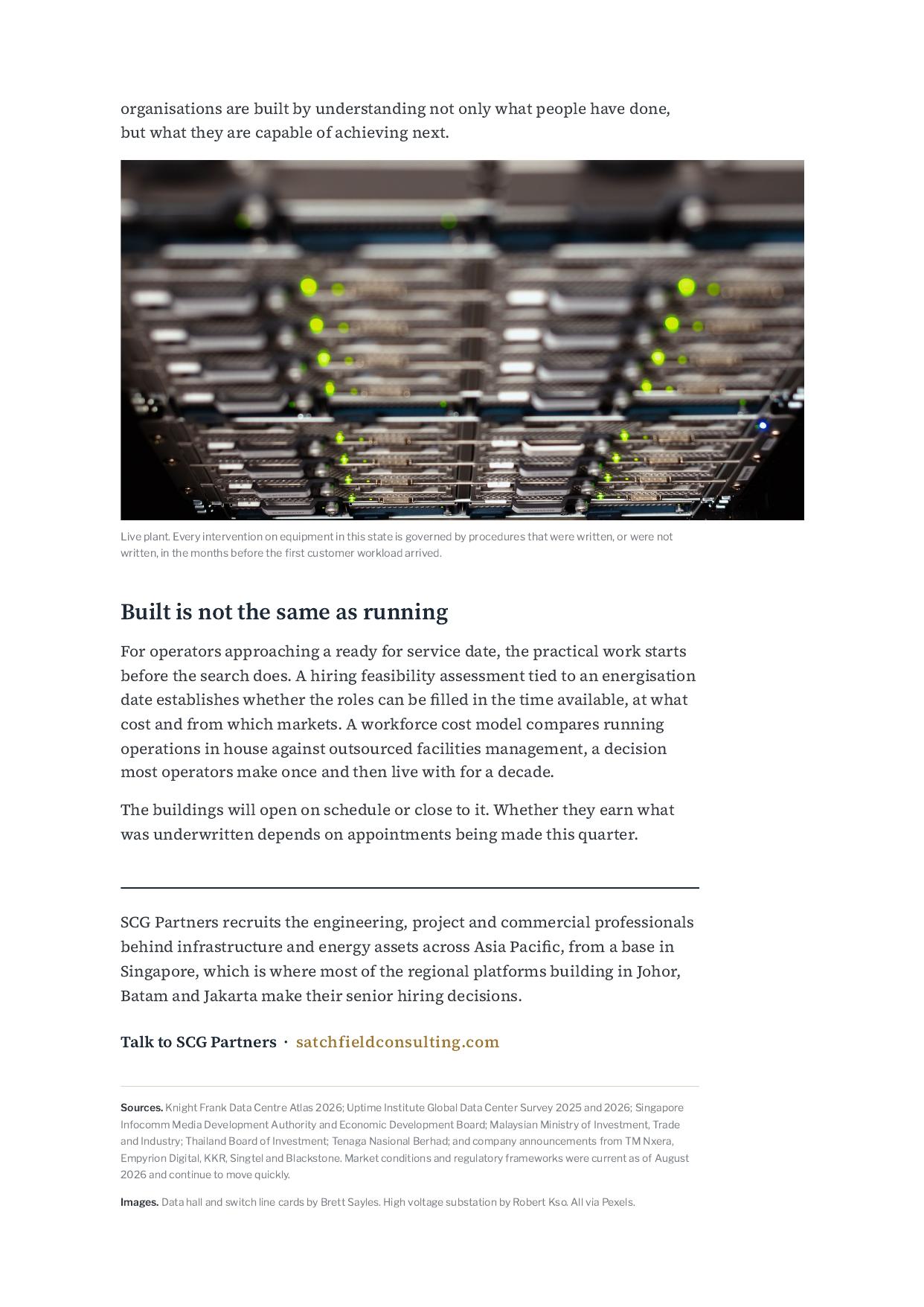
Live plant. Every intervention on equipment in this state is governed by procedures that were written, or were not written, in the months before the first customer workload arrived.
Built is not the same as running
For operators approaching a ready for service date, the practical work starts before the search does. A hiring feasibility assessment tied to an energisation date establishes whether the roles can be filled in the time available, at what cost and from which markets. A workforce cost model compares running operations in house against outsourced facilities management, a decision most operators make once and then live with for a decade.
The buildings will open on schedule or close to it. Whether they earn what was underwritten depends on appointments being made this quarter.