Full text
There is a straightforward supply problem in Southeast Asian digital infrastructure that nobody has solved and very few people are talking about honestly.
Between the end of 2023 and the end of 2025, contracted data centre capacity in Johor rose from just under 400 megawatts to more than 2.3 gigawatts. Greater Jakarta has 344 megawatts live with another 329 megawatts under construction and 1.6 gigawatts committed on top of that. Bangkok is forecast to more than triple its live capacity by 2027. Singapore, which has been rationing new capacity since 2019, still sits above 1.1 gigawatts across more than sixty facilities.
Every one of those megawatts has to be operated by somebody, on shift, in a building, around the clock, for the next fifteen to twenty years.
The number of people in this region who have actually done that work at scale is small, because until recently there was very little of it to do. Surveys of operators worldwide consistently show that close to two thirds struggle either to find qualified staff or to keep the ones they have, with the deepest shortages in mid level operations and in mechanical and electrical engineering. In Southeast Asia the gap is wider than the global average, because the capacity arrived faster.
The conclusion follows without much argument. Most of the people who run Southeast Asia's data centres in 2030 are today working somewhere else, in an industry that does not call itself digital infrastructure. If you are one of them, this article is for you.
The industries these roles actually recruit from
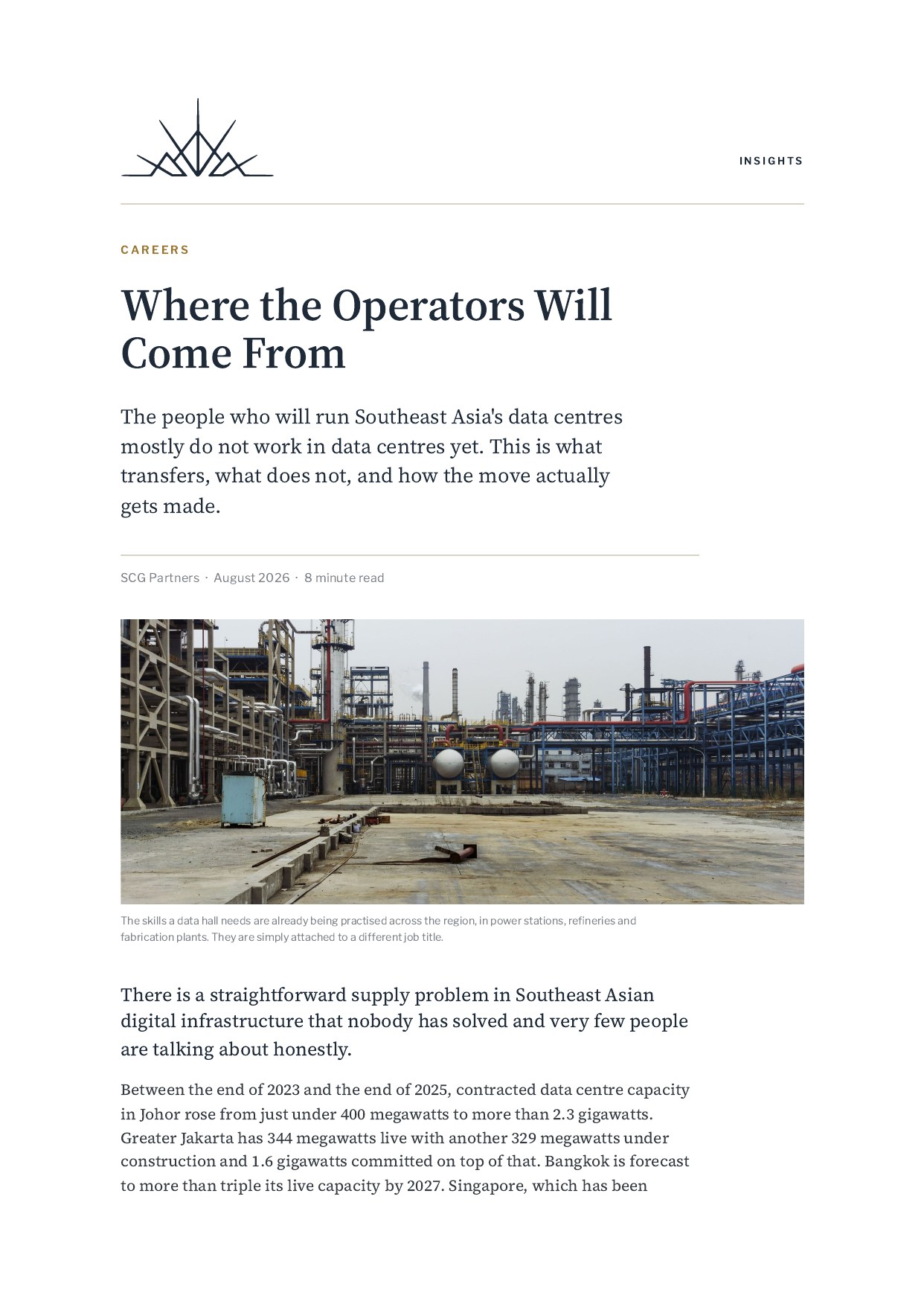
Data centre operations is a mission critical plant discipline wearing a technology label. That is why the people who succeed in it tend to arrive from other mission critical plant environments rather than from IT.
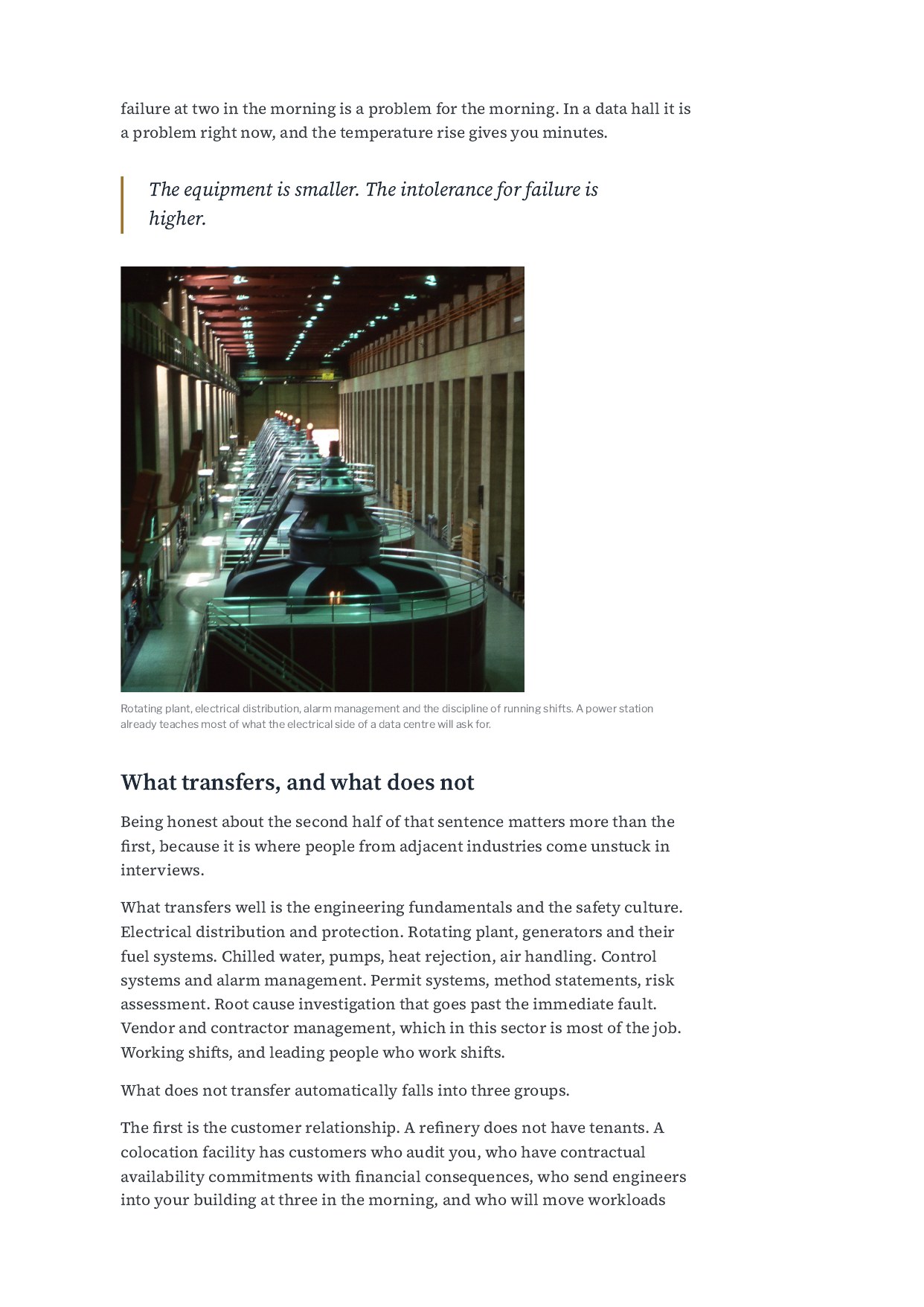
Power generation is the most direct route. If you have worked in a power station, on switchgear, on high voltage systems, on generator plant or in a grid control environment, you already understand most of what the electrical side of a data centre asks of you. The equipment is smaller. The intolerance for failure is higher.
Oil, gas and petrochemicals is the second, and it produces some of the strongest candidates in the sector. The habit of working to permits, the discipline around isolation and reinstatement, the seriousness applied to a management of change process, the instinct to stop work when something looks wrong. These are not attitudes an operator can train into someone quickly and they are exactly what protects a live data hall. Operators in Europe and the Middle East have been hiring from offshore for several years and report that the environments differ but the mindset does not.
Utilities and water, marine and offshore engineering, semiconductor fabrication and pharmaceutical manufacturing all produce viable candidates for similar reasons. Fabs and pharmaceutical plants in particular teach cleanliness protocols, contamination control and an unusually rigorous approach to documented procedure.
Building services and facilities management is a route in, but a narrower one than people expect. Managing a commercial tower and managing a data centre share vocabulary and very little else. In an office building, a chiller failure at two in the morning is a problem for the morning. In a data hall it is a problem right now, and the temperature rise gives you minutes.
What transfers, and what does not
Being honest about the second half of that sentence matters more than the first, because it is where people from adjacent industries come unstuck in interviews.
What transfers well is the engineering fundamentals and the safety culture. Electrical distribution and protection. Rotating plant, generators and their fuel systems. Chilled water, pumps, heat rejection, air handling. Control systems and alarm management. Permit systems, method statements, risk assessment. Root cause investigation that goes past the immediate fault. Vendor and contractor management, which in this sector is most of the job. Working shifts, and leading people who work shifts.
What does not transfer automatically falls into three groups.
The first is the customer relationship. A refinery does not have tenants. A colocation facility has customers who audit you, who have contractual availability commitments with financial consequences, who send engineers into your building at three in the morning, and who will move workloads elsewhere if they lose confidence. Managing that relationship is a commercial skill and it is genuinely new to most people arriving from process industries.
The second is the pace of change. Data centres are modified constantly. New customers, new racks, new power draw, higher densities, retrofits for liquid cooling. The change control discipline is familiar but the frequency is not, and the tolerance for a change going wrong is far lower than in most plant environments.
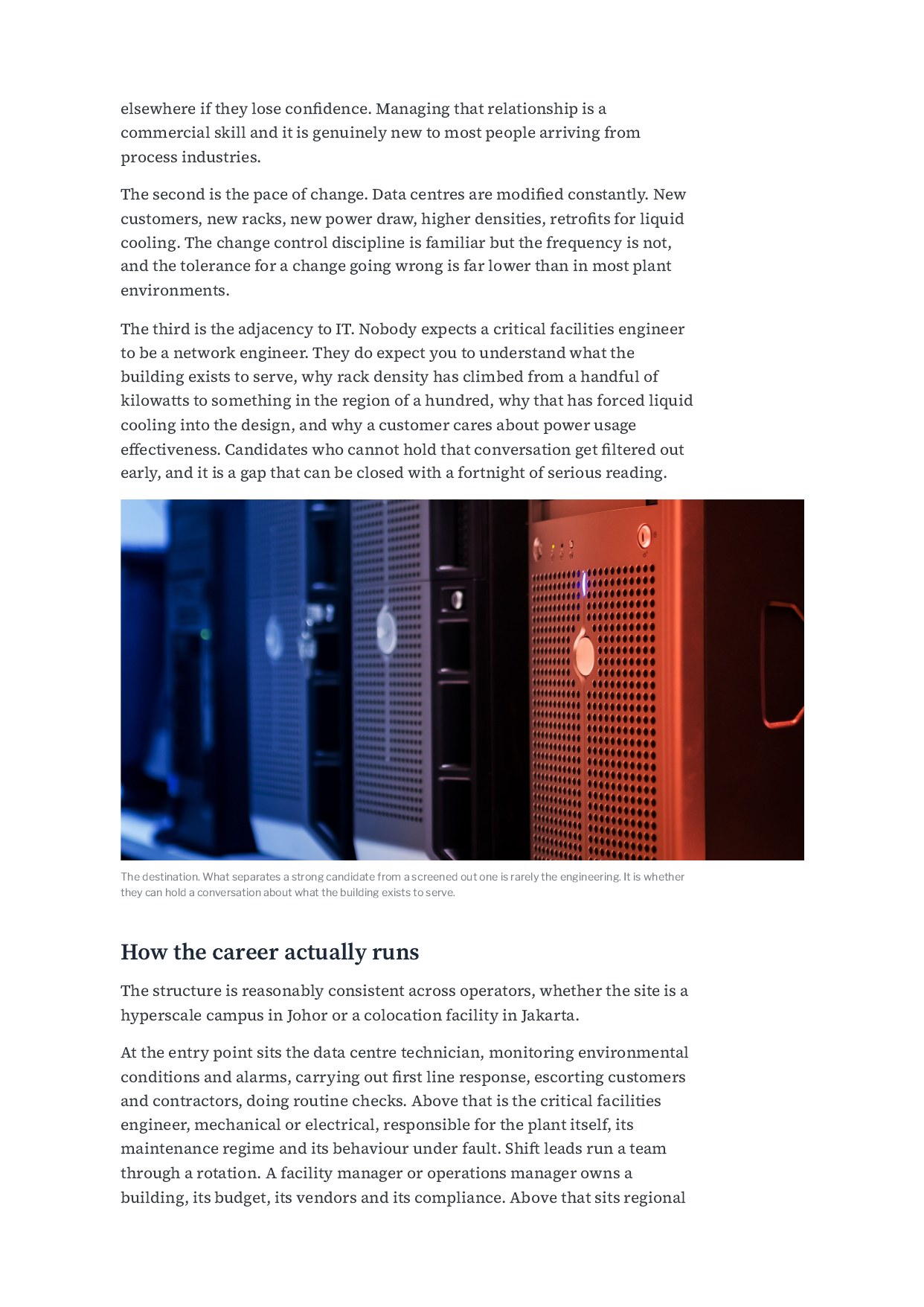
The third is the adjacency to IT. Nobody expects a critical facilities engineer to be a network engineer. They do expect you to understand what the building exists to serve, why rack density has climbed from a handful of kilowatts to something in the region of a hundred, why that has forced liquid cooling into the design, and why a customer cares about power usage effectiveness. Candidates who cannot hold that conversation get filtered out early, and it is a gap that can be closed with a fortnight of serious reading.
How the career actually runs
The structure is reasonably consistent across operators, whether the site is a hyperscale campus in Johor or a colocation facility in Jakarta.
At the entry point sits the data centre technician, monitoring environmental conditions and alarms, carrying out first line response, escorting customers and contractors, doing routine checks. Above that is the critical facilities engineer, mechanical or electrical, responsible for the plant itself, its maintenance regime and its behaviour under fault. Shift leads run a team through a rotation. A facility manager or operations manager owns a building, its budget, its vendors and its compliance. Above that sits regional or portfolio leadership, running several sites across more than one country, and increasingly reporting to an owner rather than to a technology company.
Two things are worth knowing about that ladder.
The first is that the middle of it is where the shortage bites hardest, which means the move upward is faster in this sector than in most. People who would wait years for a step in a mature industry are taking it here in months, because the alternative for the employer is an empty seat.
The second is that commissioning is a legitimate and underrated way in. Every new campus needs commissioning support, the work is intense and time limited, and it puts you inside the systems of a brand new facility in a way that years of maintenance experience will not. A significant number of operations managers in this region came in through a commissioning role on a project and stayed.
Some plain advice about the market you are entering
This is a hot market and hot markets encourage bad decisions.
Poaching between operators is routine and you will be approached. Being approached is pleasant and it is not a strategy. The candidates who do best over five years are the ones who stayed long enough somewhere to have owned an outcome, taken a facility through an audit, been on shift when something failed and can describe what they did about it. A CV that shows four employers in four years reads as a person who has been paid to move, not a person who has run something.
Location decisions matter more here than in most sectors. The Johor and Singapore corridor is a single labour market in practice and will feel more like one when the rail link opens, but the roles, the employers, the tax position and the pay structures on either side of the water are not the same. Batam, Greater Jakarta and the Eastern Economic Corridor in Thailand are all growing quickly and all have far thinner local talent pools, which makes them good places to accelerate a career and harder places to leave a role if it turns out badly.
Certification is worth something but less than experience. Vendor training on the specific plant you will operate, and any recognised data centre design and operations qualification, will get you past a screening filter. Neither will get you past a technical interview with someone who runs a facility. Practical evidence does.
Finally, be careful about the difference between a facility that is operating and a facility that is announced. A great deal of capacity in this region exists in press releases, land acquisitions and power allocation approvals rather than in buildings that are running. Jakarta has thirty five colocation operators sharing 267 megawatts of live capacity, with vacancy above 20 percent. Ask any prospective employer what is energised today, what is contracted, and what the customer commitments actually are. The answer tells you a lot about how secure the role is.