Full text
The global energy transition has stopped being a distant ambition and become a workforce event. Asia Pacific now accounts for roughly 60 percent of new renewable energy capacity added worldwide, and the International Renewable Energy Agency estimates that Asia hosted around 75 percent of the world's solar photovoltaic jobs in 2024, with China alone employing some 4.2 million people in the sector. From solar farms in Vietnam to battery plants in Indonesia and hydrogen hubs in Malaysia and Australia, demand for experienced project, engineering and commercial professionals has reached a level the region has not seen before.
Deployment is surging, but a persistent imbalance sits underneath it. Employers across the region are struggling to fill specialised technical roles fast enough to keep pace with national decarbonisation targets, and that gap is widening rather than closing. For owners and decision makers the pressing question has therefore shifted. Securing capital and capacity is no longer the primary constraint. The deciding factor is whether an organisation can identify, attract and retain the specialists capable of delivering complex projects on time, and can do so more effectively than a growing field of competitors chasing the same limited pool. Capacity can be bought. Capability has to be found.
Where the demand is concentrated
Demand is not spread evenly across the region or across disciplines. Four segments account for most of the hiring, and each carries its own geography, its own salary logic and its own scarcity.
Battery storage has become one of the fastest growing employment segments in Asia Pacific. Battery storage engineers, commanding roughly USD 85,000 to USD 120,000, are hired for systems integration, storage design and grid controls. Indonesia, with its rapidly maturing battery manufacturing base, and Singapore, focused on grid scale deployment, are the leading regional hotspots, with Vietnam emerging quickly behind them.
Green hydrogen is the newest frontier and the thinnest talent market of the four. Hydrogen systems engineers and power to gas project developers now earn between USD 95,000 and USD 140,000, a band that reflects both technical complexity and genuine scarcity. Malaysia could generate more than 200,000 hydrogen related jobs, Vietnam projects 40,000 to 50,000 roles, and Japan and Australia are positioning themselves as major players in the hydrogen economy.
Grid modernisation carries the sharpest shortages. As renewable penetration rises, ageing networks strain, and demand has intensified for grid integration specialists, power systems experts and professionals skilled in supervisory control and data acquisition (SCADA) systems, smart grid infrastructure and distribution automation. These roles pay between USD 90,000 and USD 130,000, and Singapore, Malaysia, Taiwan and South Korea are all investing heavily in smart grid capability.
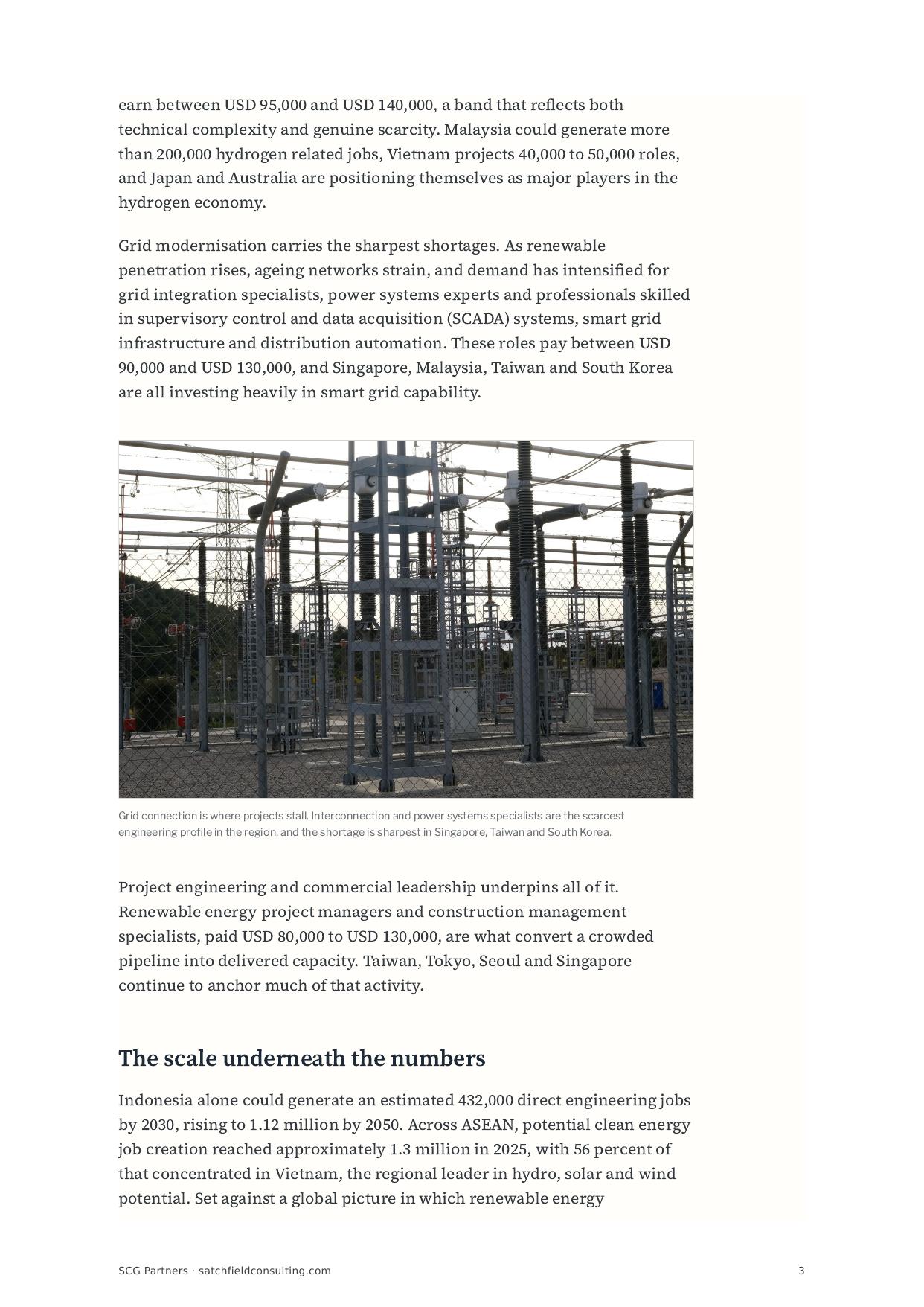
Grid connection is where projects stall. Interconnection and power systems specialists are the scarcest engineering profile in the region, and the shortage is sharpest in Singapore, Taiwan and South Korea.
Project engineering and commercial leadership underpins all of it. Renewable energy project managers and construction management specialists, paid USD 80,000 to USD 130,000, are what convert a crowded pipeline into delivered capacity. Taiwan, Tokyo, Seoul and Singapore continue to anchor much of that activity.
The scale underneath the numbers
Indonesia alone could generate an estimated 432,000 direct engineering jobs by 2030, rising to 1.12 million by 2050. Across ASEAN, potential clean energy job creation reached approximately 1.3 million in 2025, with 56 percent of that concentrated in Vietnam, the regional leader in hydro, solar and wind potential. Set against a global picture in which renewable energy employment grew by only 2.3 percent in 2024, according to IRENA, the concentration is striking. Asia is not simply participating in the transition workforce. It is most of it.
Why the shortage is specific rather than general
Reading those figures as a broad labour shortage would be a mistake, and an expensive one. Vacancies are not uniformly hard to fill. The shortage bites hardest where deep technical expertise meets digital fluency. Roles blending traditional power engineering with capability in AI driven energy management and system stability planning command the highest salaries and face the most acute shortages. In Singapore, grid connection technical experts and energy storage specialists rank among the fastest growing technical roles and among the hardest to fill.
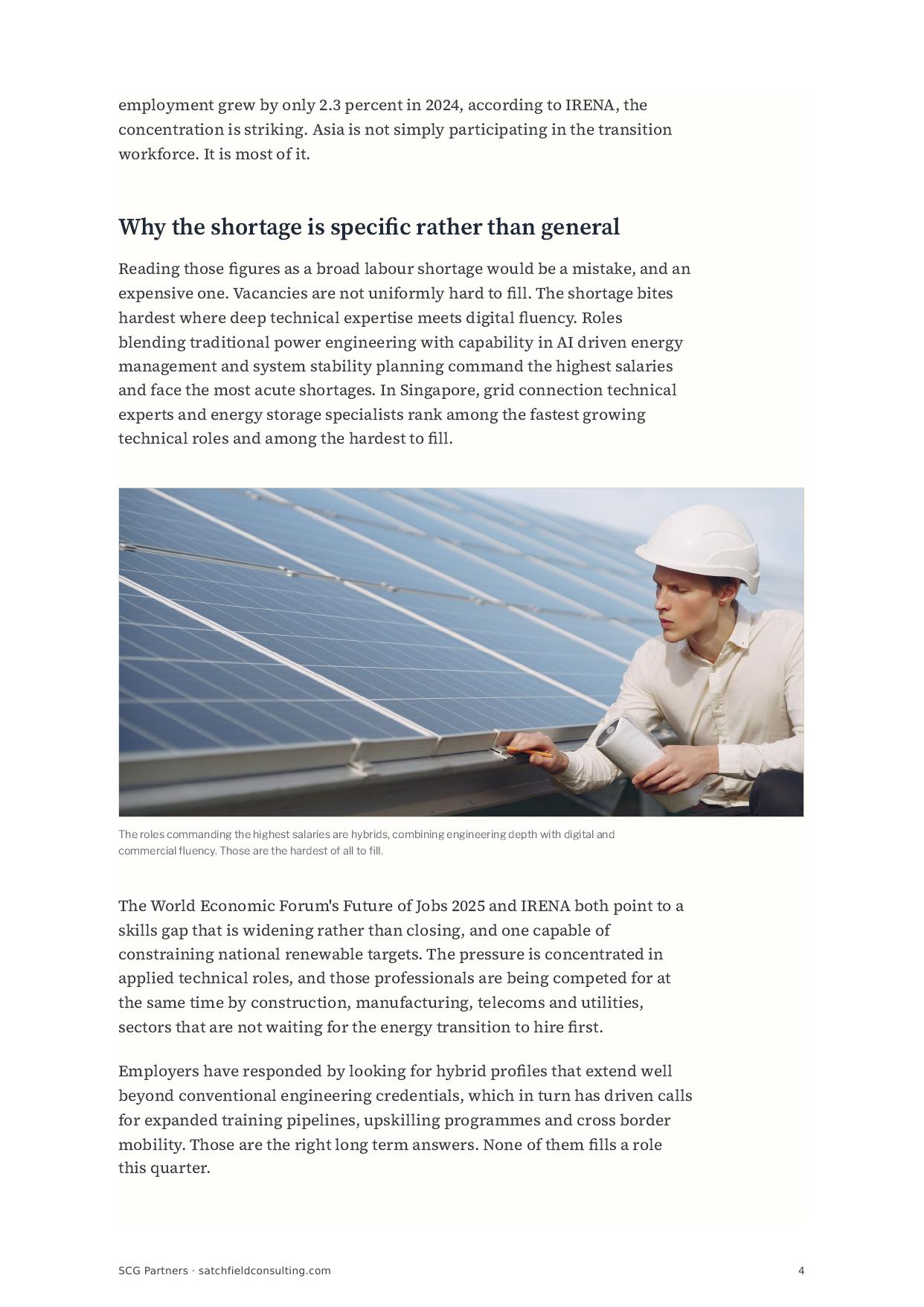
The roles commanding the highest salaries are hybrids, combining engineering depth with digital and commercial fluency. Those are the hardest of all to fill.
The World Economic Forum's Future of Jobs 2025 and IRENA both point to a skills gap that is widening rather than closing, and one capable of constraining national renewable targets. The pressure is concentrated in applied technical roles, and those professionals are being competed for at the same time by construction, manufacturing, telecoms and utilities, sectors that are not waiting for the energy transition to hire first.
Employers have responded by looking for hybrid profiles that extend well beyond conventional engineering credentials, which in turn has driven calls for expanded training pipelines, upskilling programmes and cross border mobility. Those are the right long term answers. None of them fills a role this quarter.
When qualified candidates are scarce and timelines are unforgiving, a single misjudged appointment stops being a personnel matter. It becomes a schedule risk.
The five profiles that decide delivery
For an organisation building or scaling in the region over the next twelve to eighteen months, five profiles carry disproportionate weight.
- Grid connection and power systems engineering. Moves a generation asset into a network that can actually take the output. The scarcest specialism in the region and the one most likely to delay a project.
- Energy storage systems and revenue modelling. Combines battery engineering with dispatch and market logic that is new in most Asia Pacific markets, so track record is thin by definition.
- Hydrogen systems and power to gas development. Limited regional supply. Most credible experience sits in Europe, Japan or Australia, which makes relocation and retention part of the hiring decision rather than an afterthought.
- Project and construction management. The distinction that matters is between a manager who has delivered a first of a kind build and one who has maintained an established pipeline.
- Commercial and origination leadership. Structures offtake, holds the buyer relationship, and turns a technical asset into a bankable revenue stream.
Get these right and a pipeline moves. Get one wrong and the same capital is spent more slowly, with financial close receding by quarters rather than weeks.
Rethinking how talent decisions are made
Traditional hiring leans heavily on curricula vitae, formal qualifications and interview performance. Those signals still matter. But in a sector where the most valuable people combine engineering depth with commercial and digital fluency, they rarely tell the whole story. Assessing whether someone can perform a defined role is a different exercise from understanding how they are likely to perform under pressure, inside a particular team, as a business scales.
The SCG Talent Intelligence Framework was developed to bring more structure to those decisions. It moves the central question from "Can this person do the job?" to "Will this person succeed in this role, in this market, over time?" Rather than weighing experience and qualifications alone, it considers a broader set of factors that shape long term success.
- C A P A B I L I T Y: Technical capability, commercial understanding, leadership potential, communication skills.
- EXPERIENCE: Industry experience, international exposure, project complexity, career progression.
- FIT AND GROWTH: Cultural fit and contribution to long term growth.
Which dimensions carry the most weight here
In a technical market this tight, several of these factors do more work than the rest.
Technical capability cannot be read as a single credential, because the roles commanding the highest salaries are hybrids. A power systems engineer fluent in system stability planning and data driven asset management is a materially different candidate from one who is not, and a list of qualifications will not separate them.
Commercial understanding distinguishes a storage engineer who understands how a revenue stack is assembled from one who can only specify hardware. Where the commercial framework is still forming, that difference decides whether a project is financeable.
Project complexity indicates whether someone has delivered a first of a kind asset or maintained an established one. Most of the work being hired for across Asia Pacific today is the former.
International exposure and cultural fit matter because the shortage is being met by moving people across borders. A specialist relocating from Taipei to Johor is being asked to work under an unfamiliar regulatory culture and inside a team that is often new. Capability transfers. Effectiveness does not always follow it.
Career progression deserves its own note. Where demand outruns supply, titles inflate quickly. The scope a person has genuinely carried is a more reliable signal than the label on a business card.
Titles inflate quickly when demand outruns supply. What someone has genuinely carried tells you more than what they were called.
The framework is designed to enhance professional judgement, not to replace it. It combines industry expertise, structured assessment and market knowledge, and over time it will develop into a broader Talent Intelligence Platform supporting recruitment, workforce planning, succession and leadership assessment. The underlying philosophy does not change. Technology should support better decisions, not make them. Successful organisations are built by understanding not only what people have done, but what they are capable of achieving next.
A dynamic market, and a demanding one
Asia Pacific sits at the heart of the global energy transition, not only as a manufacturing and deployment leader but as the world's most active clean energy job market. With hundreds of thousands of roles projected across storage, hydrogen, grid modernisation and project development, the opportunity for organisations that can build and scale the right teams is substantial and growing.
Realising it depends on closing the skills gap, and on the ability of employers to make sharper, better informed talent decisions under competitive pressure. The businesses that thrive will treat talent strategy as a core commercial discipline rather than an administrative afterthought. In a market where the right people are both scarce and decisive, the quality of an organisation's talent decisions may prove to be one of the defining factors in whether it leads or merely participates.