Full text
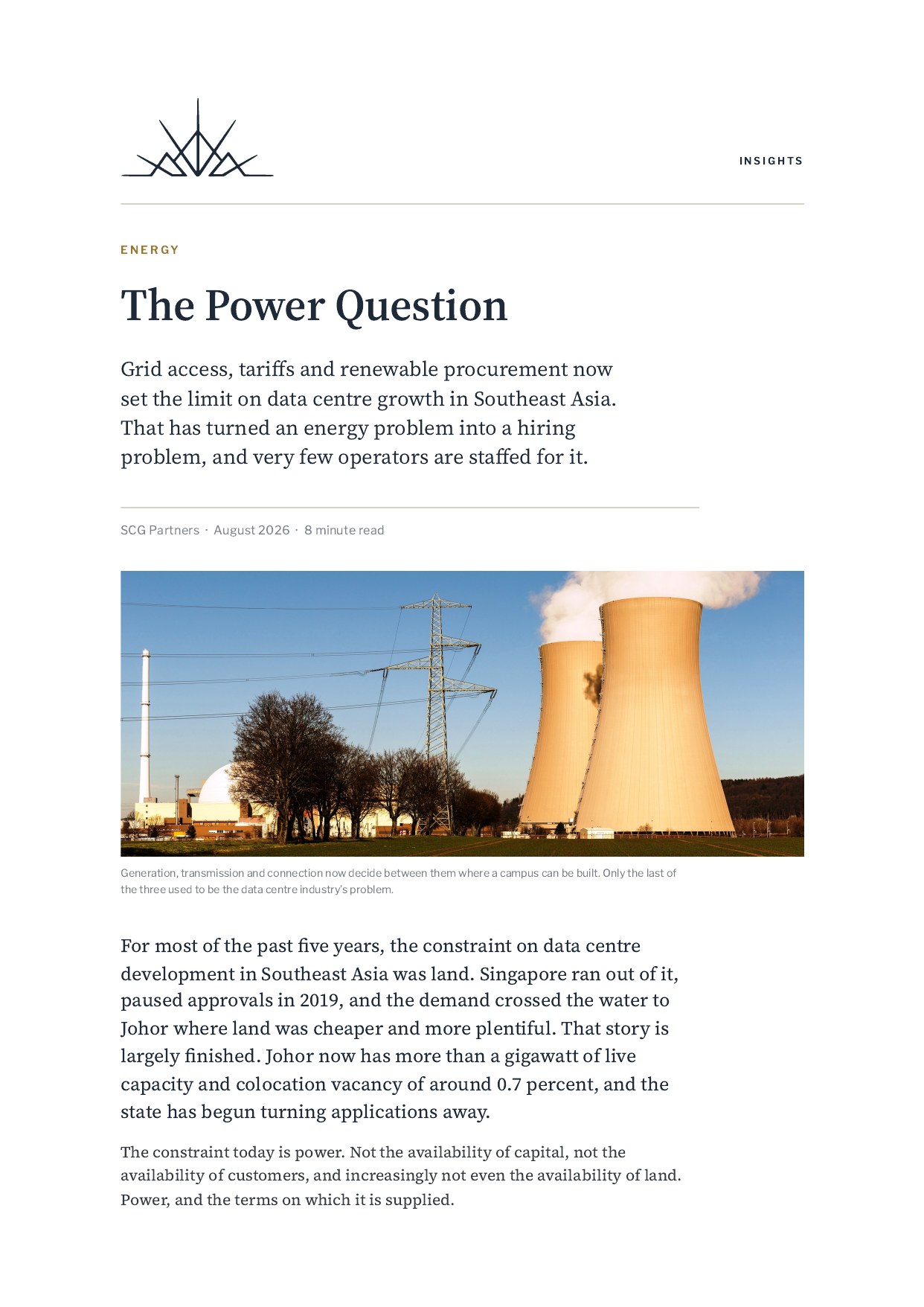
Generation, transmission and connection now decide between them where a campus can be built. Only the last of the three used to be the data centre industry’s problem.
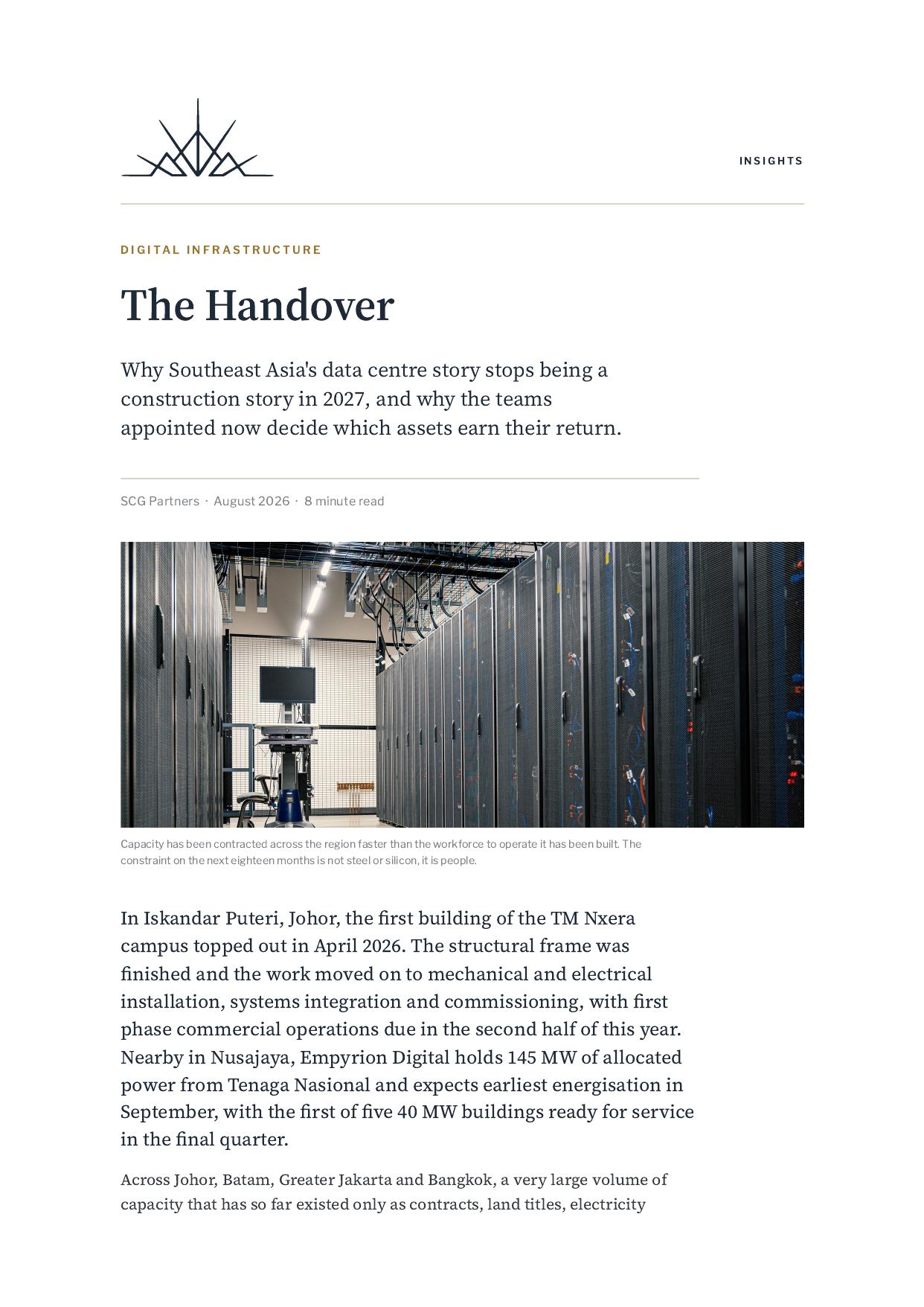
For most of the past five years, the constraint on data centre development in Southeast Asia was land. Singapore ran out of it, paused approvals in 2019, and the demand crossed the water to Johor where land was cheaper and more plentiful. That story is largely finished. Johor now has more than a gigawatt of live capacity and colocation vacancy of around 0.7 percent, and the state has begun turning applications away.
The constraint today is power. Not the availability of capital, not the availability of customers, and increasingly not even the availability of land. Power, and the terms on which it is supplied.
This is a shift with consequences that reach well beyond the engineering department, and one of them is that the sector now needs a category of professional it has never systematically recruited: people who understand electricity markets, generation, grid connection and renewable procurement, and who can apply that understanding to a building full of servers.
What the numbers say about the grid
Southeast Asia is adding data centre load to a power system that is still around 70 percent coal and gas. That single fact drives most of what follows.
Malaysia is the clearest case. Data centre electricity consumption there is projected to rise from roughly 8.5 terawatt hours in 2024 to around 68 terawatt hours by 2030, which would take the sector to something close to 30 percent of national demand. For scale, the higher of those figures is larger than Singapore's entire national consumption in 2023. Johor is expected to lose approximately 2.1 gigawatts of coal fired generation to retirement in the middle of the next decade, and reserve margins across Peninsular Malaysia are tightening in the near term. The immediate bottleneck is not generation at all but connection. Substation capacity at 132 kilovolts and suitable injection points are in short supply, which is pushing developers towards 275 kilovolt connections with substations on their own sites.
Indonesia carries a different version of the same problem. Most of its data centre capacity sits on the Java grid, which is heavily coal dependent, and that dependence has become a commercial risk rather than only an environmental one. Customers with their own emissions commitments have started to treat grid carbon intensity as a procurement criterion. Grid reliability outside Java raises separate questions for anyone considering sites beyond the main island.
Thailand is the outlier and has made the most of it. Its grid carries the lowest emissions intensity in the region at around 0.37 kilogrammes of carbon dioxide per kilowatt hour against a regional average near 0.54, achieved not through a large renewable share but because roughly two thirds of its generation is gas and only around 17 percent is coal. Bangkok's forecast growth from 122 megawatts of live capacity at the end of 2025 to more than 400 megawatts by 2027 is being supported deliberately, with the Electricity Generating Authority committing 31 billion baht to strengthen transmission in the Eastern Economic Corridor.
Singapore has taken the opposite approach and turned power into a rationing mechanism. Data centres already consume about 7 percent of national electricity, heading towards 12 percent by 2030. New capacity is allocated competitively, and applicants in the current round must achieve power usage effectiveness of at least 1.25 while sourcing a minimum of half their electricity from renewables. A proposed Digital Infrastructure Act would extend mandatory efficiency standards to existing facilities as well as new ones, which turns retrofit into a live commercial question for every operator already in the market.
The mechanisms that have appeared in the last two years
What makes this a hiring story rather than only an engineering story is that the tools for solving it are new, complicated, and different in every country.
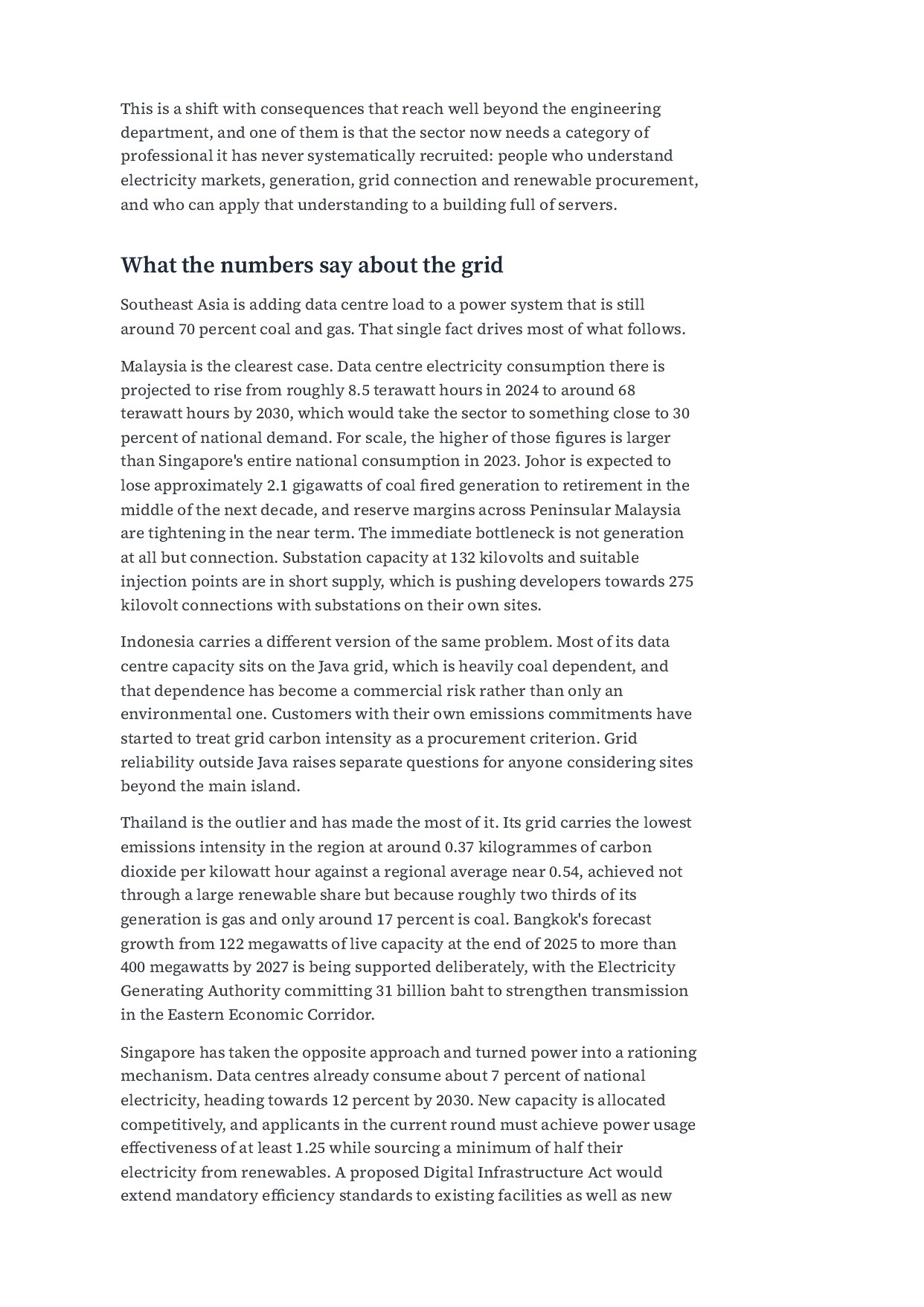
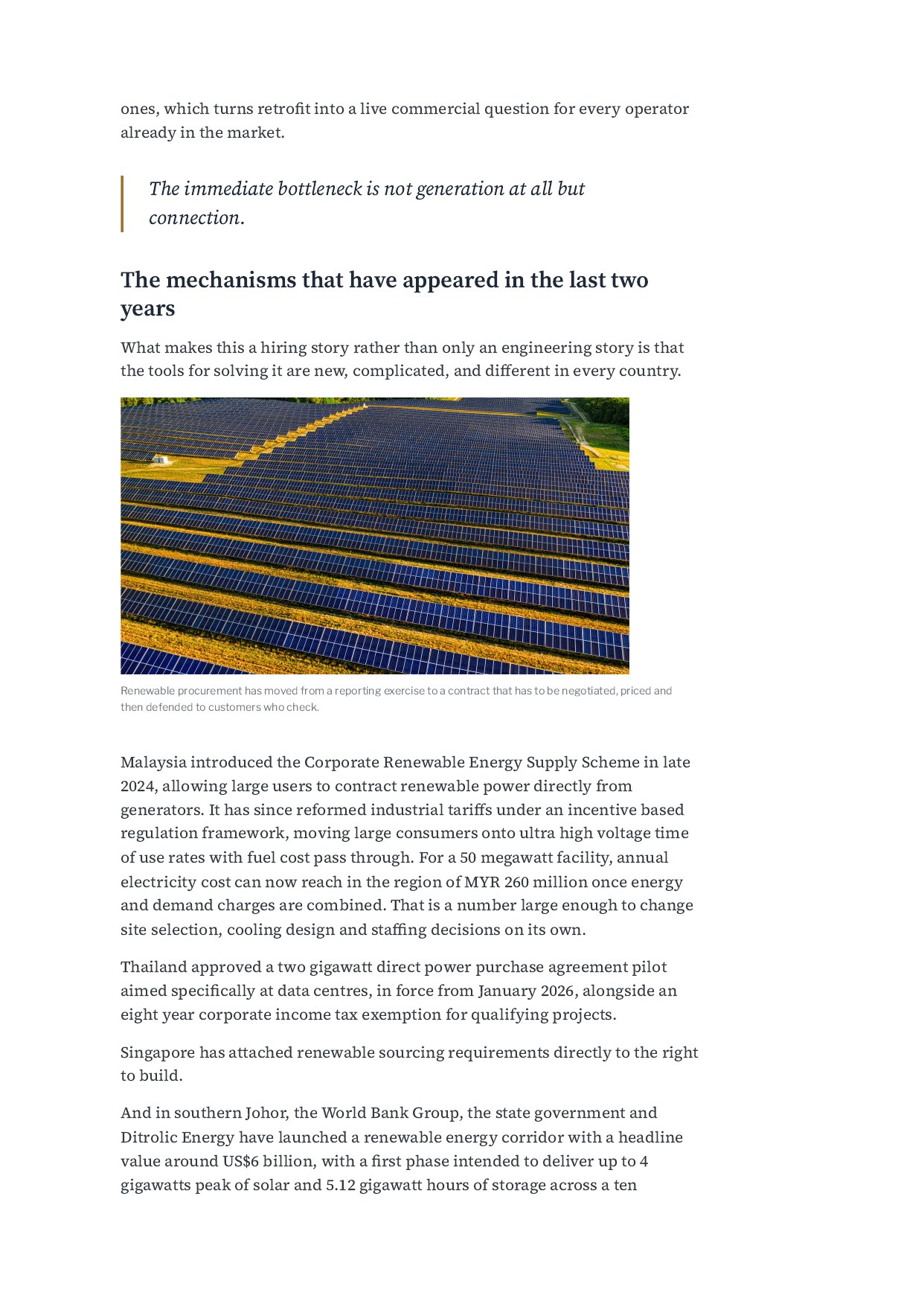
Renewable procurement has moved from a reporting exercise to a contract that has to be negotiated, priced and then defended to customers who check.
Malaysia introduced the Corporate Renewable Energy Supply Scheme in late 2024, allowing large users to contract renewable power directly from generators. It has since reformed industrial tariffs under an incentive based regulation framework, moving large consumers onto ultra high voltage time of use rates with fuel cost pass through. For a 50 megawatt facility, annual electricity cost can now reach in the region of MYR 260 million once energy and demand charges are combined. That is a number large enough to change site selection, cooling design and staffing decisions on its own.
Thailand approved a two gigawatt direct power purchase agreement pilot aimed specifically at data centres, in force from January 2026, alongside an eight year corporate income tax exemption for qualifying projects.
Singapore has attached renewable sourcing requirements directly to the right to build.
And in southern Johor, the World Bank Group, the state government and Ditrolic Energy have launched a renewable energy corridor with a headline value around US$6 billion, with a first phase intended to deliver up to 4 gigawatts peak of solar and 5.12 gigawatt hours of storage across a ten thousand acre site, explicitly aimed at industrial and data centre demand and at future cross border trade under the ASEAN Power Grid.
Set those side by side and the picture is clear enough. An operator building across three countries now has to structure power procurement three different ways, under three regulatory regimes, with three different sets of counterparties, and defend the result to customers who are checking.
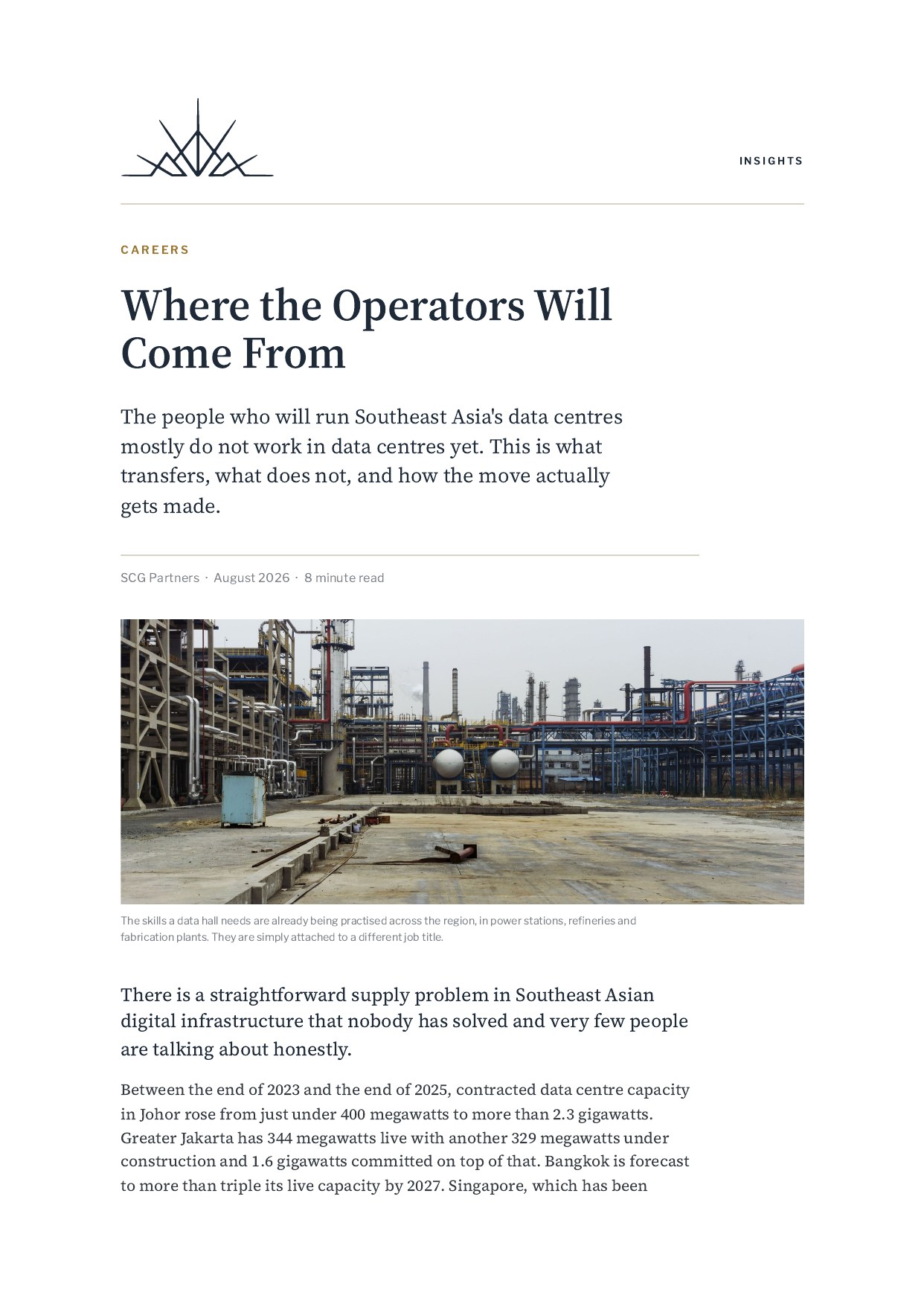
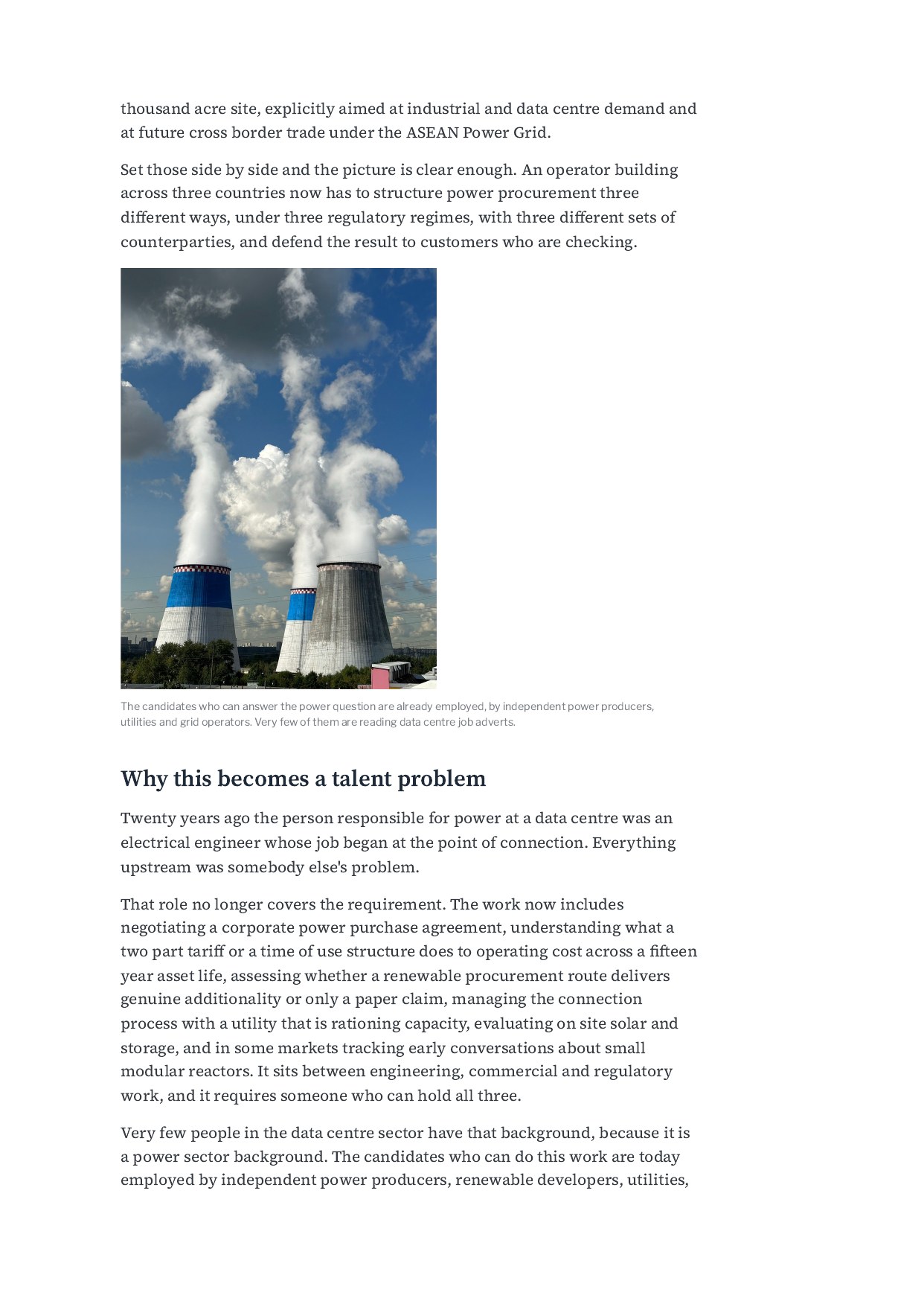
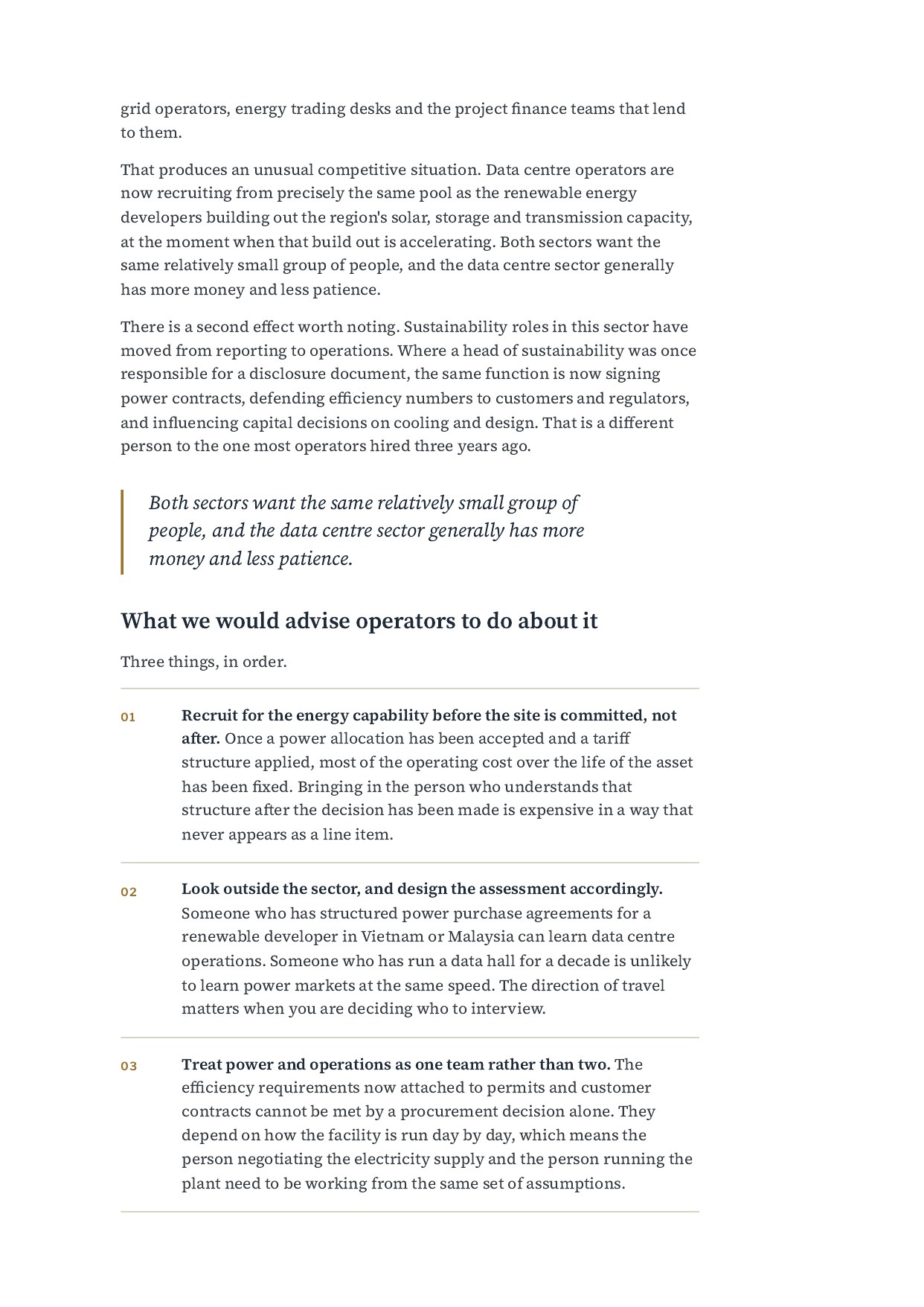
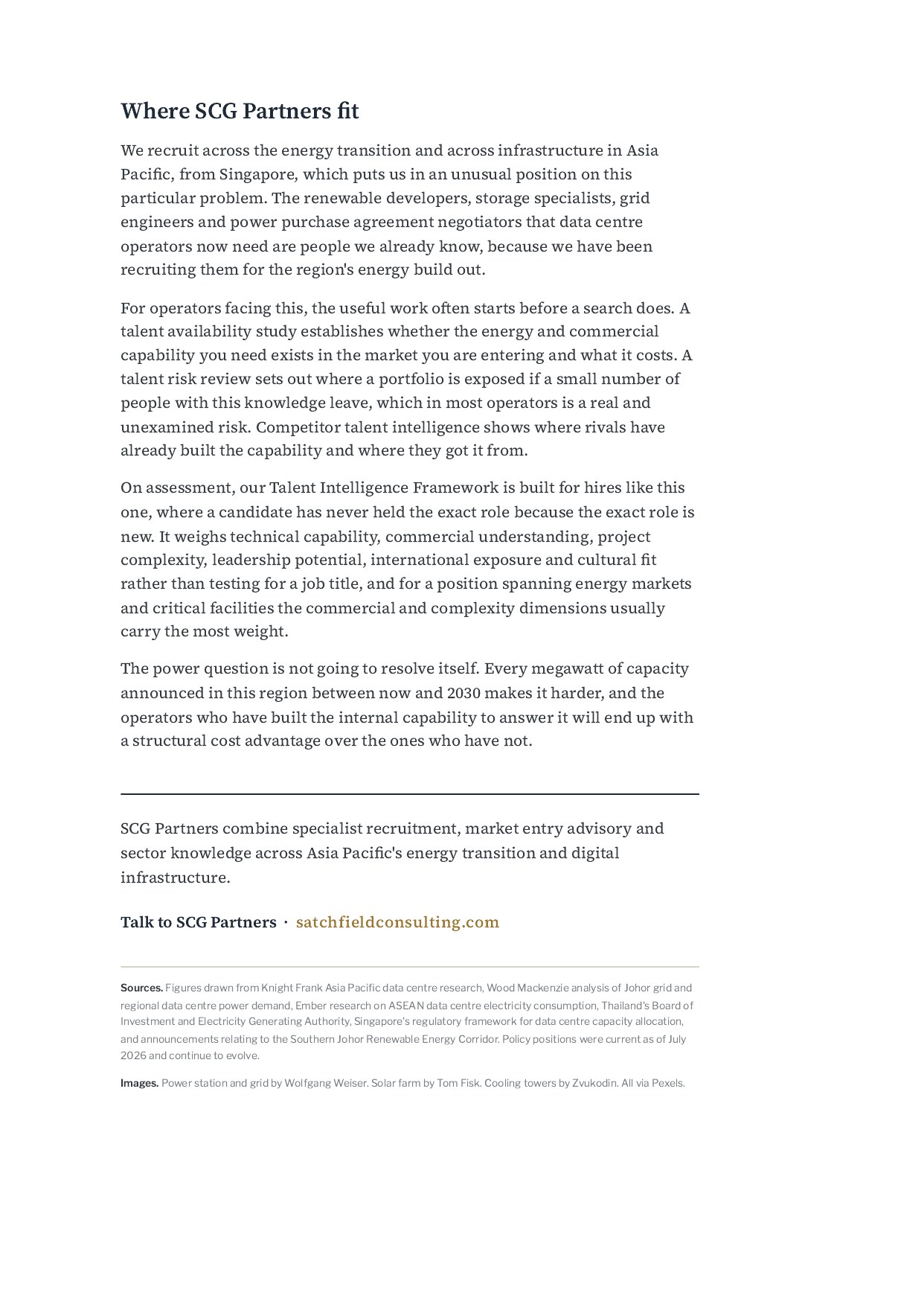
The candidates who can answer the power question are already employed, by independent power producers, utilities and grid operators. Very few of them are reading data centre job adverts.
Why this becomes a talent problem
Twenty years ago the person responsible for power at a data centre was an electrical engineer whose job began at the point of connection. Everything upstream was somebody else's problem.
That role no longer covers the requirement. The work now includes negotiating a corporate power purchase agreement, understanding what a two part tariff or a time of use structure does to operating cost across a fifteen year asset life, assessing whether a renewable procurement route delivers genuine additionality or only a paper claim, managing the connection process with a utility that is rationing capacity, evaluating on site solar and storage, and in some markets tracking early conversations about small modular reactors. It sits between engineering, commercial and regulatory work, and it requires someone who can hold all three.
Very few people in the data centre sector have that background, because it is a power sector background. The candidates who can do this work are today employed by independent power producers, renewable developers, utilities, grid operators, energy trading desks and the project finance teams that lend to them.
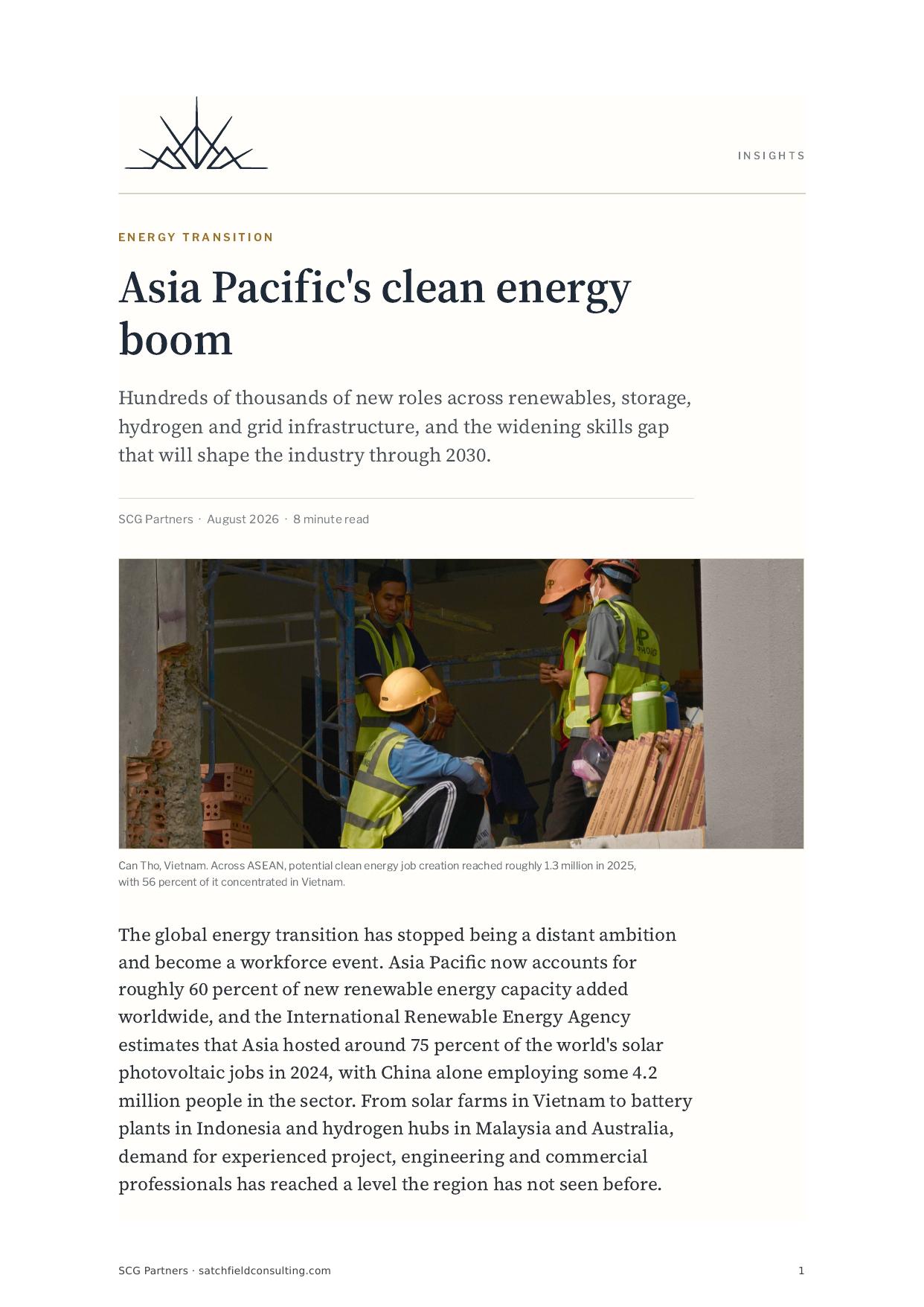
That produces an unusual competitive situation. Data centre operators are now recruiting from precisely the same pool as the renewable energy developers building out the region's solar, storage and transmission capacity, at the moment when that build out is accelerating. Both sectors want the same relatively small group of people, and the data centre sector generally has more money and less patience.
There is a second effect worth noting. Sustainability roles in this sector have moved from reporting to operations. Where a head of sustainability was once responsible for a disclosure document, the same function is now signing power contracts, defending efficiency numbers to customers and regulators, and influencing capital decisions on cooling and design. That is a different person to the one most operators hired three years ago.
What we would advise operators to do about it
Three things, in order.
- Recruit for the energy capability before the site is committed, not after. Once a power allocation has been accepted and a tariff structure applied, most of the operating cost over the life of the asset has been fixed. Bringing in the person who understands that structure after the decision has been made is expensive in a way that never appears as a line item.
- Look outside the sector, and design the assessment accordingly. Someone who has structured power purchase agreements for a renewable developer in Vietnam or Malaysia can learn data centre operations. Someone who has run a data hall for a decade is unlikely to learn power markets at the same speed. The direction of travel matters when you are deciding who to interview.
- Treat power and operations as one team rather than two. The efficiency requirements now attached to permits and customer contracts cannot be met by a procurement decision alone. They depend on how the facility is run day by day, which means the person negotiating the electricity supply and the person running the plant need to be working from the same set of assumptions.
Where SCG Partners fit
We recruit across the energy transition and across infrastructure in Asia Pacific, from Singapore, which puts us in an unusual position on this particular problem. The renewable developers, storage specialists, grid engineers and power purchase agreement negotiators that data centre operators now need are people we already know, because we have been recruiting them for the region's energy build out.
For operators facing this, the useful work often starts before a search does. A talent availability study establishes whether the energy and commercial capability you need exists in the market you are entering and what it costs. A talent risk review sets out where a portfolio is exposed if a small number of people with this knowledge leave, which in most operators is a real and unexamined risk. Competitor talent intelligence shows where rivals have already built the capability and where they got it from.
On assessment, our Talent Intelligence Framework is built for hires like this one, where a candidate has never held the exact role because the exact role is new. It weighs technical capability, commercial understanding, project complexity, leadership potential, international exposure and cultural fit rather than testing for a job title, and for a position spanning energy markets and critical facilities the commercial and complexity dimensions usually carry the most weight.
The power question is not going to resolve itself. Every megawatt of capacity announced in this region between now and 2030 makes it harder, and the operators who have built the internal capability to answer it will end up with a structural cost advantage over the ones who have not.