Full text
A demand of this size and this credit quality has never appeared in these power markets before. That is what makes the rest of it financeable.
For three years the conversation about data centres in Southeast Asia has run in one direction. The buildings arrive, they consume enormous quantities of electricity, the grid struggles, governments worry, and everyone asks how the region is going to power them.
That framing is not wrong. It is just the smaller half of the story, and it has caused most people to miss what is actually happening.
Something has changed in the last eighteen months. Data centres have become the first large scale, concentrated, creditworthy electricity demand this region has ever had. That is a very unusual thing to appear in a power market, and it makes possible a set of investments that could not previously be financed. The interesting question is no longer whether Southeast Asia can power its data centres. It is what else gets built because the data centres arrived.
This paper sets out why we think that is true. Part Two, which follows, sets out the business opportunity, the competition, where the money is going and what any of it requires in terms of people.
The constraint everybody agrees on
Start with the problem, because it is real and it is the reason the opportunity exists.
Bain and Standard Chartered put incremental data centre electricity demand across Southeast Asia at roughly 35 to 45 terawatt hours by 2030, concentrated in six places: Singapore, Johor, Bangkok, Greater Jakarta, Manila and Batam. Wood Mackenzie has more than 10 gigawatts of new data centre load arriving across the region between 2025 and 2035. RMI expects regional demand to quadruple by 2035.
What makes that load different from anything the region has absorbed before is not its size but its shape. It arrives in discrete blocks of 100 to 500 megawatts, it wants very high reliability, and it wants it quickly. A data centre campus can go from planning to commissioning in one to three years. The transmission reinforcement required to serve it takes five to fifteen. In a Bain survey of regional and global operators, 90 percent named grid connection delays as a top constraint and 70 percent named transmission capacity limits. The grid has not been keeping up, and it has not been keeping up for a while. Investment in transmission and distribution across the region fell by about 3 percent between 2015 and 2025 while electricity demand grew at roughly 5 percent a year. The International Energy Agency puts the required grid investment at more than US$300 billion between 2025 and 2040, a 72 percent increase on what was spent in the previous fifteen years, with a further US$27 billion needed for cross border interconnection under the ASEAN Power Grid. To put that in perspective, only around US$2 billion has been invested in cross border interconnectors in the entire fifty year history of the idea. The region spent more on transmission in 2024 alone than on interconnectors since the 1970s.
The result is a conversion problem rather than a capital problem. Roughly US$540 billion has been announced across Southeast Asia’s power and electric vehicle value chains. Bain estimates a 35 percent gap between what has been announced and what will actually be deployed under current conditions, with the largest shortfall, somewhere near US$210 billion, sitting in power and grid infrastructure. The money exists. The projects that would absorb it do not get to financial close.
What changed
Renewable energy projects in this region have always struggled with the same thing: who is going to sign a fifteen or twenty year contract to buy the output at a price a lender will accept.
State utilities buy, but slowly, on their own terms, and often with structures that leave developers waiting. Industrial buyers are numerous but small and individually unbankable. This is the reason so much announced renewable capacity in Southeast Asia never leaves the page.
Data centres change that arithmetic completely. A hyperscale operator is one of the most creditworthy counterparties in the world, it wants an enormous quantity of electricity in one place, it wants it for a very long time, and it has both the balance sheet and the corporate emissions commitments to pay a premium for it to be clean. That is precisely the offtake profile that renewable developers, storage developers and even transmission projects have never been able to find here.
Governments have worked this out and moved faster than most people realise.
Thailand approved a direct power purchase scheme aimed at data centres with a two gigawatt allocation, effective from January 2026. By July the National Energy Policy Council had extended direct purchase through third party access beyond data centres to industrial users generally, and created a separate electricity tariff category for data centres. In August the two gigawatt cap came off altogether. In the space of eight months, a pilot designed for one industry became the opening of a national clean power market.
Vietnam introduced its direct power purchase mechanism under Decree 80 of 2024, offering both a physical direct wire model and a synthetic contract for difference settled against the wholesale market. Malaysia introduced its corporate renewable supply scheme in late 2024. Singapore attached the requirement directly to the right to build, with its second capacity allocation exercise demanding power usage effectiveness below 1.25 and at least half of electricity from approved renewable sources.
None of that happened because governments suddenly became more ambitious about renewables. It happened because a buyer turned up.
Direct power purchase for data centres, two gigawatt allocation Effective January 2026, extended to industrial users in July, cap removed in August Vietnam Direct power purchase under Decree 80 of 2024 Physical direct wire, or a synthetic contract settled against the wholesale market Malaysia Corporate renewable supply scheme Introduced in late 2024 Singapore Conditions attached to the right to build Power usage effectiveness below 1.25 and half of electricity from approved renewable sources The part almost nobody has priced If that were the whole story it would be interesting enough. It is not. The second shift is more technical, more recent and considerably more valuable. It concerns what happens when you stop assuming a data centre must draw a flat, uninterrupted load every hour of the year. Everyone in the industry has treated that assumption as a law of physics. It turns out to be a habit.
RMI published modelling of Peninsular Malaysia at the start of this month that puts numbers on it. If the roughly five gigawatts of data centre load expected in Peninsular Malaysia by 2030 is treated as a firm, unvarying demand, the system will need to build around three gigawatts of new combined cycle gas capacity alongside two gigawatts of solar. That is a lot of new gas, on long take or pay contracts with fuel cost pass through, in a country that is phasing out roughly seven gigawatts of coal between 2029 and 2035 and that risks becoming a net importer of liquefied natural gas. Now allow those data centres to shift some load. Not much, and not often. RMI modelled shifting during about 600 hours of the year, which is under 7 percent of the time. The result is up to 800 megawatts of gas investment deferred, an additional 4.6 gigawatts of solar capacity integrated, more than 5 terawatt hours of extra solar generation entering the grid, and around US$90 million of system cost saved in 2030 alone. Expressed as a ratio, every megawatt of data centre load that can shift brings in nearly a megawatt of additional solar.
None of that happened because governments suddenly became more ambitious about renewables. It happened because a buyer turned up.
Read that again, because it inverts the entire public argument about data centres. Under the flat load assumption, a data centre forces a country to build gas. Under a flexible load assumption, the same data centre pulls solar onto the system that would otherwise have been curtailed or never built at all.
The obvious objection is that this is theory. It is not. Google has contracted a cumulative gigawatt of demand response capacity into its utility agreements as of March this year. Emerald AI ran a live cluster through 22 dispatch events over five days, cutting power by 30 percent in under 40 seconds and sustaining reductions of 10 to 40 percent for two to ten hours, while delivering 99 percent performance on its highest priority workloads. A joint study by Princeton, Camus and encoord found that applying conditional service to 20 percent of a 500 megawatt facility avoided 273 megawatts of new capacity and US$78 million of system supply cost.
The reason operators will do this is not virtue. It is speed. A three to five year wait for a firm grid connection destroys project economics, because revenue is deferred while capital sits idle and interest accrues. Regulators in several markets are now offering faster connection in exchange for flexible operation, and a fast interruptible connection is worth considerably more to a developer than a perfect one that arrives in 2032. Speed to power is the currency, and flexibility is what buys it.
And then the batteries
The third shift follows directly from the second, and it is where the physical investment shows up.
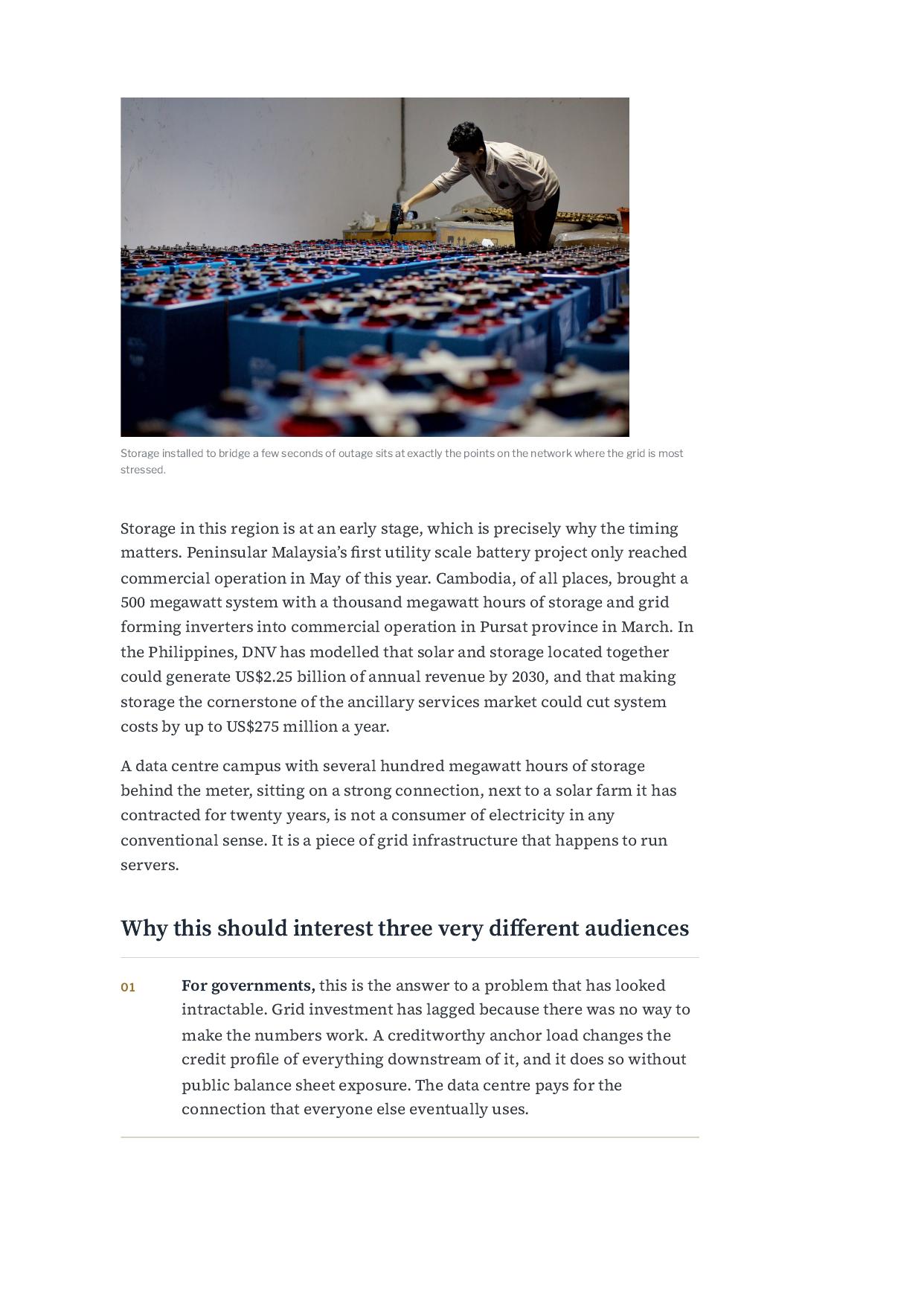
Batteries inside data centres have historically been dumb assets. They sit there, they bridge the gap between a grid failure and a generator starting, and they earn nothing for their entire life. That is beginning to look like a waste of a very large amount of installed capacity sitting at exactly the points on the network where the grid is most stressed.
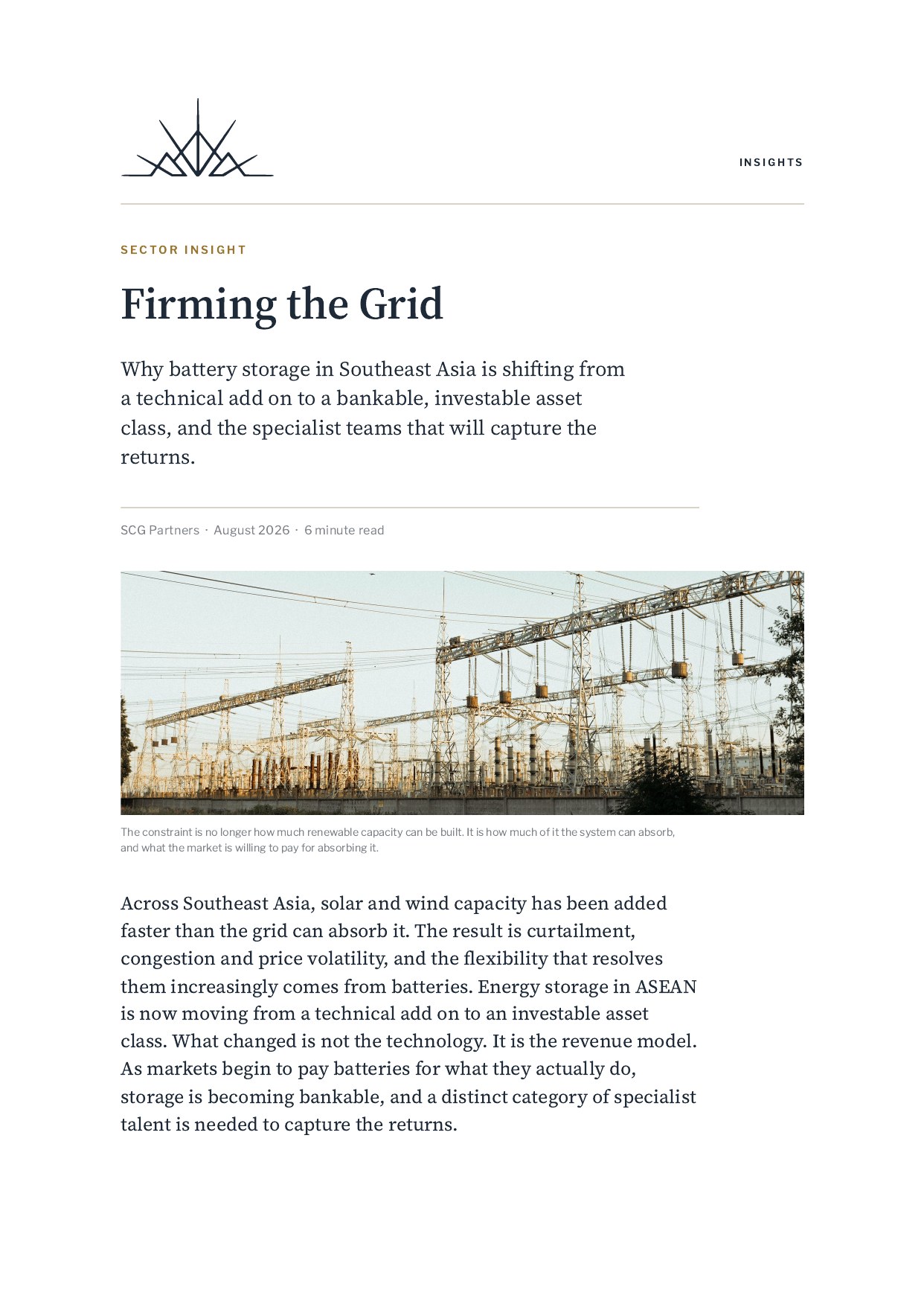
Storage installed to bridge a few seconds of outage sits at exactly the points on the network where the grid is most stressed.
Storage in this region is at an early stage, which is precisely why the timing matters. Peninsular Malaysia’s first utility scale battery project only reached commercial operation in May of this year. Cambodia, of all places, brought a 500 megawatt system with a thousand megawatt hours of storage and grid forming inverters into commercial operation in Pursat province in March. In the Philippines, DNV has modelled that solar and storage located together could generate US$2.25 billion of annual revenue by 2030, and that making storage the cornerstone of the ancillary services market could cut system costs by up to US$275 million a year.
A data centre campus with several hundred megawatt hours of storage behind the meter, sitting on a strong connection, next to a solar farm it has contracted for twenty years, is not a consumer of electricity in any conventional sense. It is a piece of grid infrastructure that happens to run servers.
Why this should interest three very different audiences For governments, this is the answer to a problem that has looked intractable. Grid investment has lagged because there was no way to make the numbers work. A creditworthy anchor load changes the credit profile of everything downstream of it, and it does so without public balance sheet exposure. The data centre pays for the connection that everyone else eventually uses.
For investors, the returns are moving down the value chain. Building data centres is now a crowded, well capitalised business dominated by very large infrastructure funds. The interesting margins are increasingly in what sits underneath them: the land with a power connection attached, the generation contracted against the load, the storage that makes the connection possible, and the operating platform that assembles all three. That is a different risk profile, a different time horizon and, at the moment, considerably less competition.
For engineers, and we say this as recruiters, this is the most interesting technical work available in this region right now. It is genuinely new. Nobody has run a gigawatt scale flexible load against a tropical grid with a high solar share and a thin storage market. The people who figure out how to do it will spend the next fifteen years doing work that did not exist when they started their careers, in a part of the world where the outcome actually matters to the electricity supply of several hundred million people.
What Part Two covers
There is a further step, and it is the one we find most interesting. If a data centre can anchor a solar farm, and anchor a battery, and pull forward a grid connection, then the question becomes what else can be anchored alongside it. A large industrial load with a long contract and a serious appetite for firm renewable power is exactly the customer that dispatchable biomass and waste derived energy have never been able to find. Indonesia alone is currently procuring thirty waste to energy projects covering sixty one districts and cities. Malaysia has several hundred megawatts of unexploited generation potential sitting in palm oil mill effluent. These have always been marginal projects looking for an offtaker. They are no longer looking.
Part Two sets out the full opportunity: four connected blocks of investment, who is already building them and who is not, what the capital structures look like, roughly what a platform of this kind would cost to assemble, and the part that most position papers leave out, which is who on earth is going to run it.
Because the constraint on all of this, in the end, is not capital, and it is not technology. Both are available. The constraint is a very small number of people who understand power markets, digital infrastructure, waste and finance well enough to hold them in one structure. There are not many of them in Southeast Asia. We know, because finding them is our job. Part Two follows.
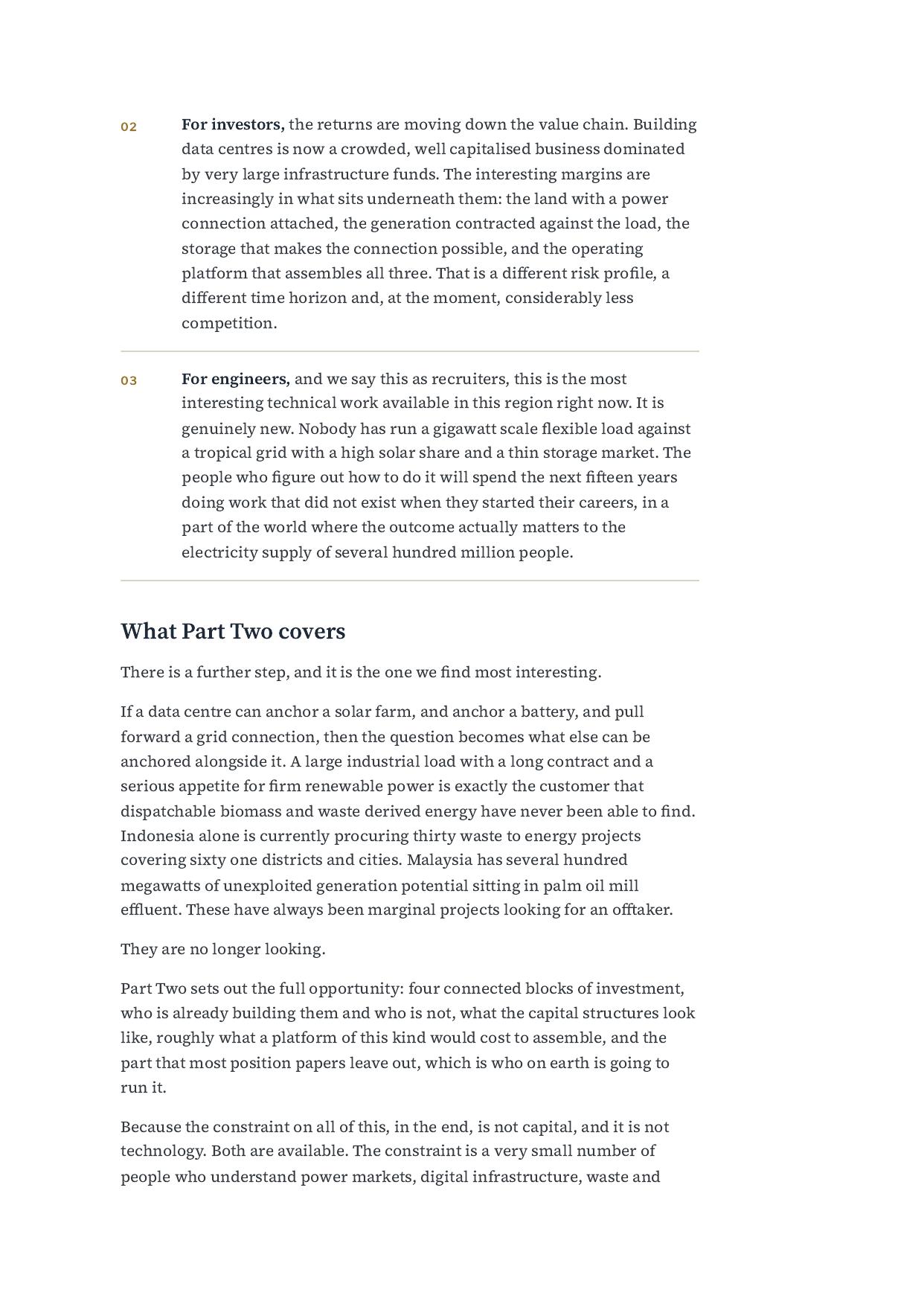
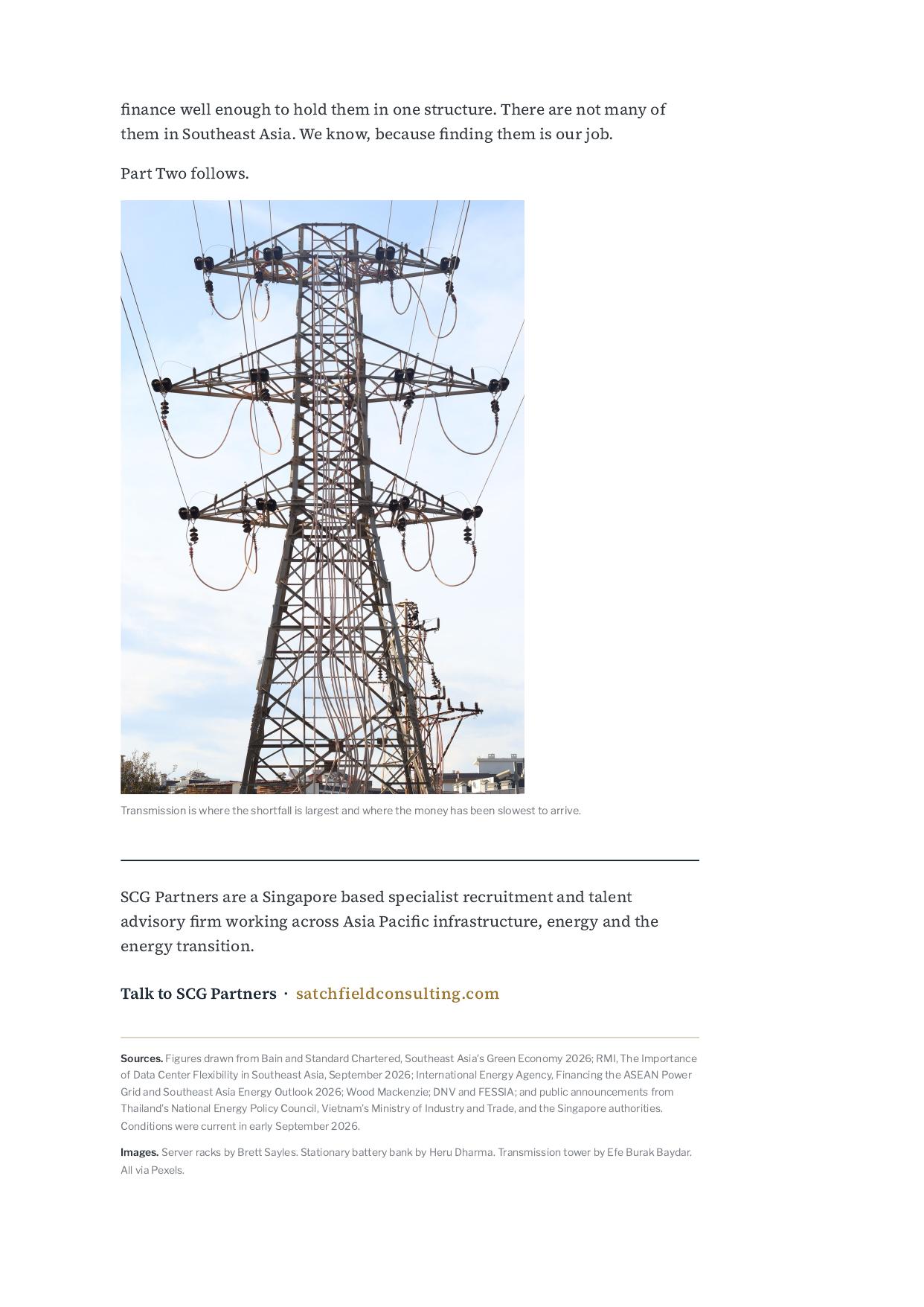
Transmission is where the shortfall is largest and where the money has been slowest to arrive.
SCG Partners are a Singapore based specialist recruitment and talent advisory firm working across Asia Pacific infrastructure, energy and the energy transition.