Full text
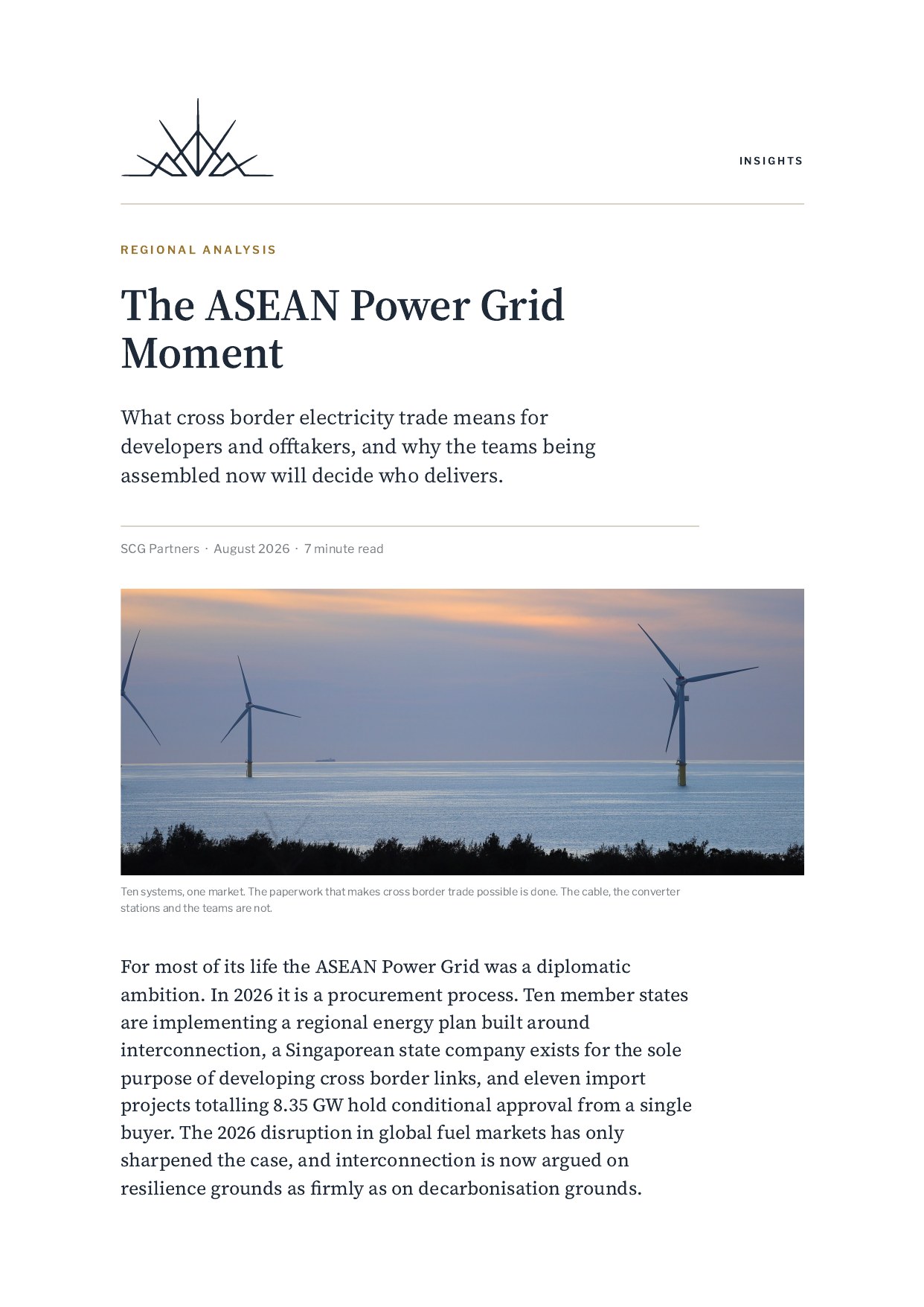
Ten systems, one market. The paperwork that makes cross border trade possible is done. The cable, the converter stations and the teams are not.
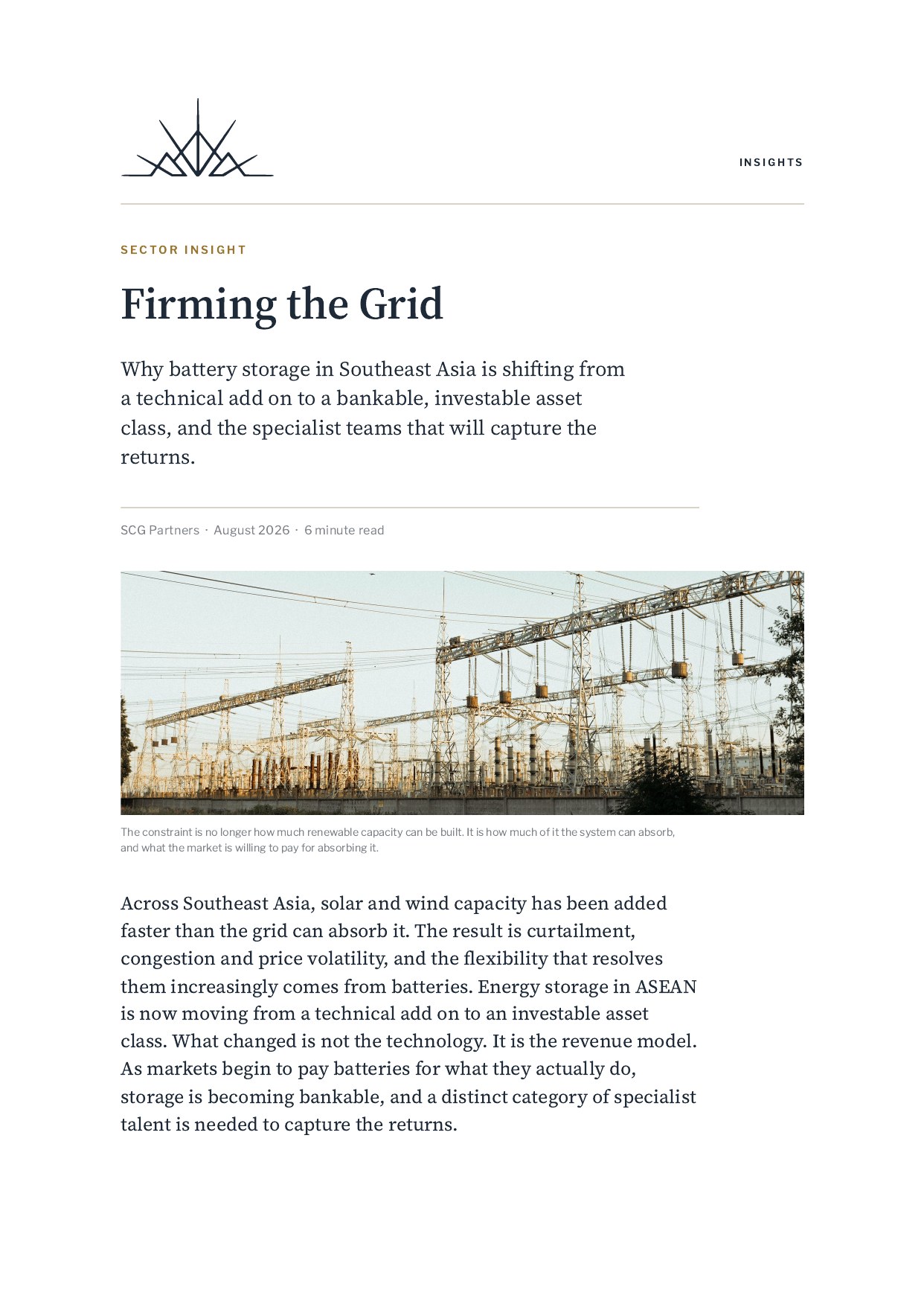
For most of its life the ASEAN Power Grid was a diplomatic ambition. In 2026 it is a procurement process. Ten member states are implementing a regional energy plan built around interconnection, a Singaporean state company exists for the sole purpose of developing cross border links, and eleven import projects totalling 8.35 GW hold conditional approval from a single buyer. The 2026 disruption in global fuel markets has only sharpened the case, and interconnection is now argued on resilience grounds as firmly as on decarbonisation grounds.
Electricity is being contracted across borders, and the commercial rules that follow are not the ones most developers are used to.
From communiqué to contract
The regional grid has existed as a concept since the late 1990s. What changed over the last eighteen months is institutional rather than technical. At the 43rd ASEAN Ministers on Energy Meeting in October 2025, member states signed an enhanced memorandum of understanding on the grid, adopted terms of reference for the bodies that will govern it, and endorsed a framework for subsea power cable development, setting a path towards full regional interconnection by 2045. The regional energy plan now in force, the ASEAN Plan of Action for Energy Cooperation (APAEC) 2026 to 2030, concentrates on the unglamorous work that actually enables trade: institutional frameworks, regulatory capacity and the alignment of technical requirements across ten different systems.
Capital followed the paperwork. In the same month the World Bank and the Asian Development Bank launched the ASEAN Power Grid Financing Initiative, which funds project preparation, feasibility work and regulatory analysis against an estimated USD 800 billion of generation and transmission investment needed by 2045. The International Energy Agency (IEA) puts the interconnection pipeline alone at roughly USD 27 billion to 2040.
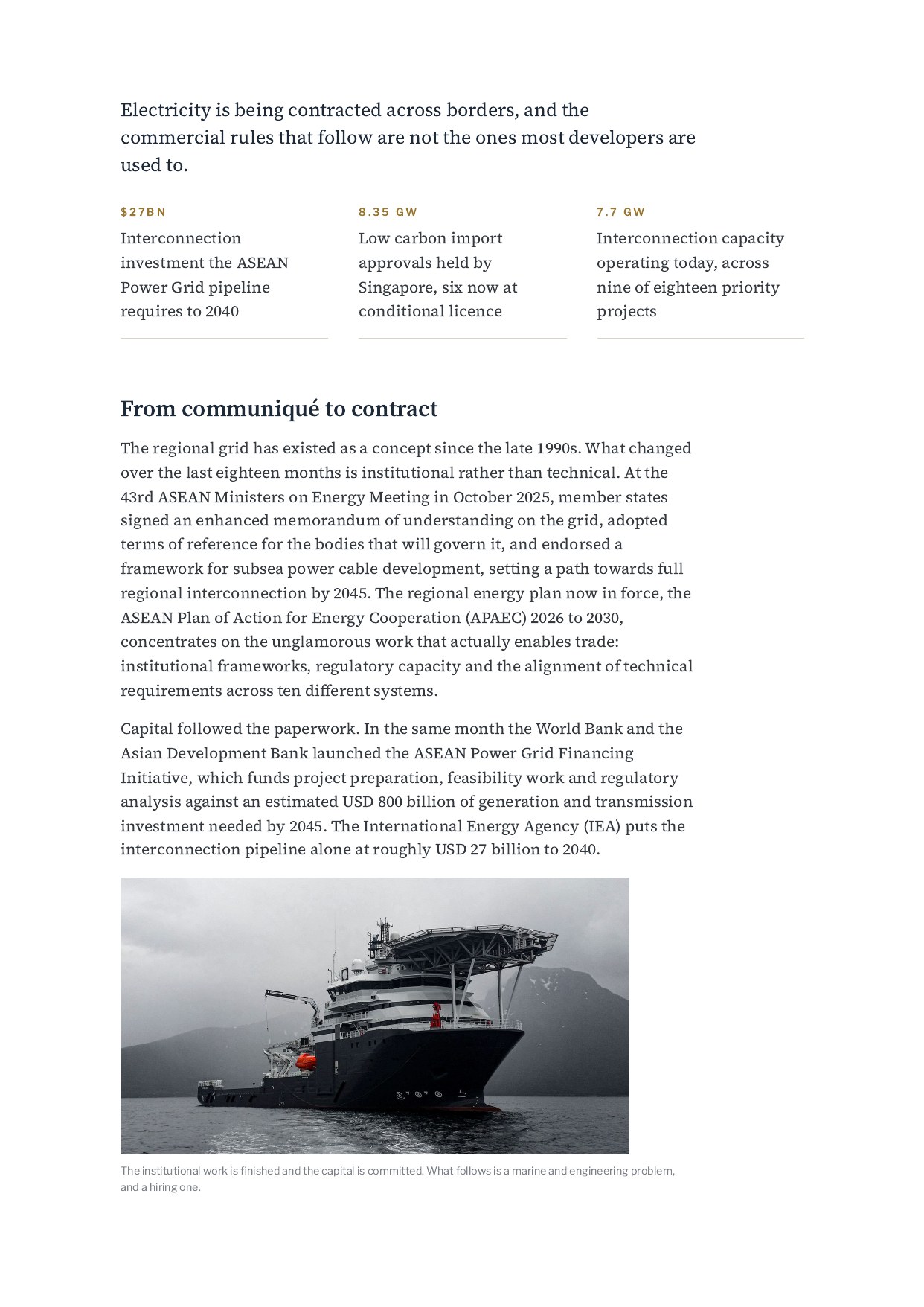
The institutional work is finished and the capital is committed. What follows is a marine and engineering problem, and a hiring one.
Where the power is actually moving
Cross border trade in ASEAN today is not one grid. It is a small number of corridors at very different stages of maturity, and each carries a different commercial logic.
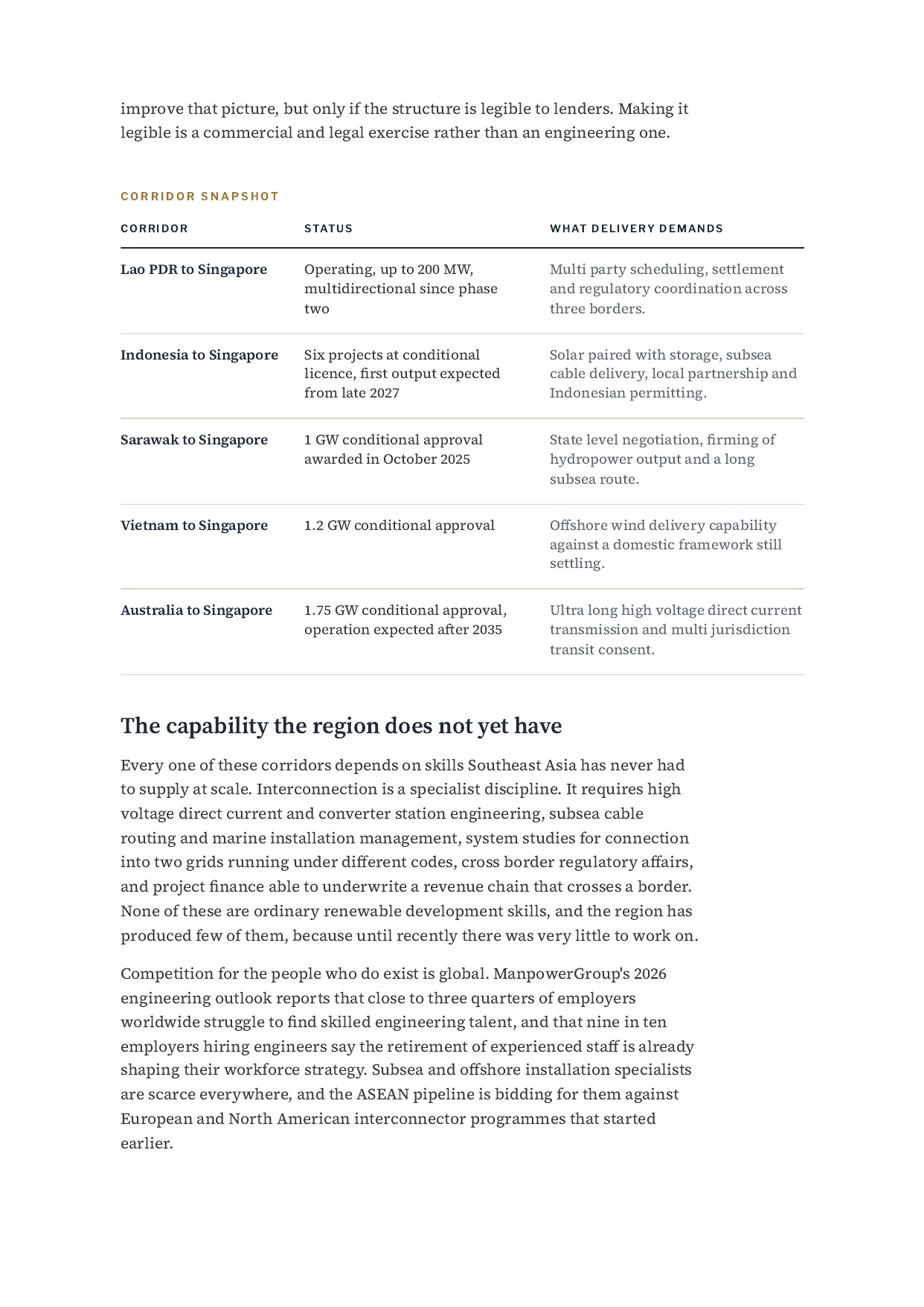
The Lao PDR, Thailand, Malaysia and Singapore Power Integration Project is the only multilateral arrangement currently delivering power. Launched in 2022, its second phase doubled traded volumes to a maximum of 200 MW and introduced multidirectional flow with additional supply from Malaysia. The volumes are small. The precedent is not. It showed that four regulators can agree scheduling, settlement and commercial terms across three borders, which is the harder half of the problem.
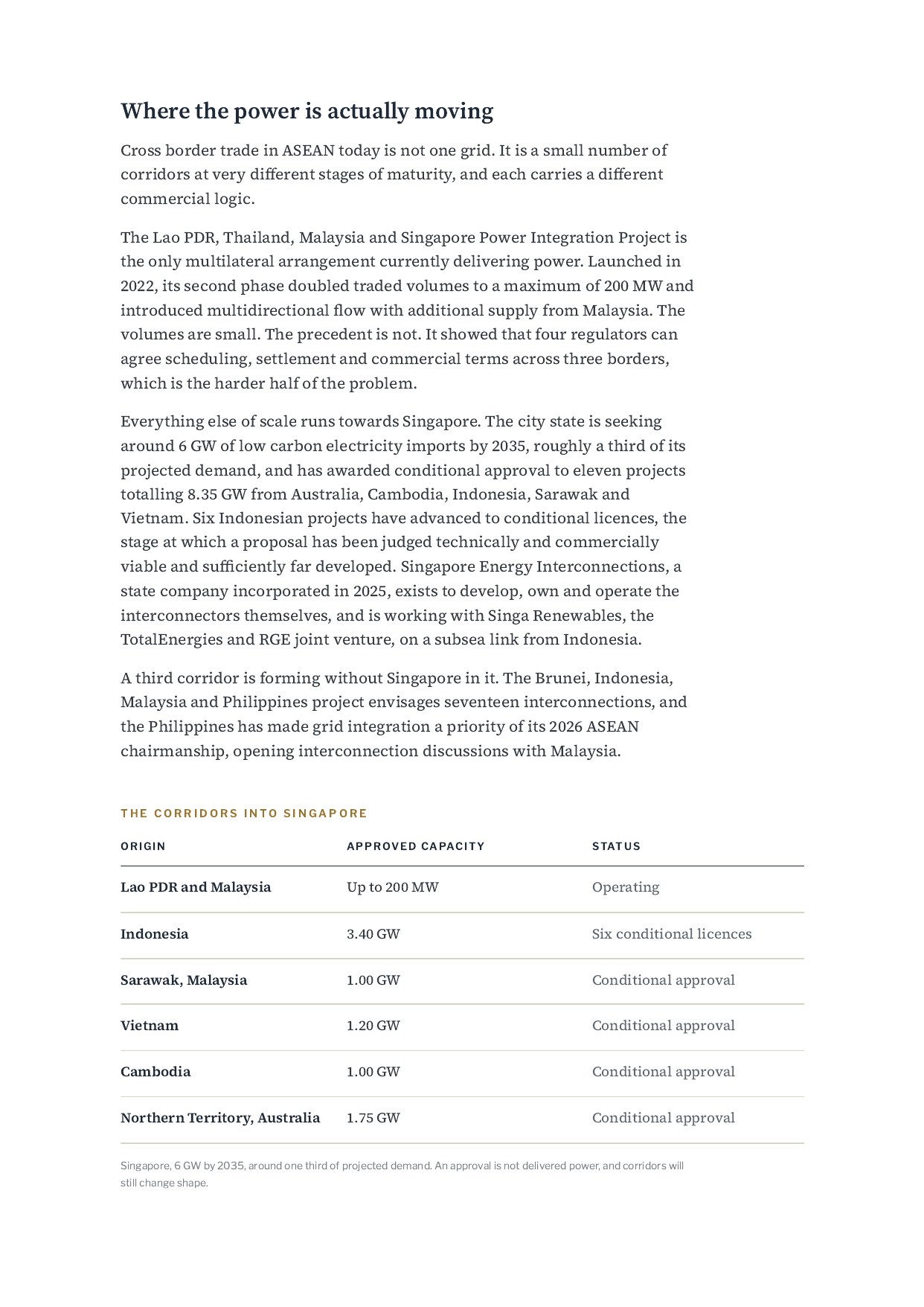
Everything else of scale runs towards Singapore. The city state is seeking around 6 GW of low carbon electricity imports by 2035, roughly a third of its projected demand, and has awarded conditional approval to eleven projects totalling 8.35 GW from Australia, Cambodia, Indonesia, Sarawak and Vietnam. Six Indonesian projects have advanced to conditional licences, the stage at which a proposal has been judged technically and commercially viable and sufficiently far developed. Singapore Energy Interconnections, a state company incorporated in 2025, exists to develop, own and operate the interconnectors themselves, and is working with Singa Renewables, the TotalEnergies and RGE joint venture, on a subsea link from Indonesia.
A third corridor is forming without Singapore in it. The Brunei, Indonesia, Malaysia and Philippines project envisages seventeen interconnections, and the Philippines has made grid integration a priority of its 2026 ASEAN chairmanship, opening interconnection discussions with Malaysia.
Singapore, 6 GW by 2035, around one third of projected demand. An approval is not delivered power, and corridors will still change shape.
What changes for developers and offtakers
A cross border project is not a domestic project with a longer cable attached. Three things change, and each lands on a different part of the organisation.
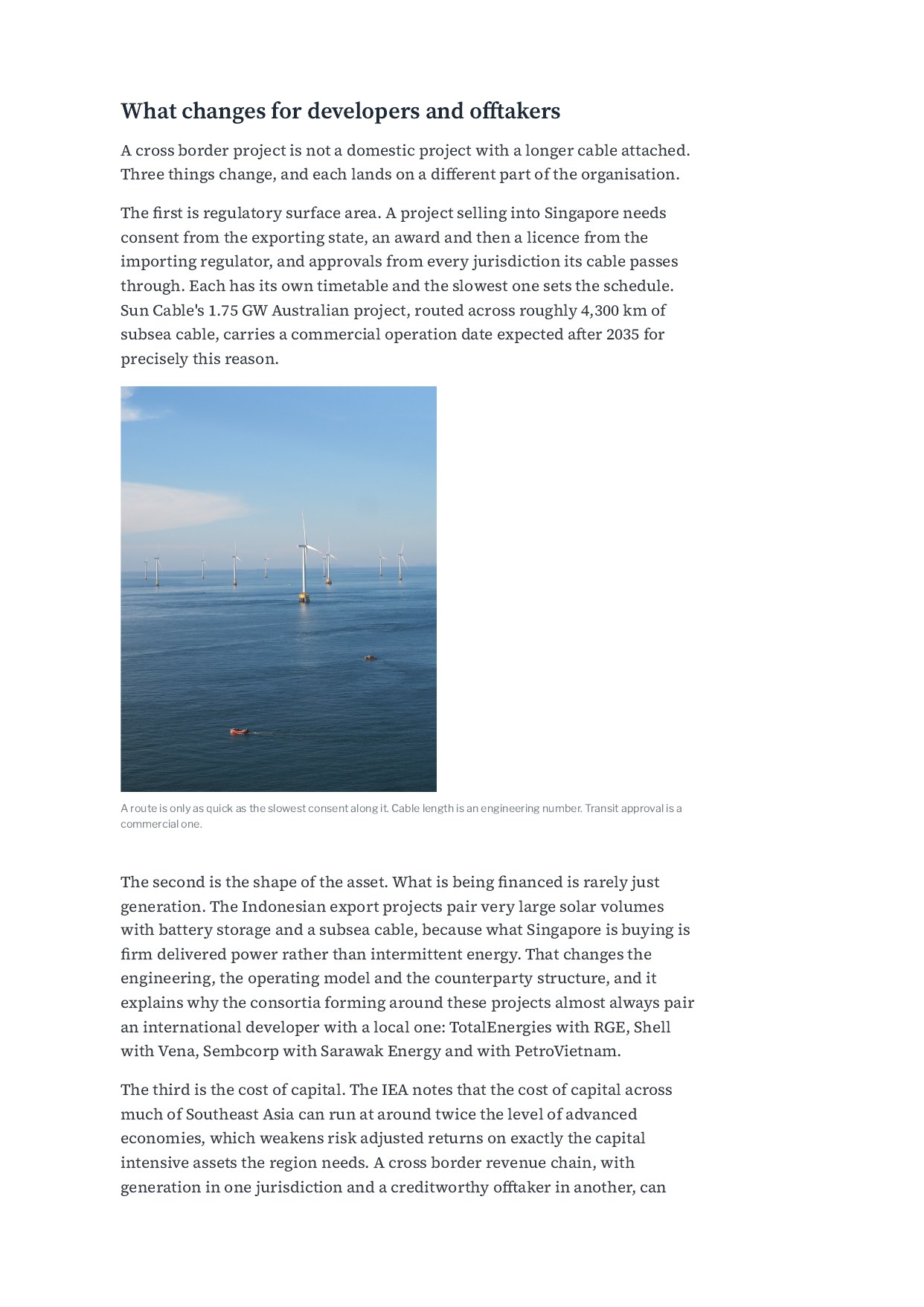
The first is regulatory surface area. A project selling into Singapore needs consent from the exporting state, an award and then a licence from the importing regulator, and approvals from every jurisdiction its cable passes through. Each has its own timetable and the slowest one sets the schedule. Sun Cable's 1.75 GW Australian project, routed across roughly 4,300 km of subsea cable, carries a commercial operation date expected after 2035 for precisely this reason.
A route is only as quick as the slowest consent along it. Cable length is an engineering number. Transit approval is a commercial one.
The second is the shape of the asset. What is being financed is rarely just generation. The Indonesian export projects pair very large solar volumes with battery storage and a subsea cable, because what Singapore is buying is firm delivered power rather than intermittent energy. That changes the engineering, the operating model and the counterparty structure, and it explains why the consortia forming around these projects almost always pair an international developer with a local one: TotalEnergies with RGE, Shell with Vena, Sembcorp with Sarawak Energy and with PetroVietnam.
The third is the cost of capital. The IEA notes that the cost of capital across much of Southeast Asia can run at around twice the level of advanced economies, which weakens risk adjusted returns on exactly the capital intensive assets the region needs. A cross border revenue chain, with generation in one jurisdiction and a creditworthy offtaker in another, can improve that picture, but only if the structure is legible to lenders. Making it legible is a commercial and legal exercise rather than an engineering one.
The capability the region does not yet have
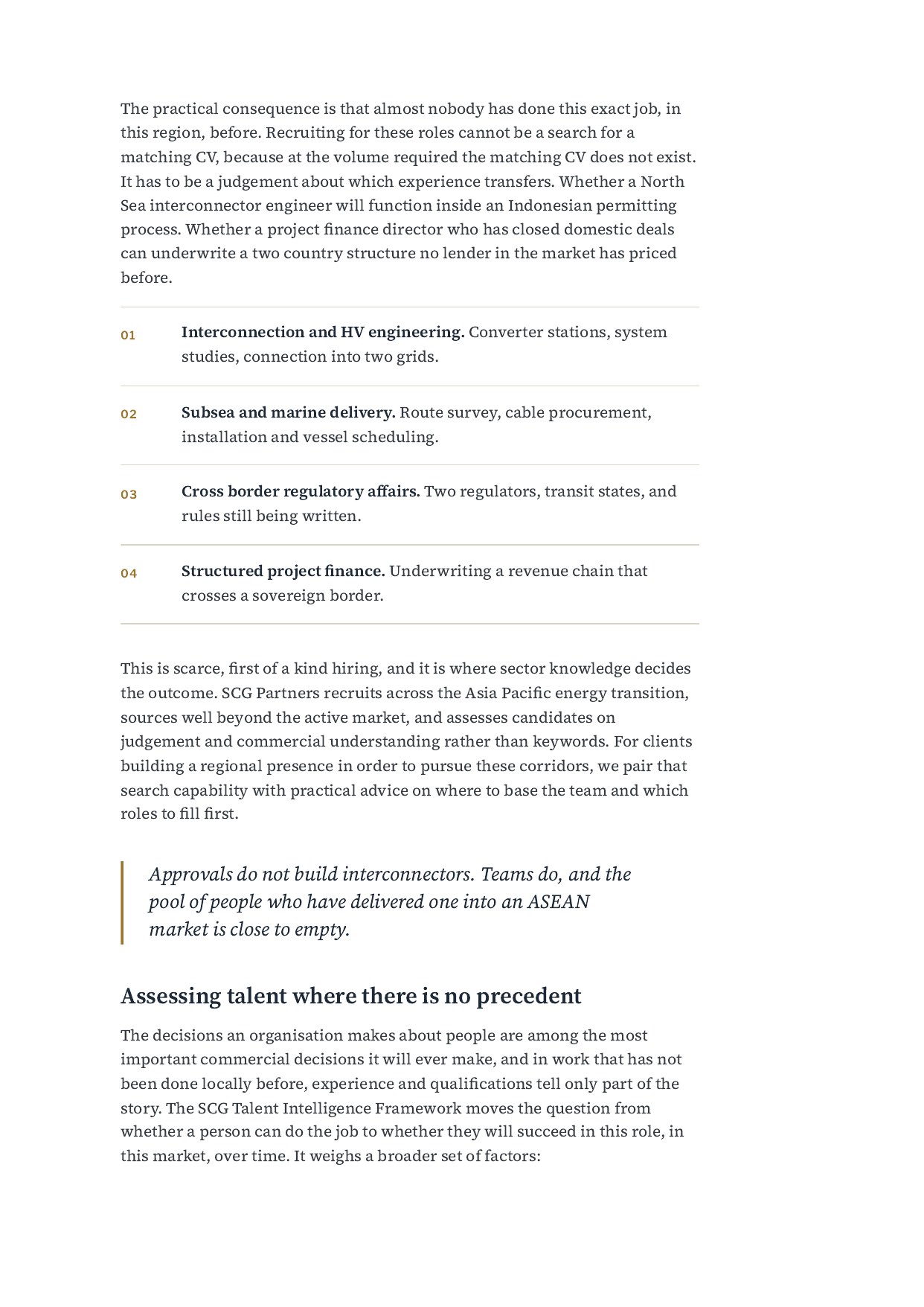
Every one of these corridors depends on skills Southeast Asia has never had to supply at scale. Interconnection is a specialist discipline. It requires high voltage direct current and converter station engineering, subsea cable routing and marine installation management, system studies for connection into two grids running under different codes, cross border regulatory affairs, and project finance able to underwrite a revenue chain that crosses a border. None of these are ordinary renewable development skills, and the region has produced few of them, because until recently there was very little to work on.
Competition for the people who do exist is global. ManpowerGroup's 2026 engineering outlook reports that close to three quarters of employers worldwide struggle to find skilled engineering talent, and that nine in ten employers hiring engineers say the retirement of experienced staff is already shaping their workforce strategy. Subsea and offshore installation specialists are scarce everywhere, and the ASEAN pipeline is bidding for them against European and North American interconnector programmes that started earlier.
The practical consequence is that almost nobody has done this exact job, in this region, before. Recruiting for these roles cannot be a search for a matching CV, because at the volume required the matching CV does not exist. It has to be a judgement about which experience transfers. Whether a North Sea interconnector engineer will function inside an Indonesian permitting process. Whether a project finance director who has closed domestic deals can underwrite a two country structure no lender in the market has priced before.
- Interconnection and HV engineering. Converter stations, system studies, connection into two grids.
- Subsea and marine delivery. Route survey, cable procurement, installation and vessel scheduling.
- Cross border regulatory affairs. Two regulators, transit states, and rules still being written.
- Structured project finance. Underwriting a revenue chain that crosses a sovereign border.
This is scarce, first of a kind hiring, and it is where sector knowledge decides the outcome. SCG Partners recruits across the Asia Pacific energy transition, sources well beyond the active market, and assesses candidates on judgement and commercial understanding rather than keywords. For clients building a regional presence in order to pursue these corridors, we pair that search capability with practical advice on where to base the team and which roles to fill first.
Approvals do not build interconnectors. Teams do, and the pool of people who have delivered one into an ASEAN market is close to empty.
Assessing talent where there is no precedent
The decisions an organisation makes about people are among the most important commercial decisions it will ever make, and in work that has not been done locally before, experience and qualifications tell only part of the story. The SCG Talent Intelligence Framework moves the question from whether a person can do the job to whether they will succeed in this role, in this market, over time. It weighs a broader set of factors:
CAPABILITY
Technical capability, commercial understanding, leadership potential, communication skills.
EXPERIENCE
Industry experience, international exposure, project complexity, career progression.
FIT AND GROWTH
Cultural fit and contribution to long term growth.
For an interconnection hire, four of the ten carry most of the weight. Project complexity indicates whether a candidate can carry a first of a kind asset rather than maintain a proven one. International exposure and cultural fit determine whether they can work across two regulators and a local partner without stalling. Commercial understanding separates the person who can structure a cross border offtake from the one who can only price a domestic power purchase agreement.
The framework is built to enhance professional judgement, not replace it. It combines industry expertise, structured assessment and market knowledge, and over time it will develop into a broader Talent Intelligence Platform supporting recruitment, workforce planning, succession and leadership assessment. The underlying philosophy does not change. Technology should support better decisions, not make them. Successful organisations are built by understanding not only what people have done, but what they are capable of achieving next.
The corridors are being contracted now. The teams built this year decide who delivers them.