Full text
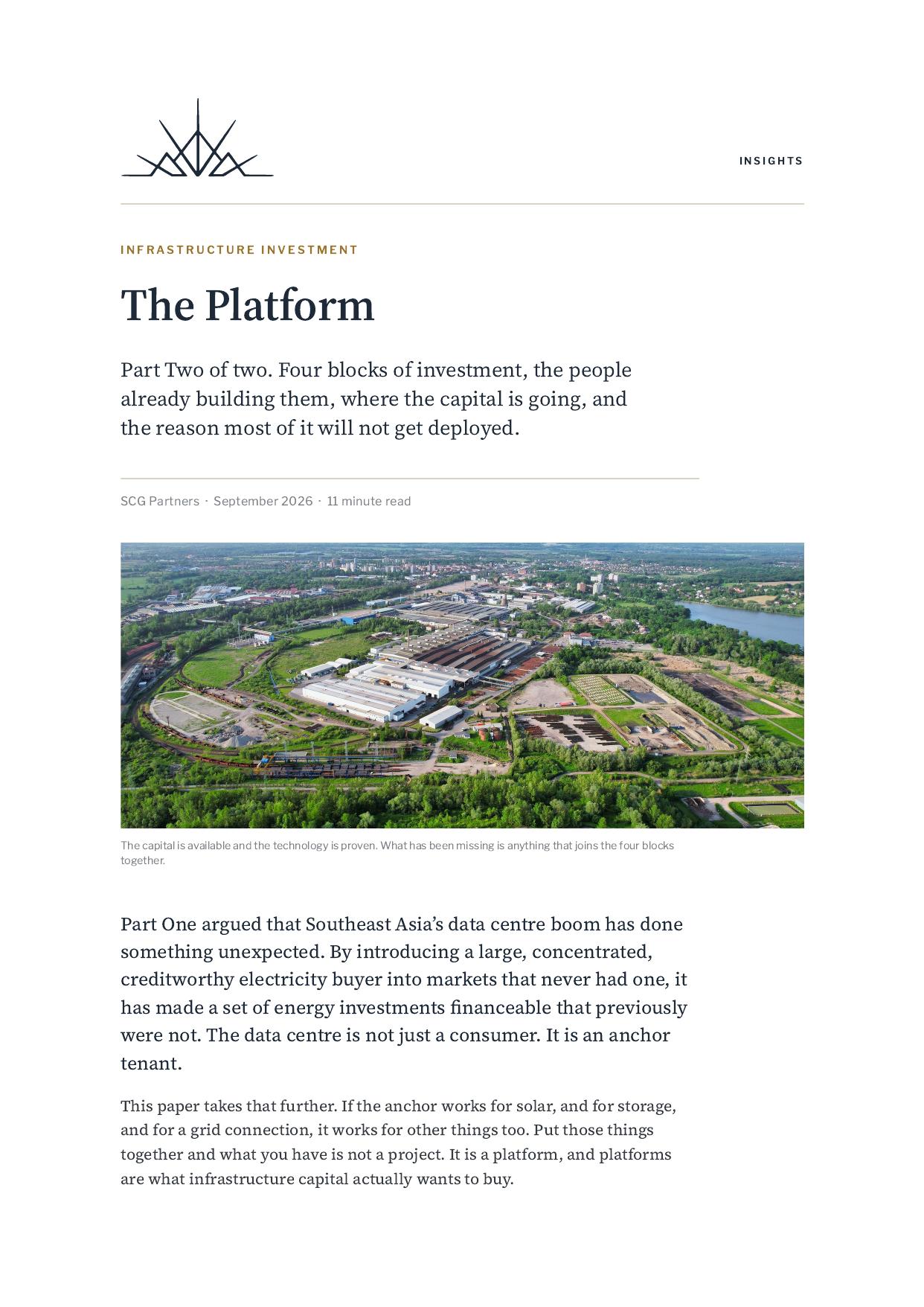
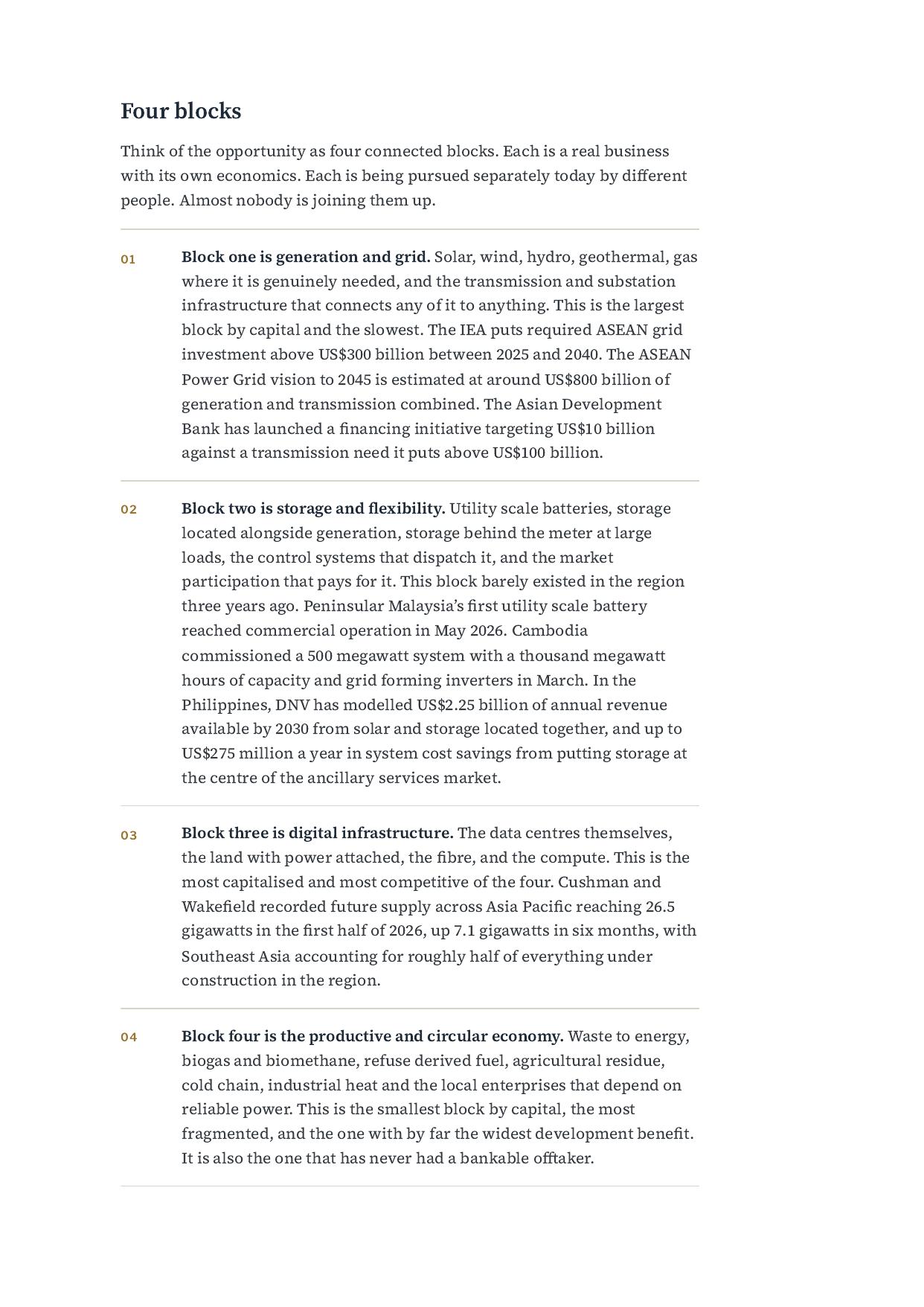
The capital is available and the technology is proven. What has been missing is anything that joins the four blocks together.
Part One argued that Southeast Asia’s data centre boom has done something unexpected. By introducing a large, concentrated, creditworthy electricity buyer into markets that never had one, it has made a set of energy investments financeable that previously were not. The data centre is not just a consumer. It is an anchor tenant.
This paper takes that further. If the anchor works for solar, and for storage, and for a grid connection, it works for other things too. Put those things together and what you have is not a project. It is a platform, and platforms are what infrastructure capital actually wants to buy.
Four blocks
Think of the opportunity as four connected blocks. Each is a real business with its own economics. Each is being pursued separately today by different people. Almost nobody is joining them up.
Block one is generation and grid. Solar, wind, hydro, geothermal, gas where it is genuinely needed, and the transmission and substation infrastructure that connects any of it to anything. This is the largest block by capital and the slowest. The IEA puts required ASEAN grid investment above US$300 billion between 2025 and 2040. The ASEAN Power Grid vision to 2045 is estimated at around US$800 billion of generation and transmission combined. The Asian Development Bank has launched a financing initiative targeting US$10 billion against a transmission need it puts above US$100 billion.
Block two is storage and flexibility. Utility scale batteries, storage located alongside generation, storage behind the meter at large loads, the control systems that dispatch it, and the market participation that pays for it. This block barely existed in the region three years ago. Peninsular Malaysia’s first utility scale battery reached commercial operation in May 2026. Cambodia commissioned a 500 megawatt system with a thousand megawatt hours of capacity and grid forming inverters in March. In the Philippines, DNV has modelled US$2.25 billion of annual revenue available by 2030 from solar and storage located together, and up to US$275 million a year in system cost savings from putting storage at the centre of the ancillary services market.
Block three is digital infrastructure. The data centres themselves, the land with power attached, the fibre, and the compute. This is the most capitalised and most competitive of the four. Cushman and Wakefield recorded future supply across Asia Pacific reaching 26.5 gigawatts in the first half of 2026, up 7.1 gigawatts in six months, with Southeast Asia accounting for roughly half of everything under construction in the region.
Block four is the productive and circular economy. Waste to energy, biogas and biomethane, refuse derived fuel, agricultural residue, cold chain, industrial heat and the local enterprises that depend on reliable power. This is the smallest block by capital, the most fragmented, and the one with by far the widest development benefit. It is also the one that has never had a bankable offtaker.
The blocks are connected in a specific way. Block three creates the demand that makes blocks one and two financeable. Blocks one and two create the surplus, the land and the grid capacity that make block four viable. Block four supplies something the other three cannot get anywhere else, which is dispatchable renewable generation that runs at night.
That last point deserves attention, because it is the least obvious and the most commercially interesting.
The waste question
Solar solves the daytime. Batteries solve four hours either side of it. Neither solves a wet season week with low irradiance, and neither gives a corporate buyer the round the clock renewable supply that increasingly sophisticated procurement standards demand.
Biogas does. Burned in a generator, it produces baseload electricity at capacity factors comparable to natural gas, from a feedstock that somebody is currently paying to dispose of. Upgraded to biomethane it can be injected into a gas network or burned in on site generation. It is one of very few genuinely dispatchable renewable sources, and in this region the feedstock is abundant to the point of embarrassment.
Indonesia is the clearest case. Presidential Regulation 109 of 2025 identified at least 33 cities as viable for waste to energy development, consolidated into thirty projects covering sixty one districts and cities, with a combined processing capacity around 14.4 million tonnes of waste a year, roughly 22.5 percent of national waste accumulation. The national target is 453 megawatts of installed capacity by 2034 against about US$2.72 billion of project investment. Danantara, the state investment body, reported 107 registered business entities and shortlisted 24 foreign companies from China, Japan and France. Groundbreaking on five priority projects was targeted for June 2026. Around 60 percent of Indonesian municipal solid waste is organic, and government estimates put generation potential at roughly 15 megawatts for every thousand tonnes a day processed.
In February the President banned the export of palm oil waste and used cooking oil outright, on the basis that these are strategic domestic energy feedstocks. Whatever one thinks of the policy, the effect is to concentrate a very large quantity of organic feedstock inside Indonesia looking for a domestic use. In Malaysia, research by the Malaysian Palm Oil Board has estimated that palm oil mill effluent alone could support around 508 megawatts of generation nationally, most of which is not captured.
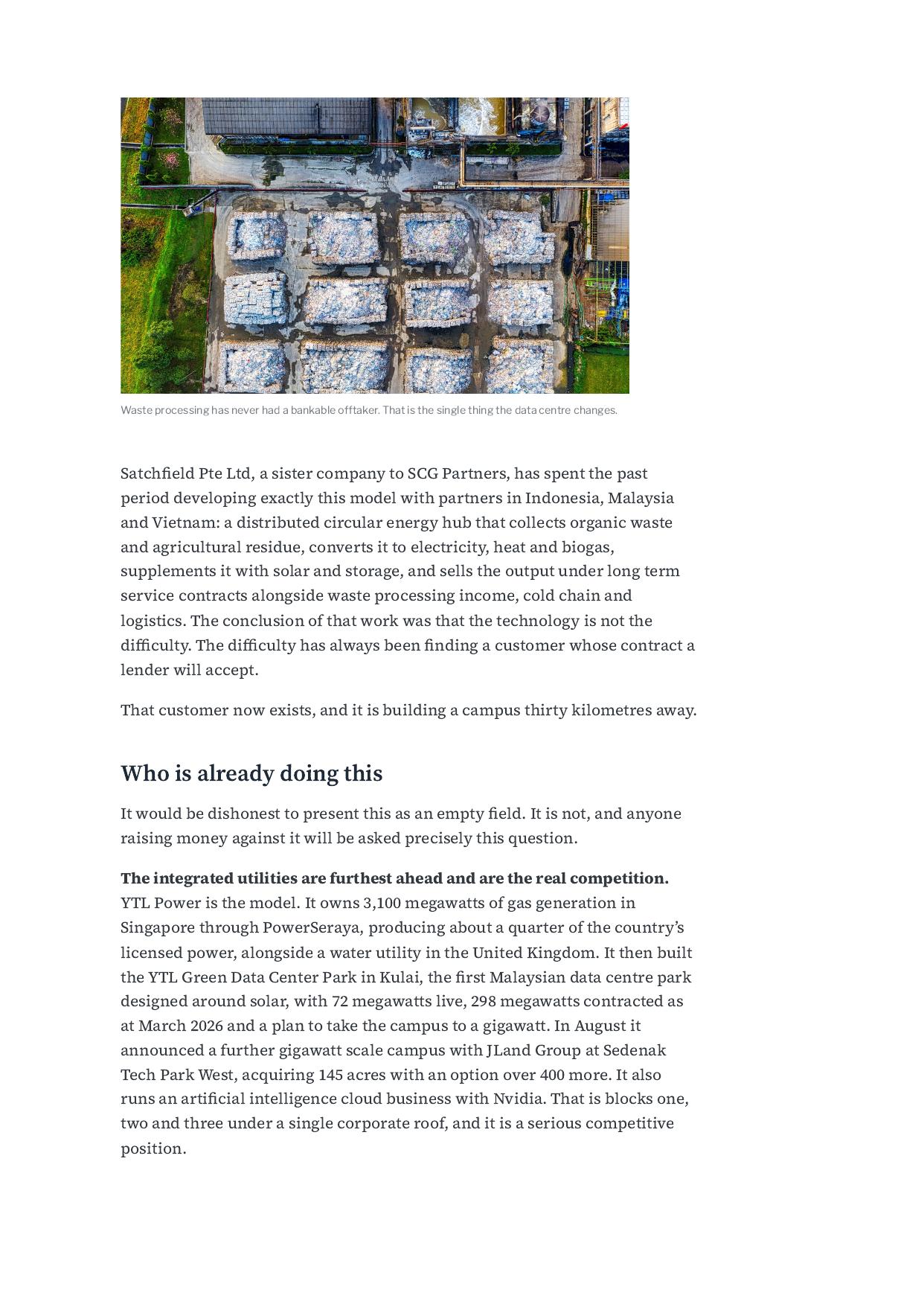
Waste processing has never had a bankable offtaker. That is the single thing the data centre changes.
Satchfield Pte Ltd, a sister company to SCG Partners, has spent the past period developing exactly this model with partners in Indonesia, Malaysia and Vietnam: a distributed circular energy hub that collects organic waste and agricultural residue, converts it to electricity, heat and biogas, supplements it with solar and storage, and sells the output under long term service contracts alongside waste processing income, cold chain and logistics. The conclusion of that work was that the technology is not the difficulty. The difficulty has always been finding a customer whose contract a lender will accept.
That customer now exists, and it is building a campus thirty kilometres away.
Who is already doing this
It would be dishonest to present this as an empty field. It is not, and anyone raising money against it will be asked precisely this question. The integrated utilities are furthest ahead and are the real competition. YTL Power is the model. It owns 3,100 megawatts of gas generation in Singapore through PowerSeraya, producing about a quarter of the country’s licensed power, alongside a water utility in the United Kingdom. It then built the YTL Green Data Center Park in Kulai, the first Malaysian data centre park designed around solar, with 72 megawatts live, 298 megawatts contracted as at March 2026 and a plan to take the campus to a gigawatt. In August it announced a further gigawatt scale campus with JLand Group at Sedenak Tech Park West, acquiring 145 acres with an option over 400 more. It also runs an artificial intelligence cloud business with Nvidia. That is blocks one, two and three under a single corporate roof, and it is a serious competitive position.
Others are moving from adjacent directions. Pertamina Geothermal stated in August that it is preparing clean firm capacity for Indonesia’s green data centres while explicitly declining to enter the data centre business itself, which is the utility answering the same question from the supply side. PLN signed the largest power purchase agreement in Indonesian history with DayOne in Batam, 511 megavolt amperes delivered in phases across 2026 and 2027. Microsoft is building in a 1,400 hectare zone in Karawang and partnering with PLN to bring 200 megawatts of solar onto the grid. The Adaro group is building a green industrial park in North Kalimantan around hydro. In the Philippines, Aboitiz Renewables plans to grow from 928 megawatts to 4.6 gigawatts by 2030 and ACEN holds around seven gigawatts attributable with plans to nearly triple by the end of the decade. S&P has the region’s Philippine and Vietnamese conglomerates planning roughly US$185 billion of investment over the next decade, about two thirds of it into infrastructure and renewable energy. In Vietnam, capital is arriving quickly: a US$2 billion partnership between G42 and a consortium of FPT, VinaCapital and Viet Thai in February, a US$2.1 billion project from Accelerated Infrastructure Capital and Kinh Bac in March, and several hundred million dollars more from Starmason and from an Evolution led group in April.
The powered land specialists are the newest entrants and are not yet here. Stonepeak launched a European land aggregation platform in July 2025. Silver Lake, with Commonwealth Asset Management, launched a global powered land platform in August 2025 backed by US$400 million. Hines has published research arguing the strategy will become one of the more important infrastructure theses of the coming years. EY’s assessment is that powered land carries medium capital intensity, longer cash flow timelines and low obsolescence risk, which is close to an ideal profile for patient infrastructure money. Nobody has applied that thesis systematically in Southeast Asia. The funds are circling but small. PIDG and August Energy launched an initial US$30 million platform intended to mobilise up to US$100 million for energy as a service projects in the Philippines, Vietnam and Thailand. A PIDG backed Indonesian climate transition fund of AUD 50 million covers renewables, circular economy, waste and sustainable logistics. Southeast Asia Clean Energy Fund II is targeting US$175 million. At larger scale, the ASEAN Catalytic Green Finance Facility runs to roughly US$3.7 billion and Climate Investor Two closed at US$1.065 billion for water, waste and related infrastructure.
And the very large infrastructure money is already in the data centres. Blackstone with CPP Investments acquired AirTrunk at an enterprise value above A$24 billion. A KKR led consortium with Singtel put S$1.75 billion into ST Telemedia Global Data Centres. A Stack Asia portfolio has attracted reported interest above US$30 billion.
So the honest competitive position is this. Every individual block has capable incumbents. One company, YTL, has genuinely integrated three of them. Nobody has integrated all four, and nobody has built a repeatable development platform that originates projects across the set rather than executing them one at a time.
The product is not a technology. It is the integration.
What it would cost, and why size helps
The structure that fits this is a development company, not a project. A regional development platform capitalised at US$10 million to US$20 million can fund a local team, screen perhaps twenty opportunities, complete measured feasibility on four to six, and take two or three to construction readiness. A subsequent asset vehicle of US$50 million to US$100 million then finances a diversified portfolio using sponsor equity, local debt, development finance guarantees and concessional capital for first of a kind risk.
There is a point about scale worth making directly, because it is often left unsaid. The cost of underwriting an investment does not scale with its size. Diligence, legal work, structuring and monitoring cost roughly the same on a US$20 million commitment as on a US$100 million one. This is precisely why so much development scale infrastructure in Southeast Asia goes unfunded: the projects are individually too small to be worth an institutional investor’s time, however good they are. A platform that aggregates them into a single portfolio with common documentation, a common operating team and a single counterparty solves that problem, and it is the main reason a platform is worth more than the sum of the projects inside it.
Four blocks, four hiring markets, and they are all competing with each other.
Two warnings belong here rather than in a footnote.
The first is that announced capital and deployed capital are very different things in this region. Bain puts the gap between announcement and realisation at around 35 percent across Southeast Asia’s power and electric vehicle value chains. In Malaysia, less than half of contracted data centre demand has actually materialised, which is why developers are now required to reach 85 percent of declared electricity usage within four years of interconnection and to have requests verified by a task force. Thailand is introducing bank guarantees against power purchases for the same reason.
Anyone underwriting this should assume that a meaningful share of the announced pipeline is speculative.
The second is that the leasing market is not uniformly tight. Johor colocation vacancy is around 0.7 percent. Greater Jakarta is above 20 percent and Bangkok higher still. Proximity to an announcement is not the same as proximity to a customer.
The part that decides whether any of this happens
Every position paper of this kind ends with a capital requirement. Very few of them address the thing that actually determines whether the capital gets deployed, which is whether anybody can be found to run it. Each of the four blocks draws on a different labour market. Generation and grid needs development directors who can originate and land projects, power purchase agreement negotiators, high voltage and connection engineers, and the regulatory people who manage utilities and ministries. Storage and flexibility needs a category of engineer that barely exists in this region: control systems, energy management, market participation, and the commercial modelling that turns a battery into a revenue stack rather than a cost. Digital infrastructure needs critical facilities engineers, commissioning specialists and operations leadership, in a market where survey work by the Uptime Institute has found close to two thirds of operators struggling to find or retain qualified staff. The circular block needs process engineers who understand anaerobic digestion and gas engines, waste logistics managers, and people who can work with municipalities without the project stalling for three years. Four blocks, four hiring markets, and they are all competing with each other. Data centre operators and renewable developers are already pursuing the same high voltage engineers. The applied technical occupations at the centre of all four, electricians, plant operators, specialist engineers, are the fastest growing part of the global energy workforce and are simultaneously being bid for by construction, manufacturing, telecoms and utilities. Above all of that sits a single role that is genuinely scarce. The person who can hold a power purchase agreement, a data centre operating contract, a waste supply agreement and a development finance structure in their head at the same time, and see how they interact. There are perhaps a few dozen such people in Southeast Asia. Investors underwrite management teams before they underwrite assets, and a platform proposition without that person named in it is a document rather than a business.
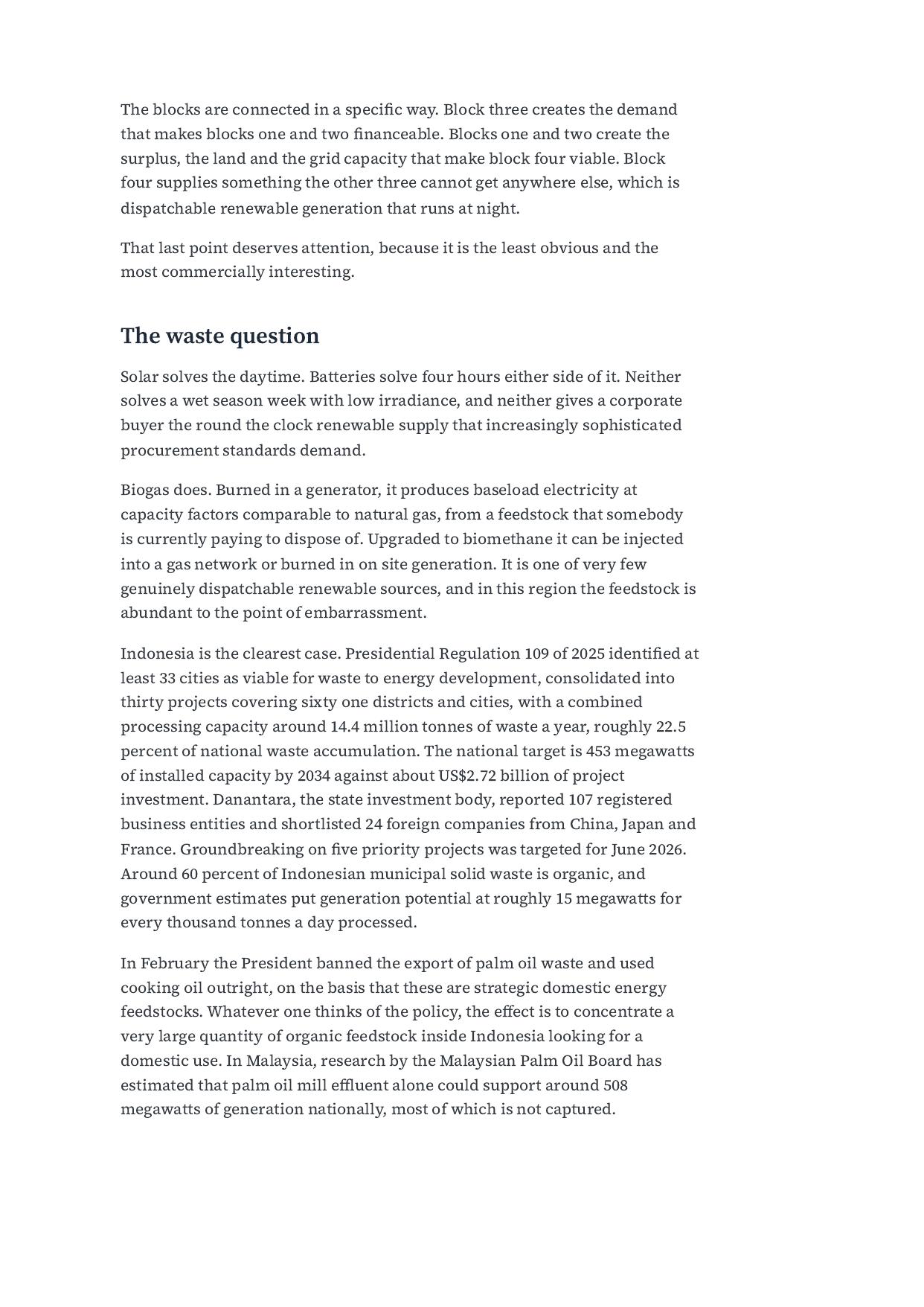
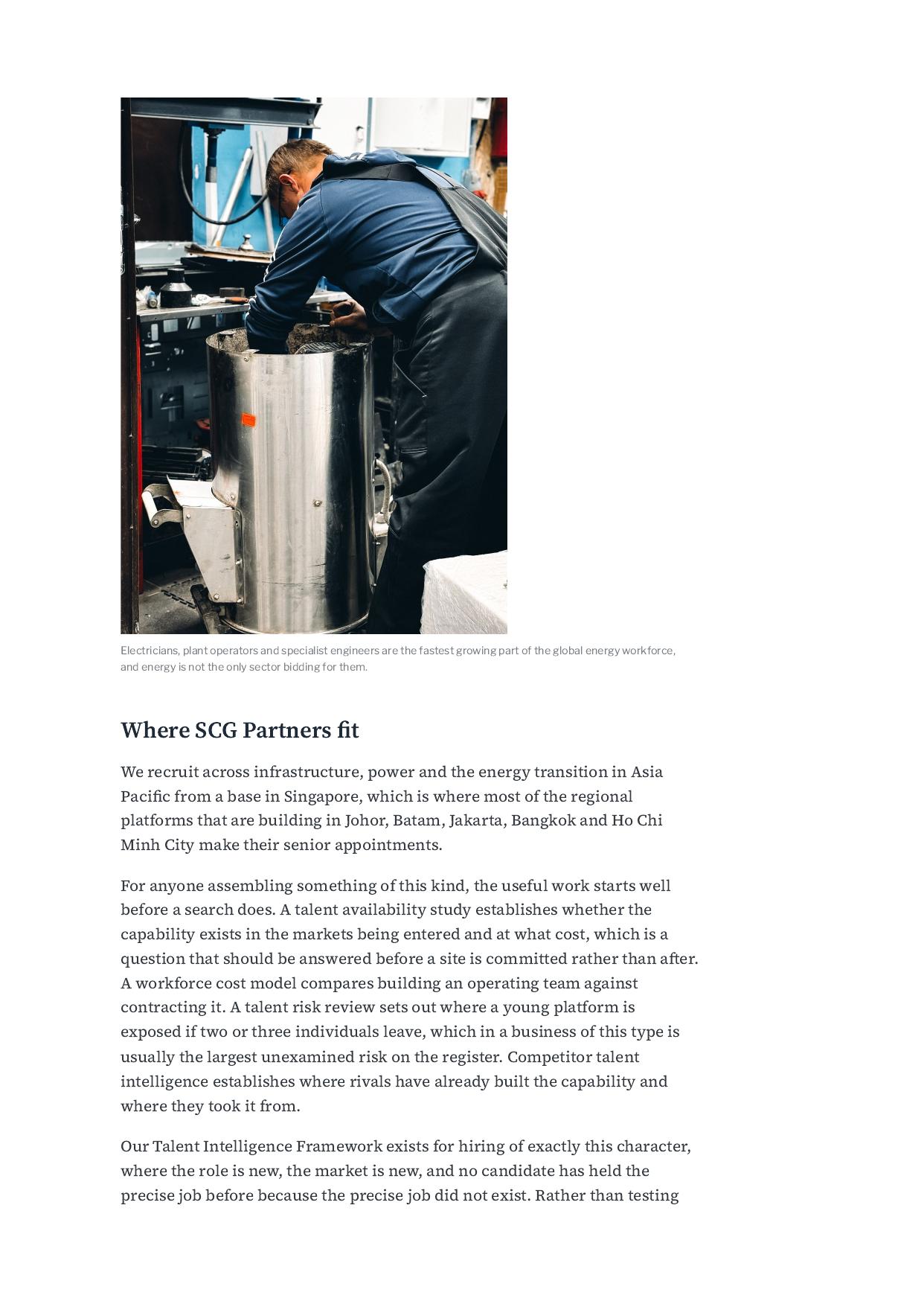
Electricians, plant operators and specialist engineers are the fastest growing part of the global energy workforce, and energy is not the only sector bidding for them.
Where SCG Partners fit
We recruit across infrastructure, power and the energy transition in Asia Pacific from a base in Singapore, which is where most of the regional platforms that are building in Johor, Batam, Jakarta, Bangkok and Ho Chi Minh City make their senior appointments.
For anyone assembling something of this kind, the useful work starts well before a search does. A talent availability study establishes whether the capability exists in the markets being entered and at what cost, which is a question that should be answered before a site is committed rather than after. A workforce cost model compares building an operating team against contracting it. A talent risk review sets out where a young platform is exposed if two or three individuals leave, which in a business of this type is usually the largest unexamined risk on the register. Competitor talent intelligence establishes where rivals have already built the capability and where they took it from.
Our Talent Intelligence Framework exists for hiring of exactly this character, where the role is new, the market is new, and no candidate has held the precise job before because the precise job did not exist. Rather than testing for a job title, it weighs technical capability, commercial understanding, project complexity, leadership potential, international exposure, communication and cultural fit, and forms a structured view on whether an individual will succeed in a specific role in a specific market over time. For a platform hire spanning power, digital infrastructure and waste, complexity and commercial judgement carry far more weight than sector tenure.
Conclusion
The capital is available. Roughly US$540 billion has been announced across the region’s power value chains and about a third of it will not be deployed under current conditions. The technology is available and largely proven. The demand is not only available but creditworthy, contracted and growing faster than anyone forecast three years ago.
What is missing is integration, and the small number of people capable of delivering it.
Southeast Asia can treat data centres as a burden to be powered, in which case the region will build several gigawatts of gas, socialise the cost across ratepayers and capture relatively little of the value. Or it can treat them as the anchor tenant that finally makes the grid, the renewables, the storage and the waste infrastructure financeable, in which case the digital build becomes the mechanism through which a much larger economic transition gets funded. The difference between those two outcomes is not money. It is sequencing, coordination and people.
We would be glad to talk to anyone working on the second version.
SCG Partners are a Singapore based specialist recruitment and talent advisory firm working across Asia Pacific infrastructure, energy and the energy transition. Satchfield Pte Ltd is a sister company holding a 50 percent shareholding in SCG Partners.