

Full text
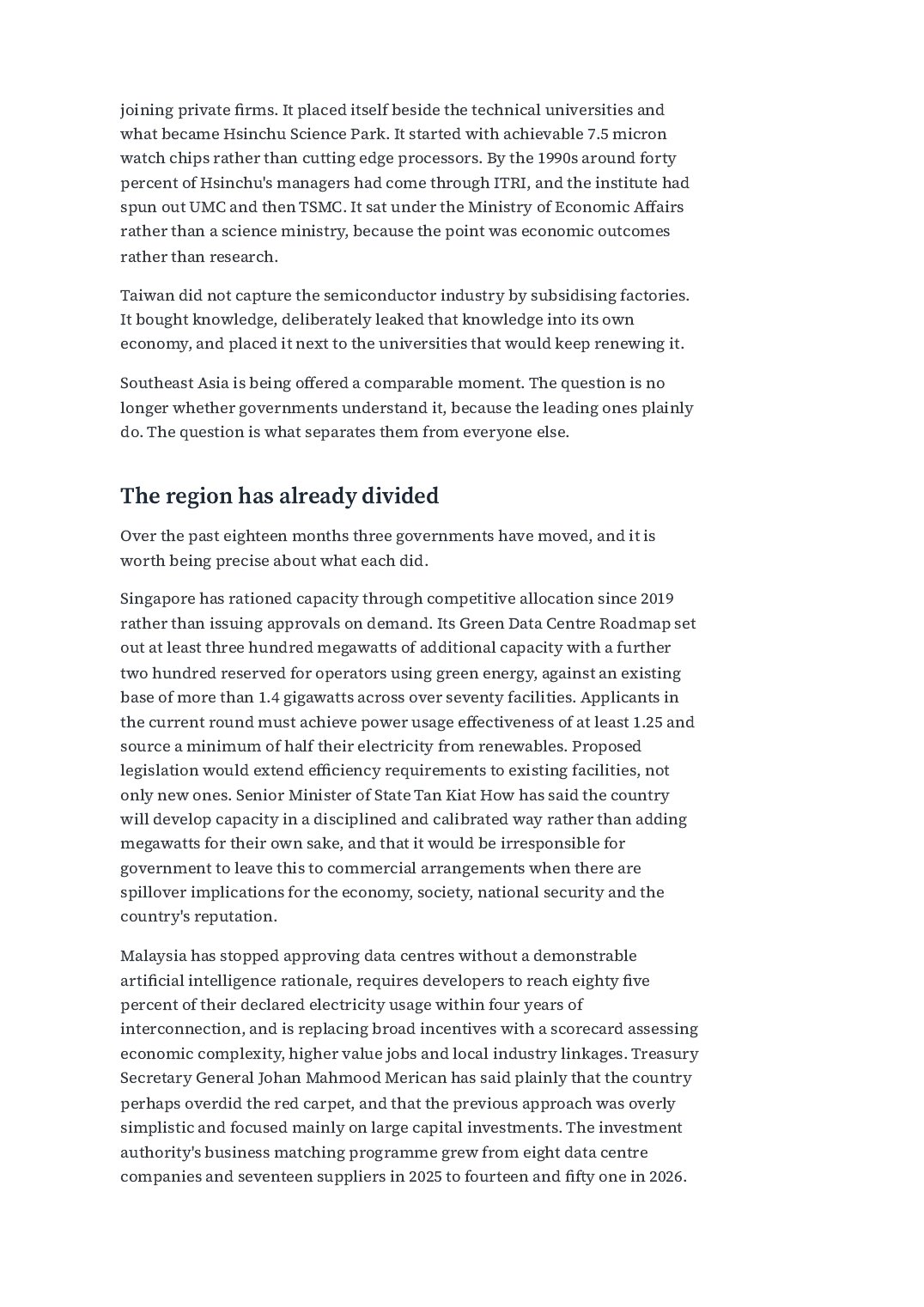
In 1974 Taiwan's Industrial Technology Research Institute paid RCA roughly sixteen million dollars for a licence to make semiconductors. It was not a large sum. Taiwan had no chip industry and no obvious reason to believe it could build one.
The mechanism matters more than the outcome. ITRI sent its engineers to RCA facilities in the United States to learn design, manufacturing, quality control and equipment management. It then deliberately ran staff turnover of around fifteen percent a year, with roughly eighty five percent of leavers joining private firms. It placed itself beside the technical universities and what became Hsinchu Science Park. It started with achievable 7.5 micron watch chips rather than cutting edge processors. By the 1990s around forty percent of Hsinchu's managers had come through ITRI, and the institute had spun out UMC and then TSMC. It sat under the Ministry of Economic Affairs rather than a science ministry, because the point was economic outcomes rather than research.
Taiwan did not capture the semiconductor industry by subsidising factories. It bought knowledge, deliberately leaked that knowledge into its own economy, and placed it next to the universities that would keep renewing it.
Southeast Asia is being offered a comparable moment. The question is no longer whether governments understand it, because the leading ones plainly do. The question is what separates them from everyone else.
The region has already divided
Over the past eighteen months three governments have moved, and it is worth being precise about what each did.
Singapore has rationed capacity through competitive allocation since 2019 rather than issuing approvals on demand. Its Green Data Centre Roadmap set out at least three hundred megawatts of additional capacity with a further two hundred reserved for operators using green energy, against an existing base of more than 1.4 gigawatts across over seventy facilities. Applicants in the current round must achieve power usage effectiveness of at least 1.25 and source a minimum of half their electricity from renewables. Proposed legislation would extend efficiency requirements to existing facilities, not only new ones. Senior Minister of State Tan Kiat How has said the country will develop capacity in a disciplined and calibrated way rather than adding megawatts for their own sake, and that it would be irresponsible for government to leave this to commercial arrangements when there are spillover implications for the economy, society, national security and the country's reputation.
Malaysia has stopped approving data centres without a demonstrable artificial intelligence rationale, requires developers to reach eighty five percent of their declared electricity usage within four years of interconnection, and is replacing broad incentives with a scorecard assessing economic complexity, higher value jobs and local industry linkages. Treasury Secretary General Johan Mahmood Merican has said plainly that the country perhaps overdid the red carpet, and that the previous approach was overly simplistic and focused mainly on large capital investments. The investment authority's business matching programme grew from eight data centre companies and seventeen suppliers in 2025 to fourteen and fifty one in 2026.
Thailand took a direct power purchase pilot designed for data centres, originally capped at two gigawatts, and inside eight months expanded it through third party access to industrial users generally and removed the cap. The data centre was the pretext. An open national clean power market is the legacy.
Those are not governments being swept along. They are governments pricing something.
What the leaders understood
Site selection in this industry is usually described as a scorecard. It is not. It is a sequence of filters, and failing the first cannot be rescued by excelling at the rest.
Grid capacity had become a speculative asset, held as a free option by parties who might never build, while real projects queued behind them.
Power comes first. If the connection date is later than the project needs, nothing else saves it, and in Greater Tokyo the average wait for a commercial power connection now runs to eight or ten years. Fibre comes second, because it decides which workloads a site can serve at all, and new long haul routes take one to three years with the carriers setting priority. Regulation comes third, having moved from the end of diligence to the front of it. Water comes fourth, because cooling architecture is fixed at design stage and is expensive to revisit. Land comes last, because almost every land problem can be solved with money.
Read that list from a government's point of view and the conclusion is uncomfortable for anyone who has been competing on incentives. The state directly controls the first constraint and the third, strongly influences the fourth, and shares the second. The private sector controls only the fifth, which is the one that does not bind.
Governments hold the constraints that decide whether a project happens at all, and have routinely been trading them away for commitments on the one that does not.
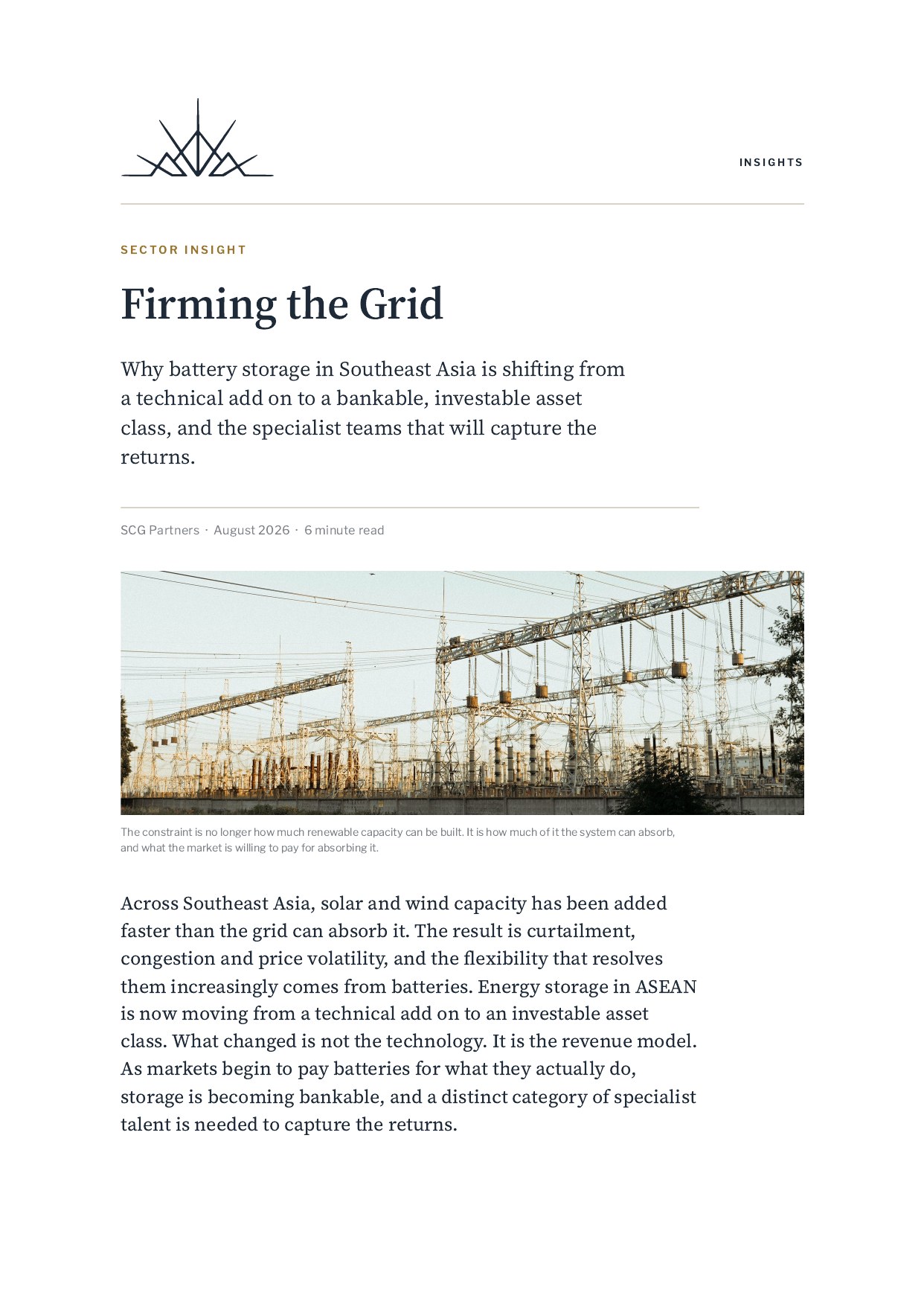
Japan is currently providing the clearest illustration of what happens when that is unmanaged. Its grid connection queue held around 172 gigawatts of battery capacity at the connection study stage as of December 2025, up from 88 gigawatts fifteen months earlier. Roughly thirty gigawatts had progressed to contract application. Approximately 0.64 gigawatts was actually connected.
For every gigawatt physically delivering power, something close to two hundred and seventy gigawatts sat ahead of it as applications. Grid capacity had become a speculative asset, held as a free option by parties who might never build, while real projects queued behind them. From 1 October 2026 Japan requires applicants to prove their right to use a site within two months or forfeit the reservation, and has capped connection requests per company per area, at five in Hokkaido, Hokuriku, Chugoku and Shikoku, eleven in Tokyo and twelve in Kansai, with anything above the cap rejected without review.
Malaysia's eighty five percent rule is the same insight. Thailand's requirement for bank guarantees against power purchases is the same insight. These are governments reclaiming an asset they had been giving away for nothing.
Is it generational, or does it only feel that way
The sceptical case deserves stating first, and Bank Negara Malaysia states it better than any critic.
Data centres generate fewer jobs than manufacturing because of automation and remote operation. The jobs they do create pay well, with entry level roles around three thousand ringgit a month and senior positions between ten and thirty thousand, but there are not many relative to the capital. Malaysia recorded roughly RM385.7 billion of data centre related investment between 2021 and the middle of 2026, while the sector's GDP contribution rose from about RM0.9 billion in 2021 to RM14.1 billion in 2025. Real growth, modest share.
The central bank also names the leakages. Reliance on imported specialist equipment weakens the backward linkages that create domestic value. Foreign owned operators repatriating profits put pressure on the primary income account. Export services benefits arrive late because facilities must be operating first. And the sector consumes electricity and water that have alternative uses.
Any government treating a data centre as an employment programme will be disappointed.
The generational argument is different and rests on three things.
This is the only large, creditworthy, long duration electricity demand most of these countries have ever been offered. A hyperscale operator will sign a fifteen or twenty year contract at a price a lender accepts, which is precisely what renewable generation, transmission and storage have never been able to find here. Thailand's experience shows what follows.
The physical infrastructure outlasts the tenant by decades. Substations, transmission corridors, generation, water treatment and fibre are twenty five to forty year assets. The compute inside the building is a three to six year asset. A country that uses this moment to build grid capacity it would otherwise have deferred has acquired something durable regardless of the artificial intelligence cycle.
And then there is knowledge, which almost nobody is pricing.
You own the slowest clock
This industry contains several clocks running at different speeds, and most confusion about it comes from treating them as one.
The silicon runs on three to six years, and even its operators disagree about which. Microsoft extended server life from four years to six, Oracle moved from four to five and now six, Amazon has shortened the assumed life of some hardware while Meta has extended others. The electrical and thermal architecture of the building appears to run on seven to ten years, which the move to 800 volt direct current distribution and direct to chip liquid cooling is now testing for the first time. The land, the building, the grid connection and the water infrastructure run on twenty five years or more.
Here is the point for governments.
You own the slowest clock, and the slowest clock is the one that compounds.
Every other party is working to a faster timetable. The chip designer is on an annual product cycle. The operator is on a lease cycle and an exit horizon. The infrastructure fund has a hold period, usually seven to ten years, and a fiduciary duty to its limited partners rather than to your citizens. The equipment manufacturer is trying to hit a quarterly number.
A government is the only party in the room that will still be there in 2060. That is the strongest negotiating position at the table, and it argues for asking for things that compound rather than things that arrive. Capital expenditure arrives; grid capacity compounds. A tax holiday arrives; a trained workforce compounds. A completed building arrives; a university department attached to a live industrial problem compounds, and keeps compounding after the tenant has gone.
The knowledge problem, and why universities answer it
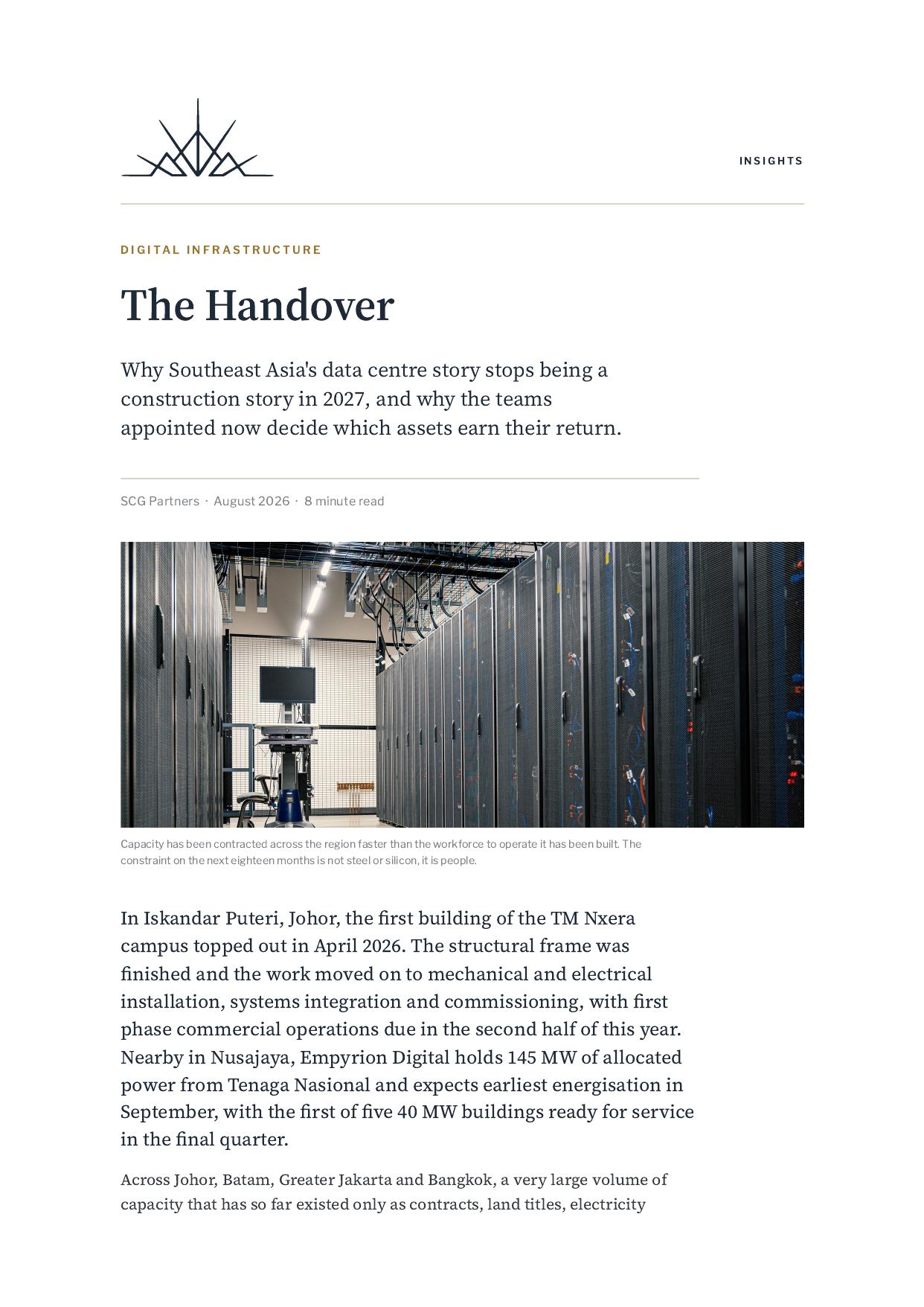
Every country here faces the same sequence. Capacity arrives faster than the training system can respond. Operators recruit internationally or poach from each other. The best local engineers acquire scarce, globally portable skills. Then they leave.
Indonesia's youth unemployment sits at 16.16 percent against an overall rate of 4.76 percent, and the hashtag KaburAjaDulu, roughly just get out first, has become shorthand for a generation's assessment of its prospects. Indonesians are now the largest citizenship group in Australia's working holiday visa programme, with grants rising from 2,984 in 2022 and 2023 to 4,285 the following year. Malaysia has lost engineers to Singapore for decades on straightforward wage logic.
The reflexive answer is a training programme, and training programmes mostly fail at this. A training programme teaches what is already known. By the time a curriculum is written, approved, resourced and delivered, the thing it teaches has moved. Rack density has gone from twenty kilowatts to a planned 1.4 megawatts inside a decade. A three year curriculum cycle is not a solution, it is a lag.
What works is what Taiwan did, and Singapore is now doing it.
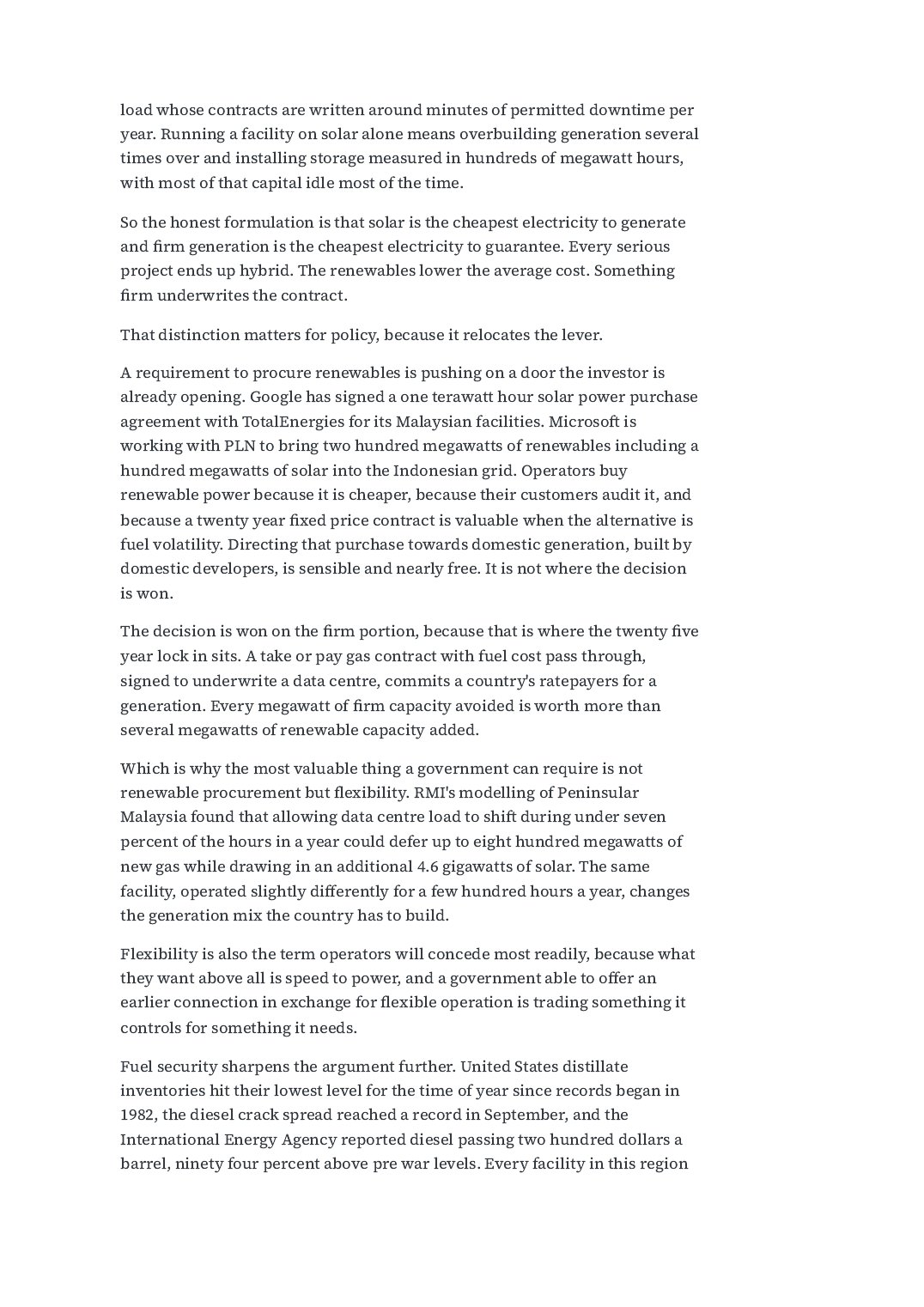
In January, ST Telemedia Global Data Centres launched the FutureGrid Accelerator at Nanyang Technological University's Electrification and Power Grids Centre on Jurong Island, described as Southeast Asia's first live high voltage direct current powered artificial intelligence infrastructure testbed. Alongside it sit agreements with NTU, the National University of Singapore, Singapore Polytechnic and the Institute of Technical Education, intended to benefit more than eight thousand Singaporeans within five years through co developed curricula, internships, mentorship and a hundred sponsored certifications.
The most consequential technical transition in this industry is being developed and tested inside a Singaporean university, by Singaporean students and apprentices, in partnership with the operators who need it to work. The knowledge does not arrive as a finished product in a shipping container. It is created locally, and the people who create it stay.
Three principles follow, and each is counterintuitive to how most governments design these things.
Place knowledge creation inside the country rather than importing the finished article, because the first creates people and the second creates assets. Put it beside a university and keep it there, because universities are the only institutions with a longer horizon than the government itself, and they renew their population every three years by design.
Then let the people leak. ITRI targeted fifteen percent annual turnover and counted it a success when leavers joined private firms. It was a pump, not a retention scheme. A government that builds a centre of excellence and measures its success by retention has built a museum.
And give them somewhere worth going. People do not emigrate because their country lacks training. They emigrate because it lacks career. If the only roles in Johor are mid level operations positions reporting to a Singaporean head office, the ambitious will leave and they will be right to. The retention problem is an industry depth problem wearing a training label, which is what local content policy is for when it is aimed at capability rather than percentages.
Renewables belong in the business case, and the policy lever is not the one most governments reach for
For a decade, a government asking an operator about renewable energy was making an environmental request with an economic cost. That is no longer true, and much policy is still written as though it were. But the correction that follows is more subtle than the headline numbers suggest, and getting it wrong produces bad policy in the other direction.
Start with the headline, which is real. Indonesia, Malaysia, the Philippines, Thailand and Vietnam are collectively planning around 49 gigawatts of new gas capacity, Vietnam at 34.5 and Malaysia at 9.6. Analysis published this month finds solar could deliver the same 263 terawatt hours of annual generation for approximately 45.4 billion dollars less between 2026 and 2031. Solar's levelised cost was already below gas in all five countries in 2025, on average around fifty percent cheaper, and is projected to be eighty four percent cheaper by 2030.
Now the correction. Analysis of the all in cost of delivered energy over an asset's life puts solar at roughly forty nine dollars per megawatt hour by year fifteen and combined cycle gas at around fifty five. Solar is unambiguously the cheapest electricity to generate. It is also unable, on its own, to serve a load whose contracts are written around minutes of permitted downtime per year. Running a facility on solar alone means overbuilding generation several times over and installing storage measured in hundreds of megawatt hours, with most of that capital idle most of the time.
So the honest formulation is that solar is the cheapest electricity to generate and firm generation is the cheapest electricity to guarantee. Every serious project ends up hybrid. The renewables lower the average cost. Something firm underwrites the contract.
That distinction matters for policy, because it relocates the lever.
A requirement to procure renewables is pushing on a door the investor is already opening. Google has signed a one terawatt hour solar power purchase agreement with TotalEnergies for its Malaysian facilities. Microsoft is working with PLN to bring two hundred megawatts of renewables including a hundred megawatts of solar into the Indonesian grid. Operators buy renewable power because it is cheaper, because their customers audit it, and because a twenty year fixed price contract is valuable when the alternative is fuel volatility. Directing that purchase towards domestic generation, built by domestic developers, is sensible and nearly free. It is not where the decision is won.
The decision is won on the firm portion, because that is where the twenty five year lock in sits. A take or pay gas contract with fuel cost pass through, signed to underwrite a data centre, commits a country's ratepayers for a generation. Every megawatt of firm capacity avoided is worth more than several megawatts of renewable capacity added.
Which is why the most valuable thing a government can require is not renewable procurement but flexibility. RMI's modelling of Peninsular Malaysia found that allowing data centre load to shift during under seven percent of the hours in a year could defer up to eight hundred megawatts of new gas while drawing in an additional 4.6 gigawatts of solar. The same facility, operated slightly differently for a few hundred hours a year, changes the generation mix the country has to build.
Flexibility is also the term operators will concede most readily, because what they want above all is speed to power, and a government able to offer an earlier connection in exchange for flexible operation is trading something it controls for something it needs.
Fuel security sharpens the argument further. United States distillate inventories hit their lowest level for the time of year since records began in 1982, the diesel crack spread reached a record in September, and the International Energy Agency reported diesel passing two hundred dollars a barrel, ninety four percent above pre war levels. Every facility in this region depends on diesel for backup, and every one of them is now rethinking what that means.
Countries that get this wrong will have built gas capacity on twenty five year take or pay contracts to serve a load that would have accepted solar, storage and a modest amount of flexing. Their citizens will carry the difference in tariffs long after the tenant has gone.
Where the value actually leaks
None of this works as a confrontation. Operators need power, land, water, permits and people in a jurisdiction that will not change its mind. Governments need capital, technology and the credibility a serious anchor investor brings. Every party fails alone.
What governments should not accept is a finished proposal presented for approval, because value leaks in the detail rather than the headline. It leaks in who funds the substation and who owns the spare capacity afterwards, which determines whether the next ten factories can connect. It leaks in a twenty year fixed power price that sets an industrial electricity cost for a generation. It leaks in tariff design, where Malaysia's move to ultra high voltage time of use pricing has already narrowed Johor's cost advantage and a fifty megawatt facility can face annual electricity costs approaching MYR 260 million. And it leaks in whether a training commitment is a number of people or a transferred capability, and whether the operations team is hired locally or seconded in for three years and withdrawn.
There is also a screening question worth borrowing from the capital markets, because it separates real applicants from speculative ones at almost no cost. The credit of the tenant decides whether a project can be financed at all. Recent data centre bond pricing runs from 5.70 percent where an investment grade hyperscaler holds the lease to between seven and nearly ten percent where the tenant is unrated. Same building, same power, several percentage points apart on the debt. A developer who cannot name a creditworthy counterparty is asking a government to allocate scarce grid capacity against a project that may never reach financial close.
The capability even the leaders are short of
Here is the uncomfortable observation, and we make it as recruiters rather than commentators.
The governments doing this well are doing it with very thin teams. Singapore's approach works partly because it is a small country with an unusually capable civil service and a regulator that has been in this sector for years. Malaysia is building a scorecard with people who are also covering several other industries. Nobody in the region has depth.
On one side of these negotiations sit people who have done this twenty times, in a dozen countries, backed by specialist advisers. On the other sit capable public servants who have done it twice, assessing technical proposals in a field where the fundamental architecture changes every two years.
That asymmetry is not corrected by better policy. It is corrected by people, and the capabilities are specific. Someone who can read a power purchase agreement and model its effect on industrial tariffs across the full term. Someone who understands grid connection economics well enough to negotiate who pays for headroom. Someone who can judge whether a facility's electrical architecture will still be commercially viable in 2035, which most private investment committees cannot answer either. And someone senior enough to say no, with the analysis to defend it.
There are not many such people anywhere. Industry surveys this year found forty six percent of operators unable to find qualified candidates and eighty seven percent reporting that workforce gaps are already affecting operations, with engineers, multi skilled operators and power systems engineers hardest to recruit. Governments are hiring from the same shallow pool as the investors sitting opposite them, without the same budgets.
Which produces the brain drain that matters most and that nobody writes about. Not engineers leaving for Singapore, but the handful of officials who genuinely understand this industry being recruited by the investors they were negotiating with.
What SCG Partners do
We are a Singapore based executive recruitment and talent advisory firm working across infrastructure, energy and the energy transition in Asia Pacific. Most regional platforms building in Johor, Batam, Jakarta, Bangkok and Ho Chi Minh City make their senior appointments here, and the people described above are the people we spend our time finding.
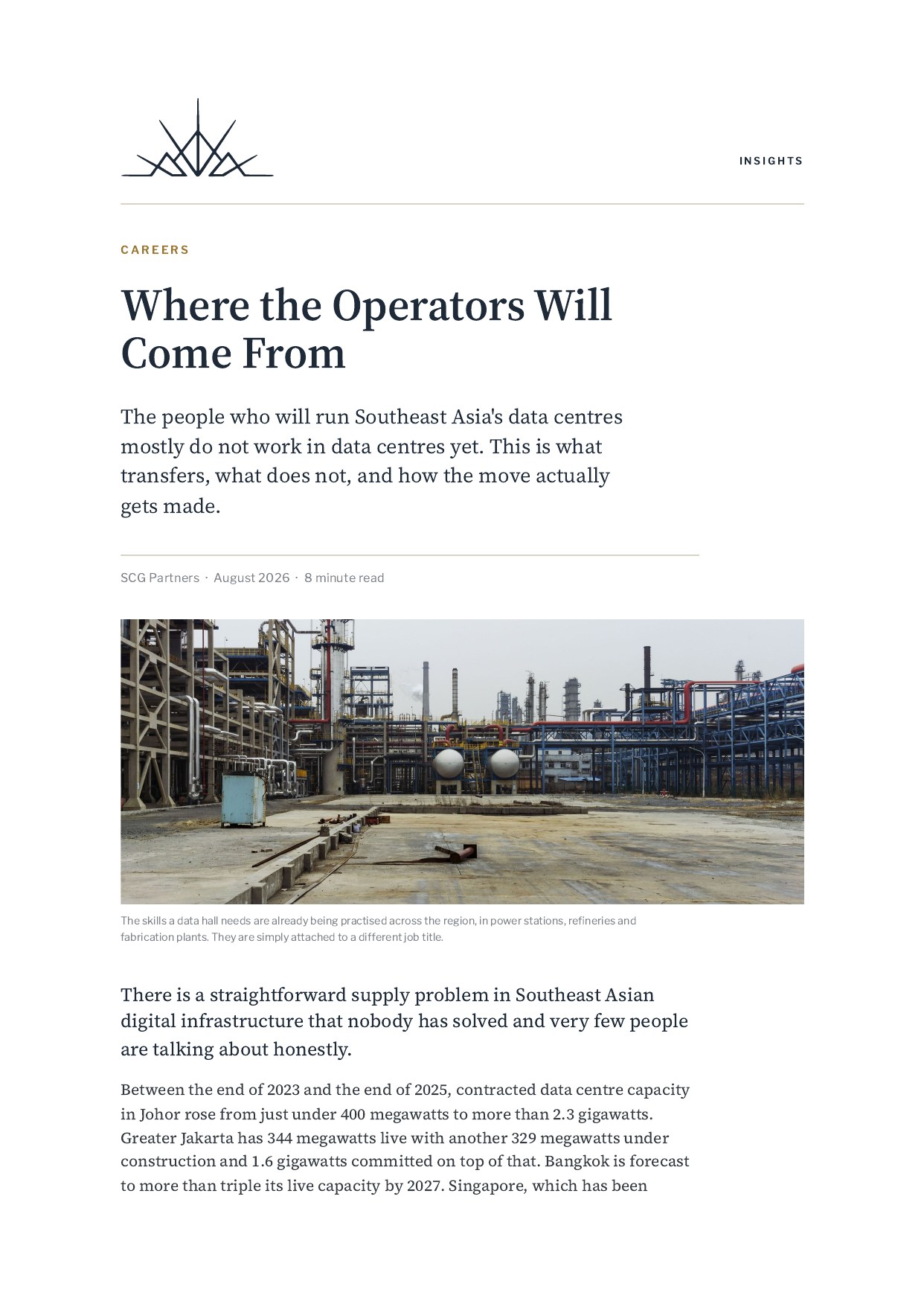
For governments, investment promotion agencies, state utilities and development agencies, the most useful work is usually not a search. It is establishing what capability exists in a market and what it costs, so that a workforce commitment in an investment agreement is a number somebody has checked. It is assessing whether a project can be staffed on the timeline it claims, which is the most common undisclosed risk in these proposals. It is identifying which local industries hold transferable skills, because the operations workforce for the next decade currently works in power generation, oil and gas, utilities and semiconductor manufacturing. And it is advising on how to build the in house capability to negotiate without a consultant in the room.
One thing we do not do is advise on capital raising or financing structures, which is regulated activity in Singapore and belongs with licensed advisers.
Taiwan's sixteen million dollars in 1974 bought a licence most people thought unremarkable. What made it generational was everything built around it over the following twenty years, almost none of which was expensive and almost all of which was about people.
The capital arriving in Southeast Asia now is several orders of magnitude larger. The question is what is being built around it.