Full text
In The Third Order we argued that this industry runs on several clocks and that value accrues to the slowest: silicon on three to six years, the building’s electrical and thermal architecture on seven to ten, and the land, grid connection and water infrastructure on twenty five or more.
There is a fourth clock and we underweighted it. It is the money.
Over the past ten months the credit market has begun to reprice the companies funding this build, in public, in instruments anyone can look up. Almost none of the commentary has asked what that means for Southeast Asia, which is financed differently, exposed through a different channel, and already inventing the contractual response.
What the credit market is saying
Oracle’s five year credit default swap spread was 139 basis points in December 2025, around 212 by late July 2026, and a record 288 on 15 October after widening 26 overnight. CoreWeave, the listed artificial intelligence cloud provider, passed 1,000 the same day, reported at 1,000 to 1,200, implying roughly a sixty per cent probability of default within five years depending on recovery assumptions, with its 2031 and 2032 unsecured notes at 76.5 to 81 cents on the dollar yielding fifteen to sixteen per cent. SoftBank, an indirect holder of exposure rather than an operator, sat at 424. Amazon, Alphabet, Meta and Nvidia all hit record wide levels while remaining well below Oracle.
In The Platform we used CoreWeave as the high end of the tenant credit spectrum, at an unsecured coupon of up to 9.875 per cent against Microsoft at 5.70. That gap has roughly doubled in weeks. The argument that the identity of the tenant sets the cost of the developer’s debt has been tested faster than we expected.
Two structural facts sit behind the price moves. Annual United States corporate bond issuance by the five largest hyperscalers rose from roughly 28 billion dollars on a 2020 to 2024 average to 121 billion in 2025. And in early 2026 JPMorgan launched a credit default swap basket for hedging the collective credit risk of those five companies. When a bank builds an instrument to short a sector as a bloc, the market has stopped treating its members as idiosyncratic.
None of this predicts failure. Alphabet, Microsoft, Amazon and Meta generate extraordinary cash flow and interest coverage remains very high. The point is narrower: the price of their credit is no longer stable, and that price is an input to every data centre built anywhere.
Where the obligations sit
The repricing matters more than headline leverage suggests because much of the obligation does not appear in it.
Moody’s estimated 662 billion dollars of future data centre lease commitments at the five largest United States hyperscalers at the end of 2025, within 969 billion of total undiscounted lease commitments and equal to 113 per cent of those companies’ most recent adjusted debt. Those leases are off balance sheet because they have not commenced, and Moody’s is fair about why: the companies are not avoiding a liability, they have not yet received the asset. It may make a nonstandard adjustment to its adjusted debt figures as a result.
A Nikkei study put total off balance sheet obligations at the same five companies at approximately 1.65 trillion dollars, roughly eight times the 2022 level, against combined on balance sheet debt of about 1.35 trillion, with Meta at around 420 billion and Oracle around 273 billion at the end of May. Morgan Stanley separately estimated roughly 1.8 trillion industry wide: about one trillion of purchase commitments, more than 800 billion of leases not yet begun and about 110 billion of accounts payable financing. Alphabet’s disclosed future payments on uncommenced data centre leases rose from 23.9 billion dollars in the second quarter of 2025 to 42.6 billion in the third.
Three mechanisms produce this. Leases that have not commenced, where accounting creates no liability for a facility under construction until the asset is handed over, so the commitment sits in the notes. Project vehicles funded by private credit, where the vehicle borrows to buy hardware and real estate and the technology company signs a capacity agreement that services the debt without the principal reaching its own balance sheet, as in the Meta and Blue Owl arrangement for the Hyperion campus, reported at around 30 billion dollars. And take or pay commitments for semiconductors and generating capacity, treated as purchase commitments rather than financial debt.
A fourth feature matters more for our region and has had almost no attention. Because the hardware has a useful life of roughly four to six years, tenants are negotiating shorter initial lease terms with renewal options, and landlords are compensated with residual value guarantees under which the tenant pays the difference if the facility’s market value falls below an agreed threshold. A renewal counts as a liability only if reasonably certain, a bar generally read as above seventy per cent, and a residual value guarantee only if a payout is judged probable. Meta disclosed leases commencing in 2029 with about 12.3 billion dollars of initial commitments and a 28 billion dollar residual value guarantee, judged the payouts not probable, and recorded no liability.
That structure is the shape of the deal now being offered to developers in Johor, Batam and Bangkok.
The fourth clock
Private credit facilities and project debt supporting this build are typically floating rate and refinance on a three to seven year cycle. CoreWeave has roughly 4.4 billion dollars falling due by the end of 2026 and 6.2 billion in 2027, against bonds maturing in 2031 and 2032. The chips depreciate over four to six years: Nvidia’s own customer guidance cites that range, Meta moved most servers and network equipment to 5.5 years during 2025, Alphabet and Microsoft sit at six, and Amazon went to six by 2024 before cutting back to five for some equipment in 2025.
So money and silicon turn over on the same cycle, much faster than the electrical and thermal architecture at seven to ten years and very much faster than the land, building, grid connection and power contract at twenty five and up.
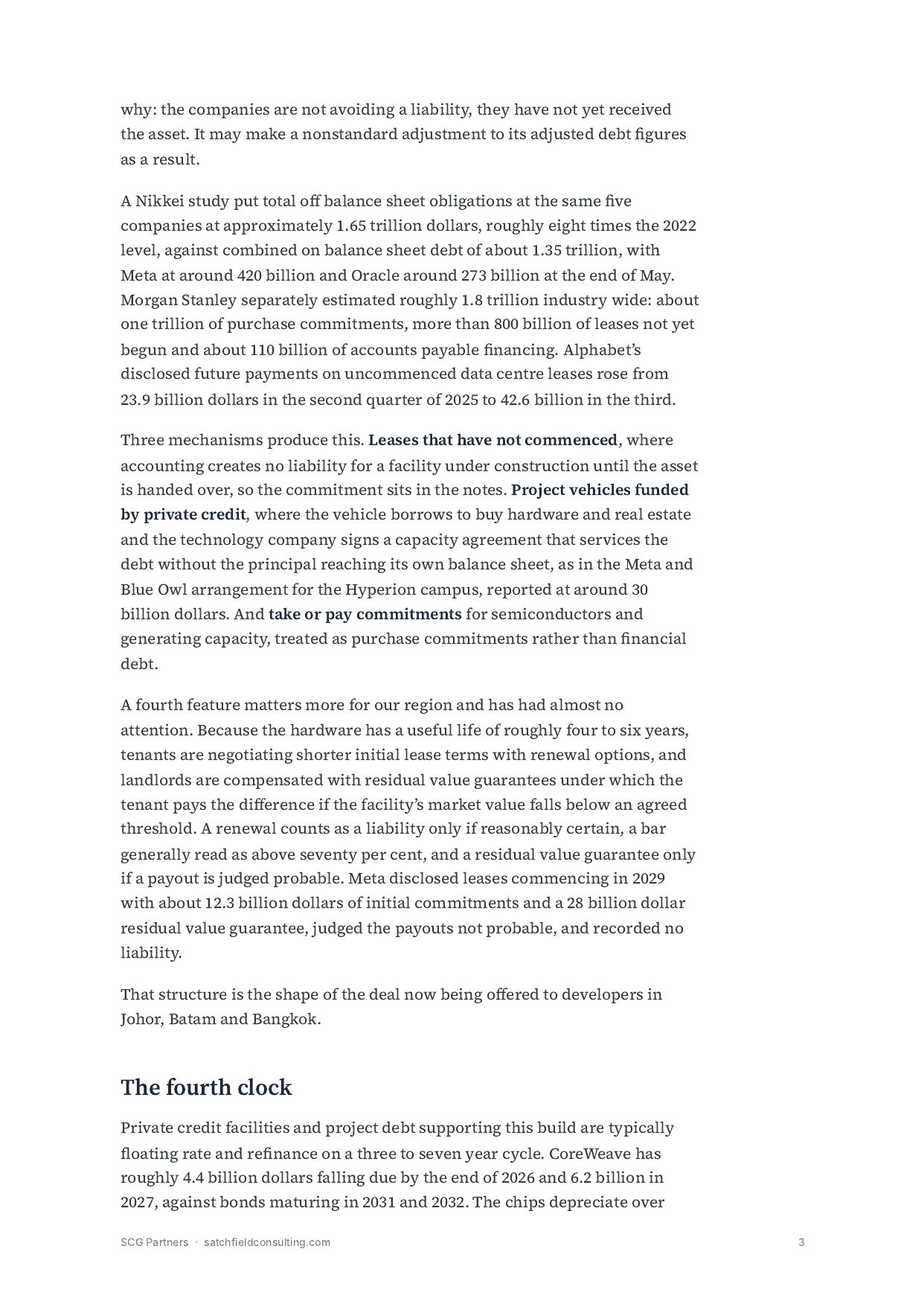
That mismatch is not a technical problem with a financial side effect. It is one problem. A lender funding a twenty five year asset on a five year facility and a tenant occupying it on a four year hardware cycle are both betting it will still be wanted when their own clock runs out. Neither can promise the other.
The accounting argument about useful life is the same argument again. Michael Burry has made the case that extending assumed lives understates depreciation, putting the effect at around 176 billion dollars across the industry between 2026 and 2028, and Meta’s own extension cut its depreciation expense by 2.3 billion dollars over the first nine months of 2025. The counter evidence is real: an H100 in its third year has reportedly resold at around 45 per cent of its new price, older A100 capacity runs close to fully booked, and a three year old H100 contract was renewed within five per cent of its prior price. Both can be true. An asset can hold its value while the company owning it has a maturity schedule it cannot meet, which is why Nvidia has agreed to buy unsold CoreWeave capacity through April 2032. The hardware is wanted. The balance sheet is the issue.
Why Southeast Asia is exposed differently
The regional story diverges from the American one, and the divergence is good news with a condition attached.
Southeast Asian data centres are overwhelmingly financed at project subsidiary level with syndicated bank debt rather than through off balance sheet private credit vehicles. DayOne closed 15 billion ringgit for its Johor platform, a 7.5 billion ringgit onshore Islamic Murabahah facility plus a 1.7 billion dollar offshore term loan under green loan principles, coordinated by OCBC with Maybank underwriting 2.5 billion ringgit, covering 120MW across Nusajaya Tech Park and Kempas Tech Park. AirTrunk raised a 2.25 billion Singapore dollar green loan for SGP2 from Crédit Agricole CIB, DBS and ING, inside a Johor programme above 9 billion ringgit for a second facility scalable beyond 270MW. Yondr raised over 900 million dollars for a 98MW Johor development from DBS, HSBC, ING, Natixis and Deutsche Bank. DayOne and the Indonesia Investment Authority raised 6.7 trillion rupiah, about 411 million dollars, from DBS and UOB for three Batam facilities totalling roughly 72MW at project subsidiary level. Digital Edge is building a 4.5 billion dollar Bekasi campus with a 665 million dollar green loan on phase one through a project subsidiary. Princeton Digital Group has 1.2 billion dollars behind its Malaysian expansion.
This is conventional, secured, covenanted bank lending into ring fenced project companies, much of it sustainability linked. It is not the structure being repriced in New York. The region has, largely by accident of its banking market, built on a more conservative footing than the market funding its demand.
The exposure sits on the other side of those loans. Every one of those facilities is underwritten against lease income, and the leasing has largely happened: Knight Frank has reported more than ninety per cent of the colocation capacity under construction in Singapore as already taken up. The debt is real, dated, secured and on balance sheet. The revenue that services it, in a material number of cases, is an uncommenced lease sitting in a footnote, with a renewal option the tenant need not exercise and a residual value guarantee the tenant has judged improbable.
The region’s obligations are hard. The region’s revenue is soft. Nobody is behaving improperly and the accounting is correct. But the party holding the committed, secured, dated obligation is the Southeast Asian developer and its banks, and the party holding the flexible, conditional, footnoted obligation is the tenant.
There is a counterweight nobody models until it fires. A tenant with mission critical compute in a building has a powerful incentive to absorb a distressed developer’s position rather than lose the capacity, which is what the Nvidia commitment above is. A regional developer is therefore both more exposed and more protected than a credit screen suggests, and which dominates depends entirely on who the tenant is. That is now a number anyone can look up.
The one idea appearing in three markets at once
This is a convergence rather than a risk.
In United States lease documents, the residual value guarantee bridges the gap between a tenant wanting a four year commitment and a lender needing a twenty five year asset financed. The tenant pays for the asset being there whether or not it continues to use it.
In Johor, the Equinix JB3 development, 65MW and delayed by around eighteen months on transformer procurement, is reported to include contingent payments tied to power availability milestones. The buyer pays as power is actually delivered, stage by stage, rather than against a promised date.
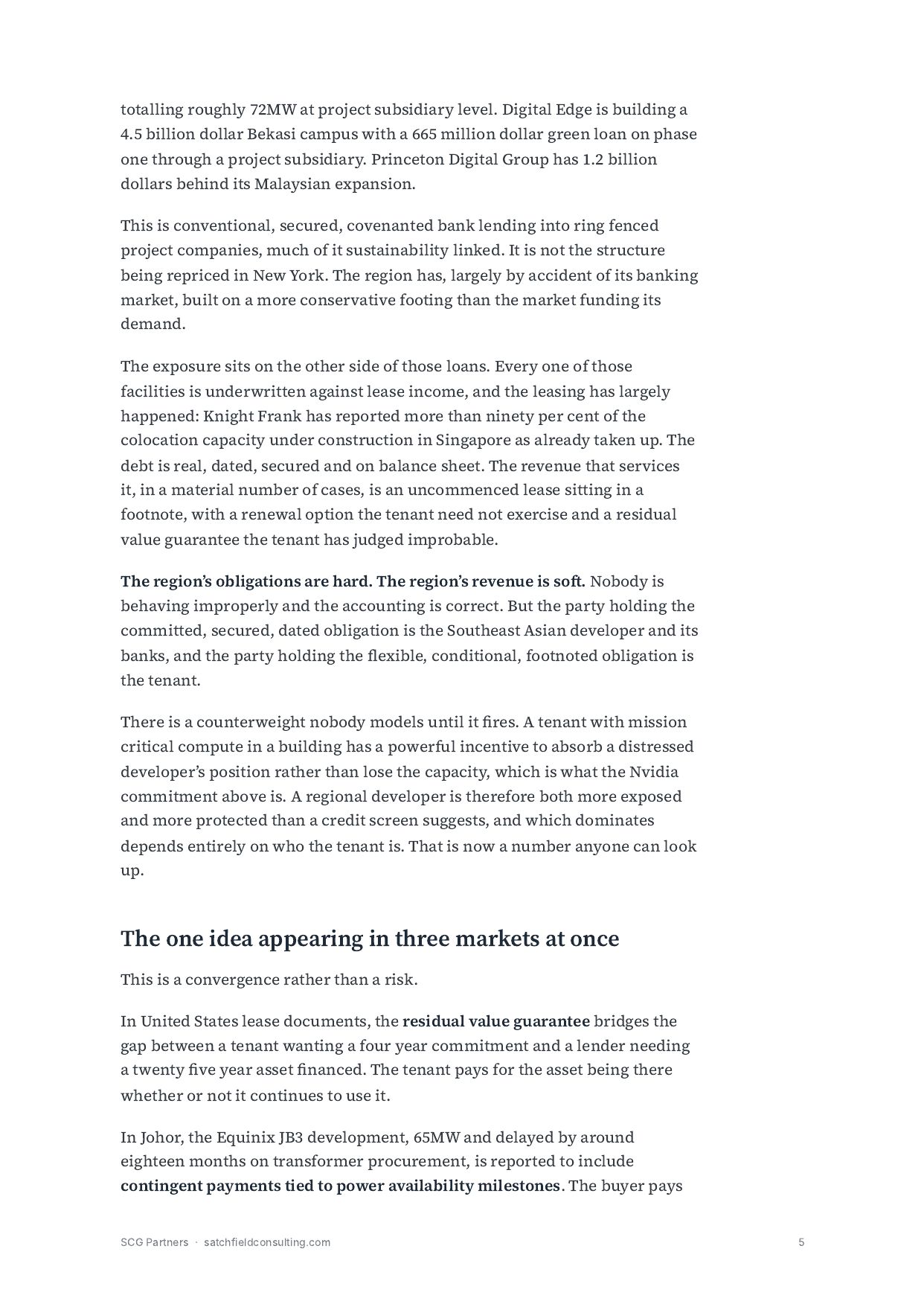
In Vietnam, the two component tariff separates a capacity charge, reflecting generation and transmission costs driven by peak demand, from an energy charge reflecting variable fuel cost. It rests on Article 50 of the amended Electricity Law 2024 and Decree 146 of 2025, ran as a paper based pilot from January to June 2026 for consumers averaging at least 200,000 kWh a month, and is expected to apply to actual invoices from July 2026. An offtaker under a direct power purchase agreement still pays the full capacity charge, because it still needs the grid available as backup.
Three markets, three instruments, one idea. In an industry where demand is uncertain and the assets are long lived, the contract has to price availability separately from use.
This is the structural answer to the fourth clock, being written into documents right now by lawyers in three jurisdictions who are probably not comparing notes. It is also what makes an asset financeable when nobody can forecast volume: the capacity payment satisfies the lender, the usage payment satisfies the buyer, and a fall in demand reduces the second without destroying the first. A flat take or pay obligation does the opposite, which is why it is the term most likely to be renegotiated, probably more than once, over any facility’s life.
Vietnam has gone further than is appreciated. Decree 243 of 2026, issued on 26 June, made large consumers buying electricity for data centre operation explicitly eligible for synthetic direct power purchase agreements across the national grid, brought licensed retailers into the physical framework, removed tariff caps on physical transactions, raised the share of excess rooftop solar that can be sold on from twenty to fifty per cent, and cut the application from seven steps to three. In The Slowest Clock we argued that governments should treat procurement access as the lever that makes anchor demand bankable. One has now done precisely that, in a dated instrument, and it is not the one most of the market is watching.
What does not move
It would be easy to conclude that a credit repricing slows the regional build. The Johor data says otherwise.
As of mid 2026, Johor had roughly 450MW operational across twelve facilities, drawing about 287MW at peak against a regional Tenaga Nasional allocation of approximately 520MW. On TNB’s own planning documents, capacity available for new data centre connections through 2028 is about 110MW. A 330kV substation upgrade completed in February 2026 added 140MW, with industrial load prioritised. TNB quotes forty two month lead times on 220kV equipment, and permitting runs fourteen to eighteen months, up to twenty two in Iskandar Puteri. Of the roughly 180MW in the near pipeline, 22MW is stalled indefinitely on power allocation and local opposition and 35MW of greenfield sits in early permitting. The upgrades that would change the arithmetic are scheduled for 2027 and 2028.
A hundred basis points on a tenant’s credit default swap does not add a megawatt to that 110, shorten a forty two month transformer lead time, or move a substation energisation date. The repricing changes who can afford to build and what return they require. It does not change the order of the queue or the date of energisation for anything already funded, connected and leased.
What is funded, powered and leased gets built and gets staffed, on the existing timetable. The obligation is contractual, the connection is allocated and the tenant is committed.
What is not yet funded becomes conditional on two things at once. Phase two and phase three of the region’s campuses now depend simultaneously on the credit market staying open and a grid connection arriving, and those conditions are uncorrelated, so the joint probability is lower than either alone. The litigation analysis published in May by Drew & Napier flagged precisely this: tighter private credit constraining staged funding for later phases, with delay or scaled back projects as the consequence. The exposure sits in phase two, not phase one.
One number deserves an honest flag rather than a convenient reading. Johor was reported at 1.1 per cent vacancy in the first half of 2025. A year later, operator level data showed 28 per cent vacancy market wide: Equinix 71 per cent occupied across 140MW, Digital Realty 65 per cent across 95MW, ten other operators roughly 24 per cent across 215MW. Either the sources measure different things, committed against occupied capacity, or the market has moved from acute scarcity to visible surplus in twelve months as a large supply wave landed. Anyone committing to phase two needs to know which, and that is a leasing question, not an accounting one.
Where this goes
The owner class changes. If credit markets keep applying look through leverage and equity multiples compress toward industrial levels, the sector stops being priced as asset light technology and starts being priced as capital intensive infrastructure, which changes who wants to own it. Growth equity and floating rate private credit are the natural owners of a technology multiple. Pension funds, insurers and sovereign funds are the natural owners of long dated, availability based, inflation linked cash flows, and they have far more money. For Southeast Asia that is better than it sounds, because such capital funds what the region needs and cannot currently finance: transmission, firm generation, storage, water. Capital that wants a twenty five year availability payment will build a substation. Capital that wants a technology multiple will only build halls.
The condition is that the assets have to look like what that capital buys. Capacity payments rather than volume promises. Investment grade or sovereign linked counterparties. Secured grid rights with a date. Concession style tenors. Tariffs that separate availability from use. Which is the list the convergence above is producing.
In an industry where demand is uncertain and the assets are long lived, the contract has to price availability separately from use.
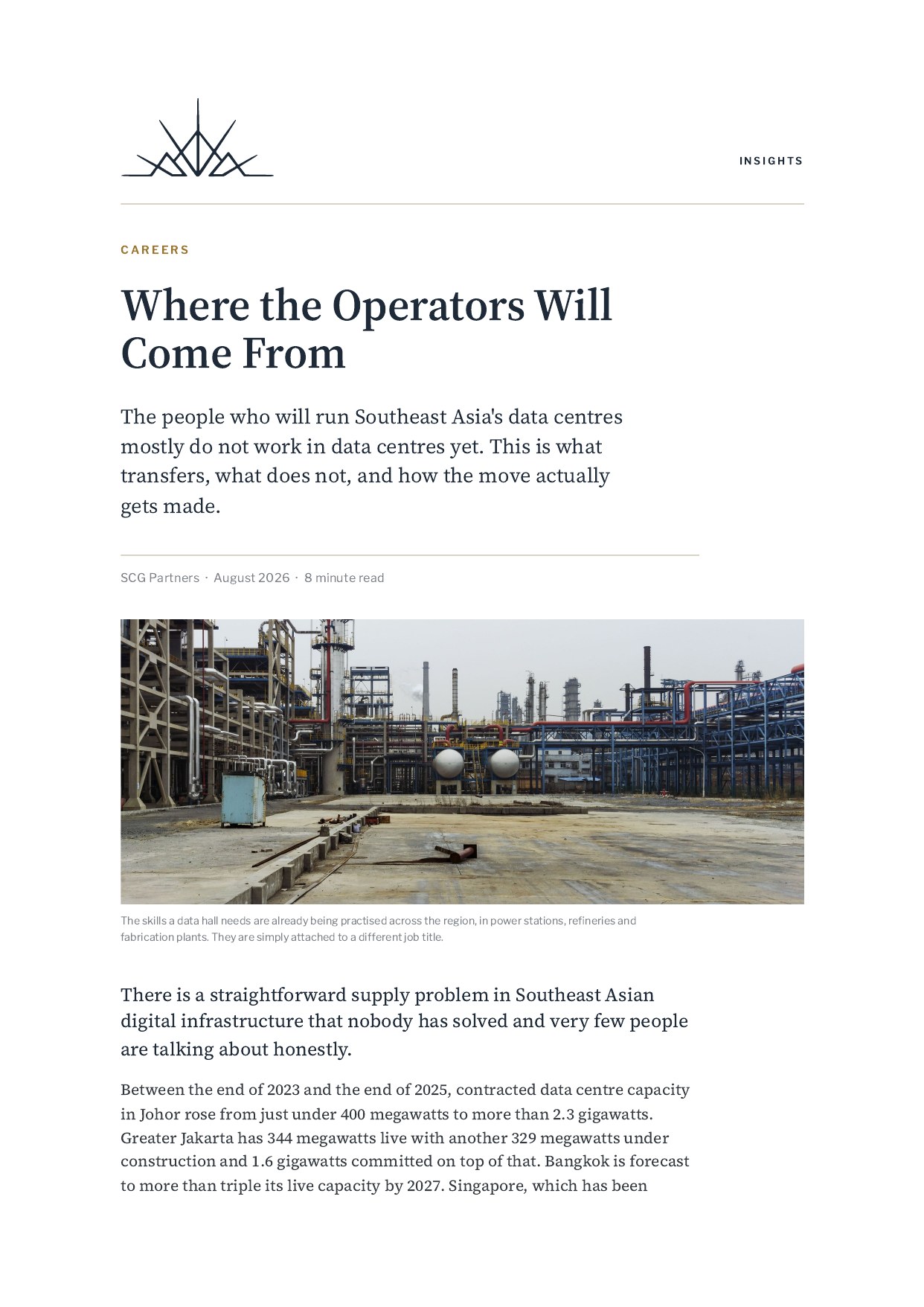
The workforce question is the real long term constraint, and not the one usually raised. The widely argued concern is that artificial intelligence erodes the apprenticeship of expertise: if junior analytical work disappears, the senior judgement built on it may never form. That is overstated generally and underappreciated here specifically, for a reason that cuts the other way.
The scarce skill in a data centre is not analytical. It is physical judgement under live load. The person who decides whether to transfer load during a fault, who hears a bearing starting to fail, who knows which isolation sequence is safe at three in the morning with a tenant’s production workload in the hall, acquires that through years on plant. It is the last thing here software will touch, because the cost of being wrong is measured in a customer’s revenue per minute. So the industry building the technology that may compress entry level white collar work has a workforce formed entirely through physical apprenticeship, in a region where the plant to apprentice on has only just been built.
That is the genuinely slow clock. Twenty five years for a substation. On our own placement experience, ten to fifteen for a critical facilities manager who has seen enough go wrong to be trusted alone with a live hall. No financing structure, policy instrument or model shortens it.
What we take from this
- For operators and developers: the commercial terms now carry the risk that used to sit in the construction programme, and whoever negotiates the residual value guarantee, the contingent power payment and the tariff determines the asset’s financeability. That is a commercial and technical capability in one person, scarcer than either alone.
- For capital: the spread between the best and worst counterparty here is now wider than between several sovereigns, and it is published. Diligence that treats all hyperscaler leases as equivalent is no longer diligence.
- For governments: availability is the lever and it costs nothing. Widening procurement access changes bankability; an incentive only changes returns.
- For hiring: operations recruitment for capacity energising to the end of 2027 is unconditional, because those buildings have tenants and dates. Forward pipeline recruitment is conditional, and should be read against the credit market and the connection queue rather than announced megawatts. Add the role that barely existed eighteen months ago and is now the most valuable in the sector: the person who can sit on either side of a negotiation about who pays for availability.